
Peguera: Giant pine topples in storm — family trapped at home for days
Peguera: Giant pine topples in storm — family trapped at home for days
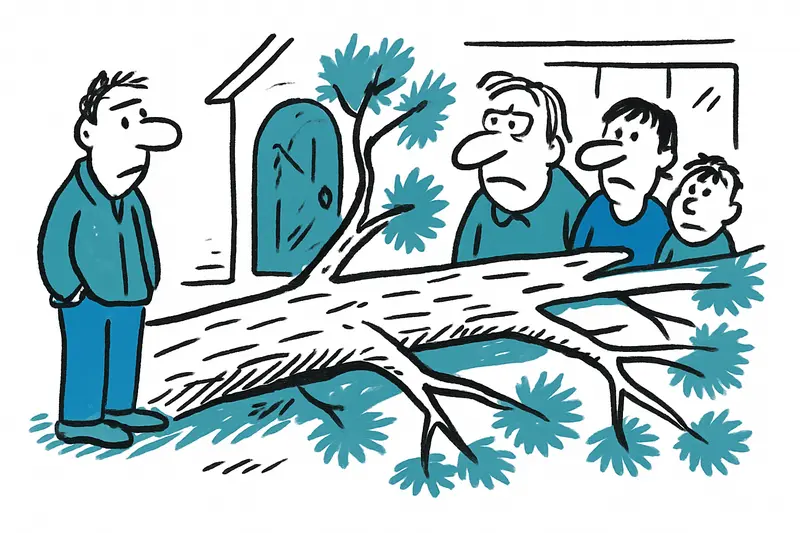
A fallen tree is blocking the front door of a house in Peguera, damaging power lines and keeping a couple practically confined to their home for almost 48 hours. Who is responsible, and why are the cleanup efforts taking so long?
Peguera: Giant pine topples in storm — family trapped at home for days
The images from the southwest of Mallorca are simple: a giant pine, broken by the storm, lying across a house driveway. In Peguera it blocks the main access to a residential building, damages the front door and has apparently also affected overhead power lines. A married couple can only leave the house with restrictions; helpers on site speak of almost 48 hours during which the residents were largely isolated.
Key question
Why is the removal of an obviously dangerous tree in a residential area taking so long, even though the police and the power company have already been alerted?
Critical analysis
From this case, observations on the island and conversations with neighbours, a pattern emerges: as soon as storm damage happens on private property, responsibility shifts into a grey area. The police secure the scene and the emergency number 112 coordinates, but when a tree lies on private land, authorities often point to the owner. At the same time, power lines are affected and thus public safety and infrastructure networks are at stake — here the grid operators should in fact act quickly. In Peguera, a company that could work professionally on the line was blocked until the tree was removed or at least stabilized. Result: the need for action is passed back and forth and the endangered family remains stuck in the middle of the problem. Similar operational strain was visible after a severe storm that prompted Over 100 emergency responses after storm in the Balearic Islands – What now matters for Mallorca.
What is missing in the public debate
There is a lack of clear procedures and transparent communication: Who pays for emergency removal if the owner cannot be reached quickly or cannot hire a company? What powers does the municipality have to intervene immediately in the interest of public safety? And: why are priorities such as initial safety measures — for example a safety corridor around loose cables — not implemented as standard? In conversations with residents one hears uncertainty: some do not know whether they are allowed to take action themselves, others fear legal consequences if they enter a property without further permission; such misunderstandings were highlighted after Morning storm over Palma and Calvià: What the short storm shock revealed.
Everyday scene from Peguera
In the late morning the beach at Peguera is quieter than in summer, cafés on the Passeig de la Mar have retracted their awnings, and now and then you hear the clatter of taped signs in the wind. A neighbour stands on the pavement with a thermos flask, looks toward the driveway and shakes his head. The children from the house above are playing in the back garden; they managed to leave via a side exit. The utility poles still crackle softly in the strong wind, and the smell of wet earth from the olive tree in front of the house drifts into the street — this is how the effects of every storm are seen here, up close and personal. Similar local scenes were described during a Stormy night in the island's interior: What's missing when rain becomes a problem?.
Concrete solutions
1. Emergency protocol "hazardous tree": municipality, police and grid operators need a binding short protocol that takes effect immediately — safety cordon, risk assessment, clearance for emergency excavators or tree-climbing specialists. 2. Temporary intervention rights: in cases of clearly dangerous situations the municipality should have the ability to order short-term measures and subsequently invoice the property owner for the costs. 3. Coordinated communication: a central hotline and transparent status updates for those affected (for example via SMS) would prevent uncertainty. 4. Reserves and rapid contracts: grid operators and municipalities should have fixed contracts with tree-felling companies that can start work directly after storms without lengthy tendering rounds. 5. Prevention: mapping of vulnerable trees in residential areas and regular pruning, funded partially through municipal hazard prevention, would reduce future emergencies.
What the Peguera example teaches
The case reveals the weakness of a system that hesitates between private and public interest. Decisions are too often postponed until it becomes a danger to people or networks. Those answering residents' questions in Calvià point to the responsibility of the property owner — legally understandable, but practically often too slow. In an island-wide climate with recurring storms the goal must be: less bureaucracy in acute danger situations and clear rules for cost recovery and liability afterwards.
Concise conclusion
If a tree traps people and damages lines, the answer must not be “that is private” and then waiting. Safety needs a course of action that is quick and legally secured. Peguera is a wake-up call: we must rethink our procedures during storm seasons so that on the next windy day a family is not again left for days between fallen trunks, hanging cables and confused authorities.
Frequently asked questions
Why can storm damage on private property in Mallorca take so long to clear?
What should you do if a fallen tree is blocking your home in Mallorca?
Can the Mallorca municipality step in if a dangerous tree is on private land?
Who is usually responsible for removing a storm-felled tree in Mallorca?
What should residents in Peguera do if storm damage leaves them isolated?
Why do power lines make fallen tree cases in Mallorca more complicated?
Is it safe to cut up a storm-damaged tree yourself in Mallorca?
What does the Peguera storm case show about Mallorca’s emergency response?
Similar News
Reality check: Palma's "white" torrent — harmless salt or neglected warning sign?
White crusts on the Torrent de Sa Riera are causing a stir. Emaya describes them as salt deposits. Our reality check: wh...
When Ryanair's fleet grows: What Mallorca's travelers should know
Ryanair will soon receive 737 Max 10 jets. The larger aircraft offer potential savings — but also new risks for flight o...
Rising fuel and housing costs: Why Mallorca's overland buses are suddenly overcrowded
More and more people are leaving Palma — and boarding TIB buses: Between January and August 2026, the network recorded o...
Carriages Without Horses: Palma Plans E-Carriages – a Reality Check
Palma plans to switch to electric carriages in 2027. The prototype was shown near the cathedral. What is the technology ...
Record season, empty coffers: Who really benefits from the tourism boom?
Full hotels and more flights: the numbers sound impressive — yet many locals feel no benefit. A reality check with an ev...
More to explore
Discover more interesting content

Can Cap de Bou

Townhouse Lleo 72
