
Please be careful: The most dangerous access points to the Vía de Cintura in Palma
Please be careful: The most dangerous access points to the Vía de Cintura in Palma
Residents and pedestrians report dangerous situations at the access points to the Ma-20: high speeds, crosswalks directly in front of acceleration lanes, and poor visibility. Who is liable — and what needs to happen now?
Please be careful: The most dangerous access points to the Vía de Cintura in Palma
Who protects people at the roundabout accesses to the Ma-20?
The ring road Vía de Cintura (Ma-20) has many faces. For drivers it is a fast connection, for residents often a barrier — and for pedestrians the access points via roundabouts are a daily source of risk. The fundamental question is: who ensures that people can safely cross the short paths that connect residential neighborhoods to the Ma-20?
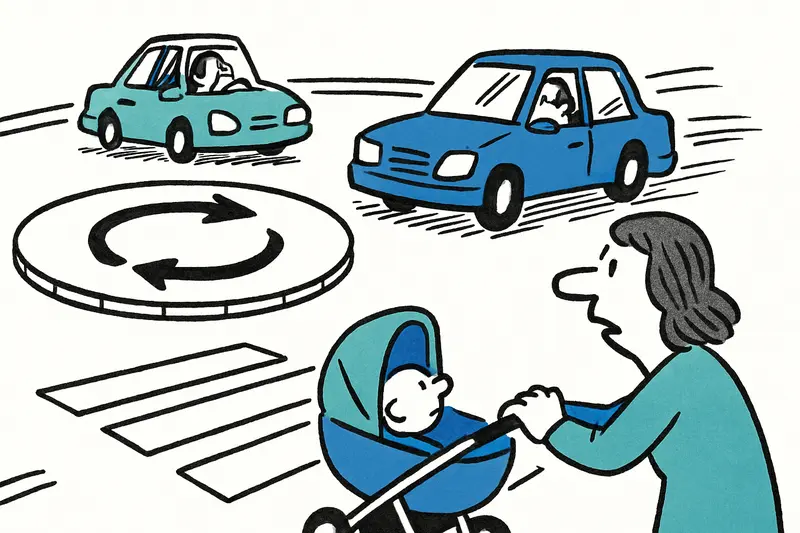
On an evening walk through Son Cotoner and Son Rapinya I first hear the buses, then the hum of cars, and on the bridge over the access road a mother with a stroller is standing, staring at the cars. Two drivers enter the roundabout one after the other, both already looking toward the Ma-20 — one accelerates before the crosswalk is fully cleared. Scenes like this tell more than any statistic — see Son Cladera: Crash Again at MA-13 Exit - Residents Demand Speed Reduction. Pedestrians are reduced to moments in which taking a step across the street becomes a test of courage.
Critical analysis: design, speed, regulation — where is the problem?
At the accesses to Son Moix, the prison area and in front of several school centers the issue lies less with an inattentive driver than in the interaction of road design and traffic management. Particularly striking are acceleration lanes that begin immediately after crosswalks. This creates a logical but dangerous gap: drivers entering a roundabout are already accelerating to get onto the fast road — and pedestrians are in conflict with that acceleration impulse.
Other trouble spots: visibility impaired by vegetation, poorly placed lamp posts or walls that reduce sight lines; missing or inadequate lighting in the early morning hours; and traffic routing that repeatedly sends school routes and sports facilities to heavily used accesses. Enforcement is sporadic. Fixed speed-measuring installations are often missing where they would make sense. Recent incidents such as Dangerous braking maneuver on the Ma-20: When will authorities finally act effectively? illustrate the potential consequences. In short: there is no consistent combination of infrastructure, regulations and enforcement.
What is missing from the public debate
Beyond the outrage I miss three things: first, reliable accident figures and time series for these very access points; second, clear responsibilities between the city administration, the Consell and the road authorities; third, practical priority lists — which crossings are acutely dangerous, which can be redesigned in the medium term? Only with such facts can one plan constructively instead of merely reacting — recent serious collisions, such as Head-on Crash on the Ma-11: Three Injured — and the Uncomfortable Question of Greater Safety, show the need.
Everyday scene from Palma
On a gray morning I see the school groups: small backpacks, loud conversations, the light turns green, the crosswalk is briefly clear — and then a motorcycle uses the gap. The grandparents waiting on the pavement fold their arms. It is not drama, it is habit: people get used to dangerous spots until something worse happens.
Concrete approaches to solutions
What appears pragmatic and short-term should at the same time be planned for the long term. Suggestions:
Short-term (within months):
- Temporary reductions of the speed limit at access points (e.g. 30 km/h) with clear signage and mobile displays.
- Raised crosswalks (plateaus) directly before roundabouts so that vehicles starting off are forced to slow down.
- Mobile speed cameras and increased police checks at school start and end times.
- Improved lighting and removal of visibility obstacles (cutting back vegetation, removing small obstructions).
Medium-term (6–24 months):
- Redesign of acceleration lanes: extend, relocate or modify them with structural measures so they do not directly adjoin crosswalks.
- Creation of central refuge islands as protective spaces for pedestrians on wide crossings.
- Installation of camera-supported traffic monitoring at particularly critical junctions.
Long-term (strategic):
- Reassessment of traffic inflows around the Ma-20: school routes, sports facility access and footpaths must be part of urban planning projects.
- Involvement of residents in prioritization — local reporting points that systematically record danger spots.
- Integration of these measures into a comprehensive mobility concept for Palma that balances pedestrian, cycling and car interests.
Who pays, who decides?
Responsibility lies across several levels: the city of Palma for intra-urban measures, the responsible road authority for structural changes and, where applicable, the island authority for overarching connecting routes. Without coordinated planning between these actors there is a risk of patchwork solutions instead of sustainable safety.
Conclusion
The complaints of residents are not alarmism — they are a description of reality. This is not about bans but about weighing priorities that give the few meters of crosswalk priority over the Ma-20's acceleration logic. Those who accompany children to school in the morning or walk to a sports center are entitled to a manageable, safe crossing. When planning, enforcement and responsibility work together, a daily danger can become an ordinary footpath again. Until then: drive slower, keep your eyes open and act rather than hope when bottlenecks occur.
Read, researched, and newly interpreted for you: Source
Similar News

Attila Seeks a New Home: Mallorca's Husky with a German Background
Attila, a three-year-old husky mix from the Son Reus shelter, urgently needs a new home after his owners separated. Neut...

Easter at Ballermann: Full Hotels, Crowded Streets — and Who Pays the Price?
Hotels around Playa de Palma are filling up — but high occupancy brings noise, pressure on staff and rising prices. A cr...
After the Landing: Arrest of a Man Living in Spain for Aggravated Human Trafficking – A Reality Check
A 62-year-old man living in Barcelona was arrested at Stuttgart Airport. He is the subject of an arrest warrant for aggr...

Island Council Allocates €84 Million: Who Benefits, Who Is Left Out?
The Island Council announces €84 million to mitigate the consequences of the war — but questions remain between reserves...
Arena noise in Palma: Judges side with residents — and question the town hall
The Balearic Supreme Court demands more than fines: three residents of the Plaza de Toros receive compensation because n...
More to explore
Discover more interesting content

Experience Mallorca's Best Beaches and Coves with SUP and Snorkeling

Spanish Cooking Workshop in Mallorca
