
Kisses on the School Wall: Why the Porto Cristo Murals Are Contested — a Reality Check
Kisses on the School Wall: Why the Porto Cristo Murals Are Contested — a Reality Check
Two large murals depicting kissing same-sex couples at the Porto Cristo secondary school have sparked controversy. Who is calling for their removal — and what is not being said?
Kisses on the School Wall: Why the Porto Cristo Murals Are Contested — a Reality Check
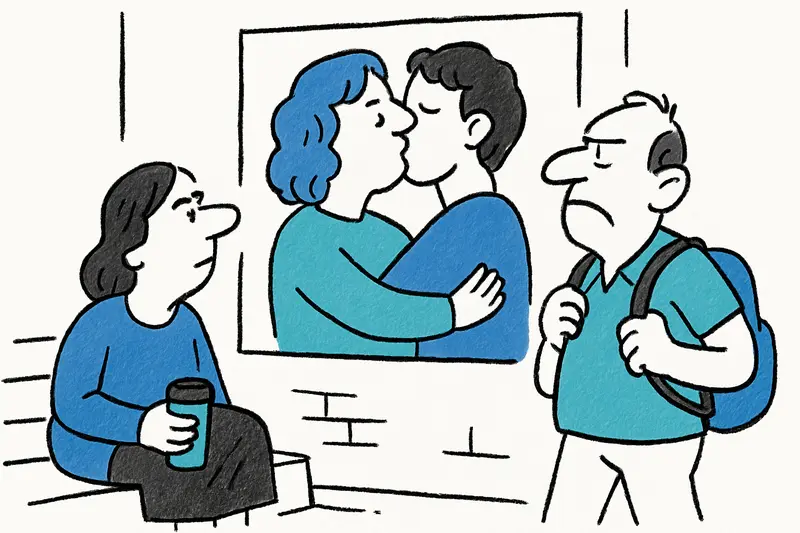
In front of the Porto Cristo secondary school, where school buses stop in the morning and vendors hurry along Carrer del Mar with noisy baskets, two large-scale murals have been on display since 2022: depictions of kissing same-sex couples created by the artist Catalina Julve during LGTBIQ+ Pride week. Now political forces and an association of lawyers are demanding their removal. The scene smells of conflict — but what exactly is at stake?
Guiding question
Is the debate about art and remembrance, or about the boundary between public education and a political culture war?
The facts in brief
The works date from June 2022; one of the motifs recalls a lesbian couple who were victims of political persecution in the 1940s. A few weeks ago, the regional spokesman for the Vox party, Gabriel Le Senne, criticized the images in a published video and called them unacceptable. The Foundation of Christian Lawyers (FEAC) has asked the city of Manacor in a letter for information about the commission and permits, calling the motifs potentially incompatible.
Critical analysis
The dispute runs on several levels simultaneously: first the substantive question — do publicly funded walls display political messages or historical remembrance? Second, the formal question — were the commissioning and approvals transparent? Third, the educational question — what signals does a school wall send to children and adolescents? The usual rhetoric of those demanding removal links artistic representation with indoctrination without disclosing the actual decision-making and participation processes. FEAC is requesting information about the contract and permits; that is legitimate. Similar transparency concerns have come up in recent local reporting, for example Porto Cristo: Trust in Expert Reports Crumbles — Why the Trial Is Being Reopened.
What is missing from the public discourse
The discussion focuses too much on buzzwords — unacceptable, incompatible — and too little on three central points: 1) the context of the motifs, in particular the remembrance of persecution in the 1940s; 2) the formal procedures for street art on school buildings, who approves such works and whether calls for proposals took place; 3) the perspective of those who pass the wall every day: the students, teachers, parents and shopkeepers in Porto Cristo. So far, outside demands dominate; the local, everyday experience remains underexposed. Related investigations into the Mallorca art market highlight why procurement transparency matters: When Pictures Lie: Why Mallorca's Art Market Must Rethink Now.
Everyday scene from Porto Cristo
Early in the morning a teacher sits on the steps of the secondary school with a thermal cup, the large murals behind her. A nearby student walks past, grins briefly, adjusts his backpack and goes on to class. An older woman returning from the market stops to look at the wall — she says the images spark conversation, but nobody explained to her how they came about. That is the kind of immediate feedback missing from the debate; local trust issues have also been reported in cases such as Porto Cristo: When Trust Shatters — Cleaner Under Suspicion.
Concrete solutions
1) Transparency drive: The city administration should publish the procurement documents, permits and the exact project brief on an accessible platform. That will quickly answer formal questions. 2) Local dialogue: A moderated meeting at the Porto Cristo cultural center with representatives of the school, parents, students, the artist and neutral mediators. Not as a show, but as a genuine hearing. 3) Educational support material: If the motifs contain historical remembrance, the school could install a short, age-appropriate information panel next to the mural — explanation instead of censorship. 4) Review procedures: For future wall projects, the island administration should develop binding guidelines on participation and procurement so decisions are transparent and not perceived as political knee-jerk reactions.
Concise conclusion
The iconography on the school wall is provocative to some, important remembrance to others. The conflict is not solved by removing images or publishing polemical videos. It requires clarification, involvement of the local community and clear rules for public art at schools. Mallorca depends on its public spaces — let us not turn them into a battlefield of political slogans, but into places where people debate, explain and come together.
Frequently asked questions
Why are the Porto Cristo school murals being criticised?
What do the murals at the Porto Cristo secondary school show?
Are the Porto Cristo murals a case of public art or political messaging?
Who is asking for the Porto Cristo murals to be removed?
What is the role of the city of Manacor in the Porto Cristo mural dispute?
What is the weather like in Mallorca if you want to see street art outdoors?
Is Porto Cristo a good place for a quiet walk and local conversation?
What should schools in Mallorca do before putting murals on public walls?
Similar News
Ancient Piece Brought to Light: Guardia Civil Recovers Roman Anchor Fragment off North Coast of Mallorca
Divers from the Guardia Civil recovered a massive iron piece from Roman times off Mallorca's north coast. The roughly 35...

Who Benefits from the Half‑Hourly Flight on the Edge? Aena, Investments and the Island's Interests
Almost one billion euros is flowing into Son Sant Joan. The figures show the scale of investment and expected beneficiar...
Are the Balearic Islands the Southern Border of Europe? A Reality Check on Immigration
The Balearic Islands are again calling for EU aid after a sharp rise in arrivals by sea. Conflicting priorities between ...

"Expensive chaos" and many open questions: What clients can do when a lawyer suddenly stops responding
Several clients complain that a well-known German lawyer in Mallorca has been unreachable for months. Key question: What...
TV tip: 'The Last Problem' — Mallorca as the setting of a classic crime
A classic whodunit on Mallorca: A new miniseries set in spring 1959 brings storm, an isolated hotel and a dense web of s...
More to explore
Discover more interesting content

Can Cap de Bou

Townhouse Lleo 72
