
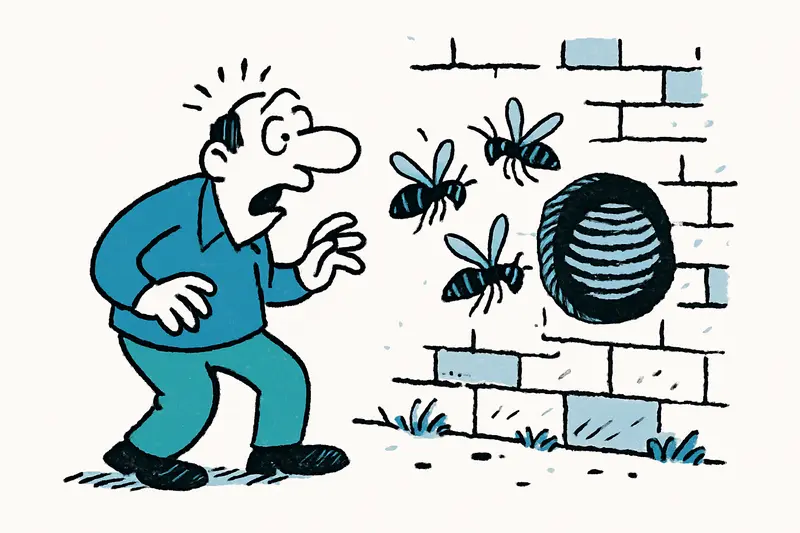
Alarm in Esporles: First Oriental Hornet Nest Discovered – What Matters Now
An Oriental hornet nest was found for the first time on Mallorca in Esporles. A disturbance that raises questions: How serious is the threat to people, beekeepers and agriculture — and what steps are needed now?
Alarm in Esporles: First Oriental Hornet Nest Discovered on Mallorca
In the early morning of October 25, an unremarkable natural stone wall in Ses Rotgetes de Canet became the center of a small village drama. Dogs barked, coffee cups clinked on terraces, neighbours half-closed shutters — and finally the report to the authorities: a hornet nest. The inspection confirmed what many had feared: a nest of the Oriental hornet (Vespa orientalis), built in a cavity of the wall very close to inhabited houses, as reported by Oriental hornet on Mallorca: First nest in Esporles raises serious questions.
The key question: start of an invasion or an isolated case?
The main question is: does this single nest mean an imminent invasion? In short: not yet. But it is a clear sign of changes we should not ignore. The Oriental hornet is adapted to warmer climates, originates from North Africa and the Near East, and prefers protected cavities — exactly the niches that old stone walls or roof overhangs in villages provide, as described in the Vespa orientalis species profile on Wikipedia.
What is often overlooked: it is not enough to point only to transport issues. Transportation routes may be entry points, but climate warming, changed land use and the availability of numerous small hiding places in settlement areas play at least equally large roles. Mallorca is becoming warmer; that creates habitat for southern species. And when a species establishes itself, ecosystems often react more slowly than people expect.
Concrete risks locally
For the residents of Esporles the discovery meant uncertainty at first: shutters are discussed in the evenings, pets are called indoors, bins are securely closed. This caution is sensible. For beekeepers the situation is more existential: hornets prey on bees, can weaken or decimate colonies and thus impair pollination services. That has knock-on effects on fruit and olive yields — and therefore on farmers' incomes.
An underestimated point is the limited capacity of public authorities. The current procedure is: report, observe, have it professionally removed. Without systematic mapping, faster interventions and local specialist teams the approach remains reactive. That increases the likelihood that further nests go undetected until the population grows.
Practical immediate measures for neighbours and beekeepers
Important: no one should try to remove a nest themselves. Hornets react aggressively when disturbed; for allergy sufferers this can be life-threatening. Please report sightings to the Servicio de Protección de Especies: Telephone +34 971 176 586, Email especies@dgmedinatural.caib.es, and follow local reporting guidance as in Primer nido de la avispa oriental en Mallorca descubierto – Hallazgo en Esporles. Provide as precise location details, time and photos taken from a safe distance as possible.
Specific protection recommendations:
- Beekeepers: check colonies more often, fit entrance screens, have emergency plans ready.
- Residents: close bins, do not leave pets unattended outdoors, reconsider evening activities at home.
- Allergy sufferers: keep emergency medication at hand and inform relatives.
Four steps to keep Mallorca prepared
The response must not consist of isolated actions alone. Four measures appear urgent to reduce the risk:
1. Rapid mapping: systematically recording all sightings and a publicly accessible map help citizens and beekeepers identify hotspots.
2. Local response centres and training: training for municipal teams and expanding response capacity so nests can be removed quickly and safely.
3. Research support: Which traps or biological measures work here? How do local beehives respond to pressure from Vespa orientalis?
4. Education campaigns: clear behaviour rules for villages and tourist areas so people know how to react — without panic, but with consistency.
A neighbourhood appeal
I saw neighbours standing with coffee cups in hand in front of the wall quietly discussing whether shutters should remain closed in future. A little extra caution is no mistake — better prevention than regret. Note the time and place, send a photo from a safe distance and report any suspicion. That is the simplest, most effective contribution.
Esporles may keep its peace, the Serra de Tramuntana watches on, and the air smells of autumn. The find is no reason to panic, but it is a wake-up call: if we stay vigilant and act in a structured way, Mallorca can steer the advance of new species — instead of being surprised by them.
Frequently asked questions
Are Oriental hornets now established in Mallorca?
What should I do if I find a hornet nest in Mallorca?
Is the Oriental hornet dangerous for people and pets in Mallorca?
Why can Mallorca be a suitable place for Oriental hornets?
What should beekeepers in Mallorca do about Oriental hornets?
What areas in Mallorca should residents watch more carefully for hornets?
How should neighbours in Esporles react if they suspect a hornet nest?
Should Mallorca expect more Oriental hornet nests this year?
Similar News

Who Benefits from the Half‑Hourly Flight on the Edge? Aena, Investments and the Island's Interests
Almost one billion euros is flowing into Son Sant Joan. The figures show the scale of investment and expected beneficiar...

Are the Balearic Islands the Southern Border of Europe? A Reality Check on Immigration
The Balearic Islands are again calling for EU aid after a sharp rise in arrivals by sea. Conflicting priorities between ...

"Expensive chaos" and many open questions: What clients can do when a lawyer suddenly stops responding
Several clients complain that a well-known German lawyer in Mallorca has been unreachable for months. Key question: What...

TV tip: 'The Last Problem' — Mallorca as the setting of a classic crime
A classic whodunit on Mallorca: A new miniseries set in spring 1959 brings storm, an isolated hotel and a dense web of s...

Nipping Sea Creatures: Why Bathers in Cala Major and Elsewhere Should Be Cautious
In Cala Major, bathers have reported being nipped by small fish. What is behind it, how can problems be avoided — and wh...
More to explore
Discover more interesting content

Can Cap de Bou

Townhouse Lleo 72
