
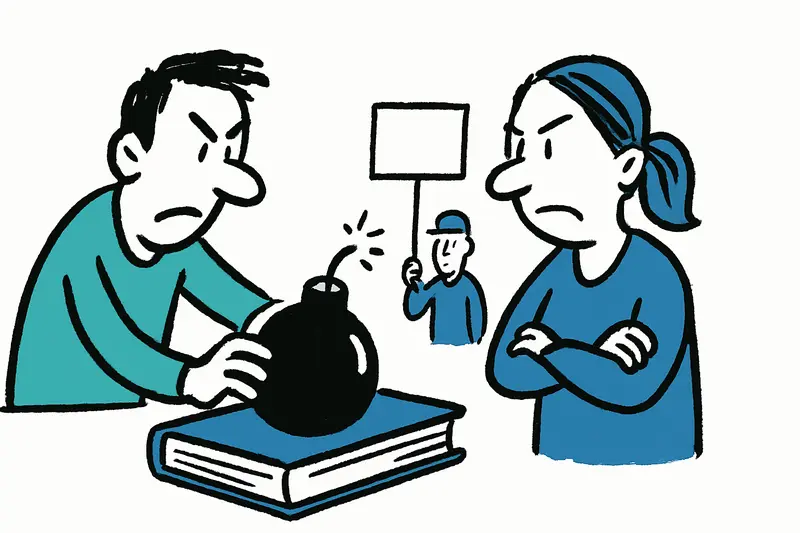
Sabotage Handbook: How Mallorca Stands Between Protest and Criminalization
A guide to direct actions has triggered a legal and political chain reaction in Mallorca. Who sets the boundaries here — and how can legitimate protest be protected without endangering the public and businesses?
Sabotage Handbook: How Mallorca Stands Between Protest and Criminalization
Key question: Where does legitimate protest end — and when does criminal law begin?
The heated issue can be summarized briefly: An action guide published by the platform Menys Turisme, Més Vida has been taken off circulation; an international law firm has filed a criminal complaint; business associations are considering legal steps; the regional government is calling for de-escalation. Those are the hard facts. The important question, however, is: Who defines in this dispute the line between civil disobedience and criminal incitement — and who ensures that the answer does not hollow out democratic debate?
A sober analysis reveals two camps with contradictory dynamics. On one side are activists who for years have pointed to housing shortages, noise and working conditions. On the other side, business representatives and now also a law firm are pushing for tough legal responses. In between, the government is trying to calm things and avoid escalation. The momentum of legal actions — criminal complaints, the naming of offenses such as property damage and coercion, the draft of a law with high fines — changes the rules of the game: a political debate can easily become a matter for criminal law.
What is often missing in the public debate is nuance: criticism of an economic model must not be criminalized across the board, while at the same time clear limits must be set against calls for violence and intimidation — incidents such as New xenophobic graffiti at Playa de Palma – How is the island reacting?.
The current situation reveals a third problem: the small number of institutionalized channels for affected people to participate. People who suffer from rising rents, tourist crowds and precarious employment need more than noisy pressure valves — they need reliable forums where complaints are heard and binding responses are produced.
A simple everyday impression helps to understand this. In the morning at Passeig Mallorca the cool air still lies over the park benches; delivery vans honk, a woman with boxes from the weekly market looks for a taxi, an old café owner sweeps in front of his place. Tourists come with maps in hand, a rental car is double parked. This scene repeats itself in many places on the island: life, work and tourism press up against each other within a few metres. When residents feel their problems are not taken seriously, frustration grows — and protests, such as Palma after the Protest: How Freedom of Expression and Everyday Life Can Be Balanced, get louder.
The legal escalation carries concrete risks: First, there is the danger of deterrence, where even legitimate forms of protest fall under a blanket suspicion. Second, a broadly worded criminal law provision that harshly punishes, for example, the “spreading of sabotage calls” can also cause unintended collateral damage, for instance for researchers, journalists or activists who generally encourage criticism — a dynamic visible in campaign controversies such as Posters, Provocation, Polarization: How Mallorca's Streets Become a Campaign Ground. Third, enforcement is problematic: how do you prove that a handbook has directly caused criminal acts? The evidence in online networks is often diffuse.
Concrete solutions therefore cannot be based on gut feeling but on a mix of legal clarity, dialogue and prevention:
1. Verifiable definitions: If laws or regulations are introduced, they must clearly specify which actions are punishable — with concrete examples and a threshold that separates genuine calls for violence from strong criticism.
2. Independent review: Complaints about calls to violence should first be assessed by an independent body before immediate criminal proceedings follow. This reduces political instrumentalization.
3. Local dialogue forums: In every larger town on the island a binding round table with representatives of neighbourhoods, tourism workers, business owners and politicians — public, recorded and with actionable recommendations.
4. Prevention programmes: De-escalation training for police and municipal officials, communication campaigns that make legitimate protest visible and counter illegal calls.
5. Targeted sanctions: Fines should be precise in their effect — directed at those responsible within organizations proven to call for crimes — not at informal supporters or uninvolved activists.
6. Allocation of revenue: Additional funds from tourism levies should flow directly into housing programs, infrastructure and employment initiatives; this reduces local tensions.
These proposals may sound technocratic, but they serve a political purpose: the protection of public order must not become a gag on political criticism. Those who commit crimes must be held accountable; those who point out grievances must not be criminalized. An island society that many see as overwhelmed needs both: enforcement instruments and spaces where conflicts can be resolved.
Conclusion: The legal steps against the handbook are a wake-up call. They show how quickly protest can become a legal case — and how thin the dividing line is when political leadership moves from speech to criminal prosecution. Anyone who wants Mallorca to remain livable must pay attention to two things: clear rules about what is criminal, and real access for people who want to change things. Otherwise only the defence of positions remains — loud, costly and ultimately little solution-oriented.
Frequently asked questions
What is the core issue behind Mallorca's debate on protest and criminal law?
What safeguards are proposed to separate legitimate protest from criminal incitement in Mallorca?
How can residents in Mallorca participate in decisions affecting housing, tourism, and work conditions?
What risks arise if protest is punished too harshly in Mallorca?
How would a binding round table work in Mallorca’s larger towns?
What does the Passeig Mallorca scene reveal about life, work, and tourism on the island?
Where should revenue from tourism levies go to ease tensions in Mallorca?
What role does Mallorca's regional government play in de-escalating protests and preventing criminalization?
Similar News
Can Malle hits really work in Hamburg? A reality check for the premiere of "ALLE LIEBEN MALLE"
Premiere at the Großmarkt: thousands of attendees, stars from the Megapark and long beer queues. Why the concept works —...
Adrien Brody strolls through Mercat de l'Olivar – celebrity visit leading to Sa Pobla
Actor Adrien Brody was casually spotted at the Mercat de l’Olivar: tapas, fish stalls and later a stop in Sa Pobla spark...
Who can pick up whom? The complicated life of Mallorca's taxis
Three years after the inter-municipal service, empty runs are rarer — but there is a lack of equal treatment, transparen...

When the Tap Only Runs Sometimes: Why Municipalities in the Balearic Islands Are Now Rationing Water
Deià, Valldemossa, Esporles, Sóller and several places on Menorca are scaling back water supply. Who is responsible, why...
Battle for the Ramp: Why Cala Gamba Needs More Than Enforcement
The Guardia Civil intervened in Cala Gamba — residents breathed a sigh of relief, but unease remains. Key question: Are ...
More to explore
Discover more interesting content

Boat Tour with BBQ along Es Trenc Beach

Private transfer from Mallorca Airport (PMI) to Pollensa
