
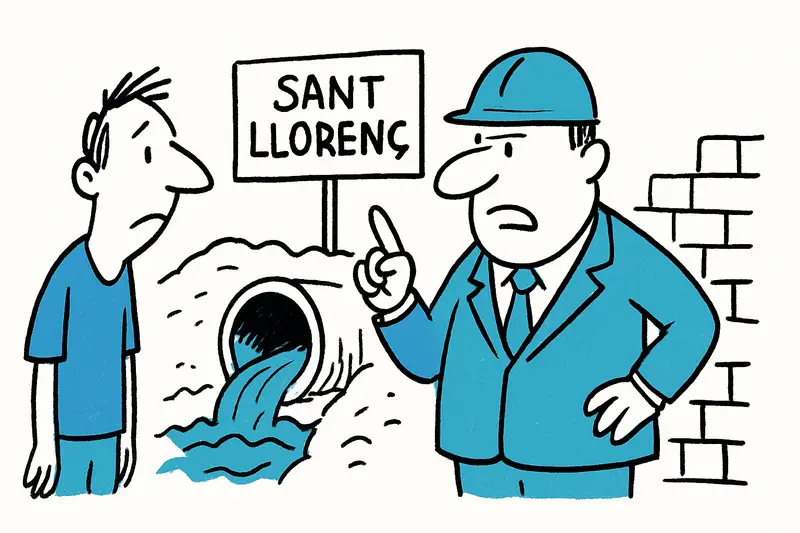
Sant Llorenç: Flood Protection Begins — Seven Years After the Disaster
Sant Llorenç: Flood Protection Begins — Seven Years After the Disaster
Work on the Sant Llorenç torrent starts in spring: larger culverts, greater discharge capacity, reinforced riverbanks. Why did it take so long — and why does the project now cost more than twice as much?
Sant Llorenç: Flood Protection Begins — Seven Years After the Disaster
Key question: Why did flood protection take so long — and how did €4 million suddenly become €9 million?
At the moment you hear more dogs barking in the village than drilling noises, but that should change in spring: work on the Sant Llorenç torrent, which devastated the village on 9 October 2018, is finally beginning, following island-wide discussions about torrent clearance in When the Torrents Are Cleared: Cleaning Up Against Heavy Rain — Is That Enough?.
These figures hang over the Plaça like two question marks. One is technical: Are larger pipes and concrete walls really enough to cope with a climate that has changed and with more frequent heavy rain events? The other is political and organizational: Why were seven years allowed to pass between the flood and the start of construction, and who is responsible for the sharp rise in costs?
A look back helps: on the day of the flood cars were inside the church, basements were full, people lost their livelihoods. Since then Sant Llorenç has been waiting for help and lasting solutions, while flash floods elsewhere have shown how torrents can wash tons of household waste and plastic, as documented in Garbage avalanche after flash flood: S'Arenal section closed — who pays the price?. What is now to be built are classic engineering measures: larger culverts under the roadway so water can flow unimpeded, increased discharge capacity and stone-lined banks. Such measures can show quick results — but they are not automatically future-proof.
Critical analysis: The delay and the additional costs suggest several problems. Planning and financing often operate in separate spheres: initial cost estimates are based on preliminary designs; later, environmental regulations, geotechnical reports, compensation for affected land and construction price increases are added. In addition, the technical debate has shifted: whereas linear canalization used to be the standard, the current debate more often calls for nature-based solutions such as retention basins, controlled flood zones or reforestation above the catchment area. When the original plan is adjusted afterwards, time requirements and costs rise, a dynamic also seen in other local renewal projects like Calvià Invests 25 Million: Between Renewal and Construction-Site Logic.
What is missing from the public discourse: Who will explain transparently to the people of Sant Llorenç which options were examined and why this particular solution was chosen? A clear breakdown of what the additional €5 million is budgeted for is lacking. And there is no visible maintenance perspective: once built, the system must be maintained — without regular cleaning of culverts and inspection of the walls, new problems will arise, as debates over who cleans the island's streams show in After the Rain: Who Cleans the Streams — and Is It Enough?.
A slice of everyday life in the village: on a cool February afternoon a woman sits on the bench in front of the bakery on Carrer Major, her hands deep in her jacket pockets. She points to the waterline still visible on some houses years after the flood and says quietly that she hopes this time everything will be done right. Children slide on the square, a delivery van parks crookedly — ordinary scenes that are often overlooked in the technical debate.
Concrete solutions — not empty talk, but practical points:
- Transparency: Public breakdown of cost items and contract award phases. Citizens must be made clear what the additional costs cover.
- Multi-stage measures: Combine hard infrastructure (culverts, walls) with nature-based measures higher in the catchment: small retention basins, soil loosening and reforestation can dampen peak flows.
- Maintenance obligation: A clearly regulated maintenance plan with responsible bodies and funding sources prevents the facility from clogging up after a few years.
- Early warning systems and evacuation plans: More sensors along the stream and regular drills with the population create safety beyond concrete.
- Independent review: An external technical audit of the design and cost development would build trust.
Conclusion: It is good that construction is starting now — but "building" alone does not equal "securing". Sant Llorenç does not need quick, one-off fixes but a well-thought-out package: robust engineering, a responsible cost structure and a maintenance perspective. If the coming months are only the prelude to a short-sighted rationing of concrete, the Plaça will recognize the waterline of the next storm again. If planning and execution instead rely on transparency and a combination of methods, Sant Llorenç could move out of the disaster phase and build a lasting line of protection. The clock is ticking — not only because of the construction traffic lights, but also because of further extreme weather events that can no longer be ignored.
Frequently asked questions
Why is Sant Llorenç finally starting flood protection works so many years after the 2018 disaster?
Will larger pipes and concrete walls be enough to protect Sant Llorenç from future floods?
What should people in Mallorca do to prepare for flash floods and heavy rain?
What is usually included in a flood protection project like the one in Sant Llorenç?
Why did the Sant Llorenç flood protection cost go from €4 million to €9 million?
What kind of maintenance will Sant Llorenç’s new flood defences need?
What happened in Sant Llorenç during the 2018 flood?
Are there places in Mallorca where torrent cleaning and flood prevention are still being debated?
Similar News
When Ryanair's fleet grows: What Mallorca's travelers should know
Ryanair will soon receive 737 Max 10 jets. The larger aircraft offer potential savings — but also new risks for flight o...

Rising fuel and housing costs: Why Mallorca's overland buses are suddenly overcrowded
More and more people are leaving Palma — and boarding TIB buses: Between January and August 2026, the network recorded o...
Carriages Without Horses: Palma Plans E-Carriages – a Reality Check
Palma plans to switch to electric carriages in 2027. The prototype was shown near the cathedral. What is the technology ...

Record season, empty coffers: Who really benefits from the tourism boom?
Full hotels and more flights: the numbers sound impressive — yet many locals feel no benefit. A reality check with an ev...

Pool ordered for €46,000 – €23,000 paid, no work carried out: A fraud case in Palma
A homeowner in Palma transferred €23,000 for the construction of a pool. Weeks later it emerged that no building applica...
More to explore
Discover more interesting content

Can Cap de Bou

Townhouse Lleo 72
