
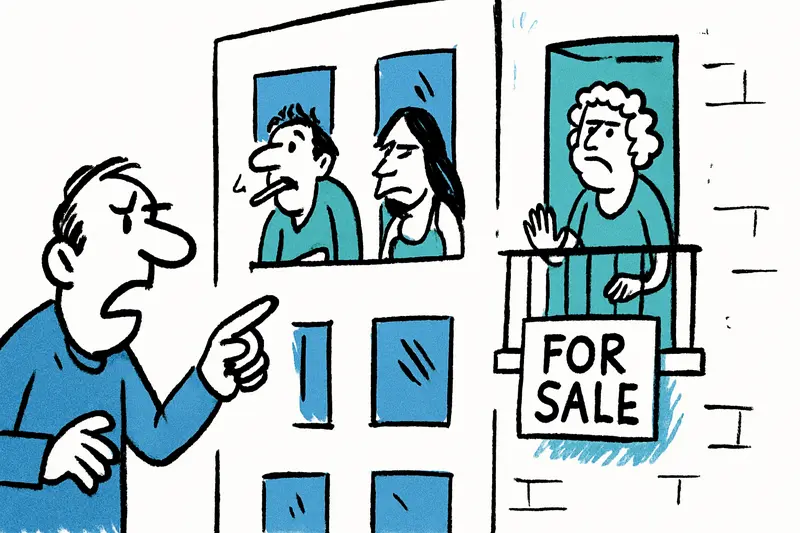
Who Acts First? Squatters in Santa Margalida Cause Trouble in Half-Finished Housing Blocks
For months people have been living in half-finished housing blocks on Calle Pere Estelrich Fuster — unsettling the neighborhood. The question remains: Who carries responsibility, and what solutions exist before an accident happens?
Half-built block, full problems: A neighborhood seeks answers
Early on Sunday mornings, when the smell of fresh ensaimadas drifts along Calle Pere Estelrich Fuster and a small street dog greets the few passersby, the half-finished building immediately stands out: bare walls, broken windows, construction noise long since fallen silent — and suddenly life again on the floors. What began as a housing project and stalled after the construction company's insolvency has become a scene of occupations, as in Between Concrete and Surf: Squatters at Espigol Beach — Where Should the People Go?. Neighbors ask loudly: Who acts first?
Uncertainty instead of everyday life
For the elderly woman who feeds her pigeons every morning, the change is noticeable. Children who used to play in the small square next door are now collected earlier. Residents report nighttime music, voices, occasional petty deals at the door and even instances of short-term prostitution in an apartment. These incidents are less spectacular than dangerous — but they change daily life.
Dangerous tricks with electricity and water
On site, tangible risks appear: new locks on the main door, improvised wiring that apparently taps electricity, and hoses that lead water into the building. Such makeshift solutions mean increased risk of fire and short circuits; poorly installed systems can cause flooding. The problem is not only criminal or regulatory — it is also a matter of public safety.
The invisible responsibility
The situation raises a series of questions of responsibility that are often overlooked: Who is legally responsible for securing an unfinished property — the insolvent construction company, a bank holding the plot, or the municipality? How quickly can the judiciary act when ownership rights are unclear? And how far may the police and the Guardia Civil intervene when an occupation has already taken place in fact? There have even been violent attempts documented in Valldemossa: Violence During Attempted Occupation — Who Protects the Houses in the Village?.
Public debate also often lacks focus on two points: first, the role of online platforms that continue to list vacant units as properties for sale, fostering confusion and fraud attempts. Second, the need to think social services in parallel with police measures — many people in occupied flats do not need punishment but perspectives. Similar dynamics are reported in other towns, for example Inquietud en Santa Margalida: Bloques de viviendas vacíos ocupados por okupas.
Concrete steps instead of helplessness
What could pragmatically help now, without undermining the rule of law: first, a rapid securing of the construction site by the municipality — temporary fences, lighting and transparent access controls. Second, police and judiciary should consider accelerated procedures to act swiftly in clear ownership situations. Third: professional inspections by energy and water providers to eliminate acute hazards.
In parallel, a municipal offer for initial social care should be on the table — a contact hotline, social workers, mediation into emergency shelters or hostel places. And finally a binding obligation for property platforms to verify listings so sales ads do not produce additional legal chaos.
Between pragmatism and principles
The neighborhood demands more presence, clear responsibilities and rapid repairs — but also solutions that endure in the long term. A fence will not solve all problems; a combined strategy will: legal clarity, technical securing, preventive inspections and social services.
When the wind blows from the sea and cafés put their tables outside, a place like Calle Pere Estelrich Fuster should not become a trouble spot. It's about more than order — it's about the sense of security in the quarter. The central question remains: Who will make the first move? The municipality, the owners, the judiciary — or the local community that finally organizes? This mirrors neglect at places like Enough is enough: Can Picafort's neglected squatted Espigol Beach complex and the failure of those responsible.
The situation is evolving. We will continue to follow and report on new measures or decisions.
Frequently asked questions
What should you do if an unfinished building in Mallorca is occupied by squatters?
Is it dangerous to have squatters in a vacant block in Mallorca?
Who is responsible for securing an unfinished property in Mallorca?
What can the police do if squatters have already entered a property in Mallorca?
Why do unfinished housing blocks in Santa Margalida attract squatters?
How does squatting affect daily life in Santa Margalida?
What can Mallorca municipalities do to prevent trouble around occupied buildings?
Can property listings online cause confusion in Mallorca squatters cases?
Similar News

Who Gets Left Out? Why Overbookings Will Hit Many Mallorca Travelers This Summer
On hot check-in days at Son Sant Joan, frustrated travelers pile up. New figures from Reclamador.es show that a large sh...

When the Handyman Came: How an Engagement Ring Disappeared in Mallorca and What It Says About Trust
During a repair in Andratx a highly personal engagement ring went missing — a case that calls not only for punishment bu...

How Burglars Test Fincas in Mallorca — and What You Can Do About It
The Spanish National Police warn of a simple but effective trick: small markings on doors reveal whether a finca is occu...
Palma doubles blue zone: What this means for residents, tourists and narrow streets
From 1 January 2027 Palma's ORA area will grow from around 12,000 to 24,000 spaces. Key question: Will the expansion bri...

Engagement ring disappears during repair: court upholds prison sentences for plumber and partner
During a heating repair in an apartment in Andratx an engraved engagement ring disappeared. After a trace to a pawnshop ...
More to explore
Discover more interesting content

Can Cap de Bou

Townhouse Lleo 72
