
After Storm in Santa Ponsa: Four Boats Damaged — Who Protects Our Coast?
After Storm in Santa Ponsa: Four Boats Damaged — Who Protects Our Coast?
Overnight, strong gusts in Santa Ponsa damaged or sank four boats. The incident reveals gaps in inspections, a risk of marine pollution and the question: Who intervenes in an emergency?
After Storm in Santa Ponsa: Four Boats Damaged — Who Protects Our Coast?
Key Question
Who is responsible when a storm throws boats onto the rocks and diesel leaks into the water — and why does coastal protection in Santa Ponsa apparently fail?
Summary of Events
In the night to Thursday the wind veered to the west and lashed the waves into the bay of Santa Ponsa. According to eyewitness reports, at least four pleasure boats were damaged or sank completely. Members of the environmental association Mallorca Neta hurried to the shoreline in the morning, collected floating debris and tried to contain visible pollution. At the same time the temperature dropped noticeably — the weather warning had been raised earlier.
Critical Analysis
These scenes are not new, but they are symptomatic. When boats are moored without adequate securing, fuel tanks are poorly maintained, or anchors are inadequate, a stronger northwest wind is enough to create major problems. Mallorca Neta criticises that there are hardly any inspections and that the responsible authorities are understaffed. It's a simple but bitter equation: fewer checks + more boats = higher probability of accidents and oil traces.
Who is liable? Owners, port or coastal authorities, insurers — legal responsibilities are defined, but practically they are often hard to enforce. In the meantime the sea pays the price: leaked fuel endangers fish, seagrass and bathing water quality. And visually such a sight is an annoyance for both tourists and residents.
What Is Missing in the Public Debate
There is a lot of talk about individual incidents, but rarely about preventive figures and procedures: How often does the coastal authority actually inspect free anchorage areas? How many boats are currently operating without up-to-date safety checks? What contracts exist with salvage companies for rapid response? These facts are missing from the debate — without them any call for better protection remains vague.
Everyday Scene from Santa Ponsa
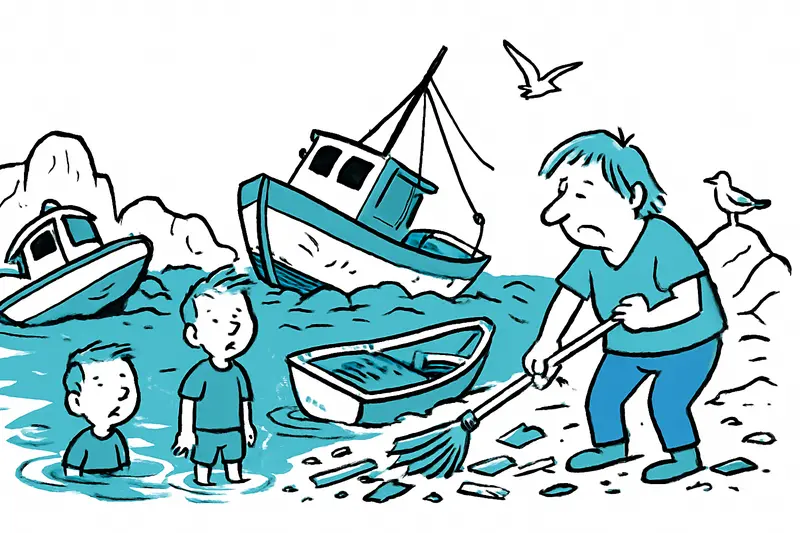
Early in the morning the promenade is still calm. A fisherman on the jetty repairs his nets, tourists drink coffee under parasols, seagulls circle over a sheen of diesel on the water surface. Children stand with wet feet at the edge and stare at a half-sunken rowboat, while a local resident tries to sweep plastic and wood debris together with a broom. Such scenes show how close environmental problems are to everyday life here.
Concrete Solutions
- Immediate measures: Equip central mooring sites with first-response kits — floating oil booms, absorbent mats, grabbers and designated contacts for quick alarms.
- Strengthen inspections: Regular (and documented) inspections of anchorage and berthing areas by the coastal authority or contractual partnerships with port operators; sanction violations with fines.
- Reporting and response chain: A clearly communicated phone number, a digital reporting channel and coordinated responses with local fire brigades, harbour services and certified salvage companies.
- Prevention through education: Information campaigns for boat owners on proper anchoring, fuel tank maintenance and behaviour during storm warnings.
- Financing: Short-term funds for emergency kits and, in the long term, an increase in resources for the coastal authority — financed through fees, local funds or public grants.
- Use technology: GPS-based monitoring of anchorage positions in sensitive zones and satellite data for rapid situational images during storms.
Why This Would Be Good for Mallorca
Better preparedness protects not only nature but also the island's image. Clean bays are directly linked to tourist appeal, provide habitat for marine life and contribute to residents' quality of life. Investments in rapid response capability pay off multiple times.
Concise Conclusion
The incident in Santa Ponsa is not an isolated annoyance but a reminder that prevention and local responsibility belong together. It is not enough to clean up after the storm and look on in outrage. We need clear inspections, well-equipped emergency teams and a culture in which boat owners take their duties seriously. Otherwise the whole thing will repeat — with worse consequences for the beaches, marine life and the people who live here.
Frequently asked questions
What storm-management measures help protect boats and the coastline around Santa Ponsa and Mallorca?
Who is liable for damage and pollution after a storm along Mallorca’s coast?
What should Mallorca boat owners do to reduce risk during storms?
What coastal-protection measures are proposed to improve Mallorca’s response to storms?
Why does stronger coastal protection matter for Mallorca’s tourism?
How important is public reporting in protecting Mallorca’s coastline after storms?
What signs suggest Mallorca’s coastal protection may be under-resourced?
What everyday scenes in Mallorca show how coastal issues affect daily life?
Similar News
Pearl oyster off Mallorca's coasts: How the warm sea is changing the island
The pearl oyster Pinctada radiata from the Red Sea is spreading further into the western Mediterranean. A study by IATS ...

Demolition or Opportunity? The Casetas on the Costa des Teatre — What Palma Really Must Decide
The city plans to redesign Plaça Major — but the small wooden huts on the Costa des Teatre are at stake. An inventory wi...

Douglas scion shakes up Deià's short film festival — behind the camera
Dylan Douglas worked in Deià on a one-minute short film about the solar eclipse and handled the editing. For the island ...

He disappeared after a bike tour near Campos: A reality check on the case of Hans Peter Harke
Since 31 July there has been no trace of 72‑year‑old Hans Peter Harke. Drones and a helicopter searched unsuccessfully a...
Morning Light and Half-Shadow: Partial Lunar Eclipse over Mallorca on 28 August
In the early hours of 28 August the Earth moves in front of the full moon: a partial lunar eclipse will be visible from ...
More to explore
Discover more interesting content

Boat Tour with BBQ along Es Trenc Beach

Private transfer from Mallorca Airport (PMI) to Pollensa
