
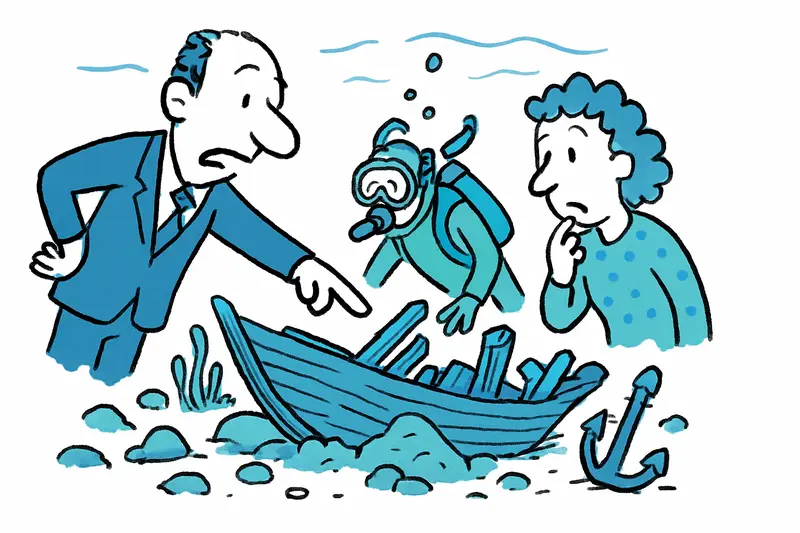
Ses Fontanelles: 1,700 Years Underwater – the Wreck That Makes Mallorca Proud
A Roman merchant ship lay hidden for 1,700 years off Can Pastilla. Now Ses Fontanelles is in the spotlight: salvage, conservation and a nomination at National Geographic Historia.
Ses Fontanelles: 1,700 Years Underwater – the Wreck That Makes Mallorca Proud
How a piece of late antique everyday life resurfaces
When I drive along the Passeig Marítim in the morning, the air smells of sea and grilled food from the kiosk on the corner. On warm days older people sit on the wooden benches and look toward Can Pastilla; sometimes the waves glint, sometimes divers are working far out. Right there, about 65 metres from the beach, a wooden merchant ship lay hidden in the seabed of the Mediterranean for almost one and a half millennia. Its name in our area: Ses Fontanelles.
The story of the find reads less like a film plot and more like patient archaeology. An autumn storm exposed parts of the seabed, and suddenly shapes and fragments appeared that did not fit the tourist scenery. Since then, teams under floodlights and amid the smell of diesel have spent weeks underwater recovering piece by piece: hull segments, anchors, ropes, baskets, kitchen pottery, amphorae and even remnants of sails.
That is what makes this wreck special: it is not a single amphora in a grain of sand, but an entire everyday outfit from the 4th century. Such assemblages allow researchers to reconstruct the daily life and trade of past times – from cargo securing to provisions to the tools on board. For Mallorca this means: here lies a window into an era when the Mediterranean knew different routes, different goods and different people than today.
The salvage itself was not a one-off triumph but a precise operation carried out over months. At least fifteen people worked underwater, uncovering the timbers layer by layer and lifting the largest floor planks with flotation airbags. The cargo was brought to the Yacht Club Sant Antoni and from there by lorry to the Castell de Sant Carles, where the conservation journey continues: hours-long desalination in tanks, later treatment with polyethylene glycol and controlled drying in specialised laboratories – much of the follow-up work will take place in Cartagena.
And then there are the sails. Few finds allow the fibres and weave of ancient sails to be studied. These textile remains could shed new light on aspects of ship technology and answer specialist questions that researchers until now could only speculate about. For science, Ses Fontanelles is therefore more than a local curiosity: it fills gaps in the maritime history of the late Roman Empire.
The significance will be tangible this year: the nomination for the +HISTORIA awards by National Geographic Historia brings attention beyond the island. Until 12 October the public can have a say – a chance to present Mallorca as a place of archaeological quality and to spark critical interest in underwater research.
For the island this has several benefits: cultural recognition, new educational offerings and a stronger linking of science and tourism. In November an exhibition at the La Misericòrdia Cultural Centre will show the discovery’s path: models, excavation photos, finds and explanatory panels. I can already picture school classes from Palma, with wet hair and curious looks in front of the display cases – pride mixes with the certainty that we have something worth preserving here.
A small appeal from everyday life: those walking the coast can look more attentively. Museums and conservators need publicity and interest, volunteers for accompanying programmes are welcome, and local schools can bring the wreck into the curriculum. Ses Fontanelles shows that our beaches are not just sunbathing spots but layers of history.
It is heartening to see how a place between sunbeds and fishing nets suddenly becomes the centre of scientific work. For Can Pastilla and the whole Playa de Palma this is a story that gives hope: more appreciation for what lies beneath the surface, and an open window into a distant yet tangible past.
Frequently asked questions
What is Ses Fontanelles and why is it important for Mallorca?
How was the Ses Fontanelles wreck discovered and what did the salvage involve?
What can Ses Fontanelles tell us about late antique life in the Mediterranean?
Are there public events or exhibitions about Ses Fontanelles in Mallorca?
Can visitors see the wreck itself or only exhibits?
How can locals or visitors get involved with Ses Fontanelles?
What broader cultural or tourism benefits does Ses Fontanelles bring to Mallorca?
Where exactly is Ses Fontanelles located in relation to Can Pastilla?
Similar News

Mallorca gets winter link to Lyon: Transavia France flies from October
Transavia France will launch a winter direct connection Palma–Lyon from late October: twice weekly, around 17,000 seats ...
Mini-tsunamis in Mallorca: Harmless natural phenomenon — or an underestimated danger?
Two harbor towns in Mallorca recorded unusual water level fluctuations. An analysis: How rissagas form, who is at risk —...
Stinging jellyfish in Cala Banyalbufar: Why everyone suddenly fled the water
In Cala Banyalbufar, Pelagia noctiluca washed up in droves. A personal account of why this is no coincidence, what is of...

New low-pressure trough brings rain — and the heat remains: What's missing in Mallorca?
A short, intense window of showers hit Mallorca, yet the air remained muggy and warm. Key question: Why does rain hardly...

Klaus-Michael Kühne has died: The entrepreneur who gave Mallorca a second home
He first arrived on the island at 60; later the holiday house became Castell Son Claret – a hotel, a music venue and an ...
More to explore
Discover more interesting content

Boat Tour with BBQ along Es Trenc Beach

Private transfer from Mallorca Airport (PMI) to Pollensa
