
Seven Catamarans, a Party — on the Edge of the Protected Area
Seven Catamarans, a Party — on the Edge of the Protected Area
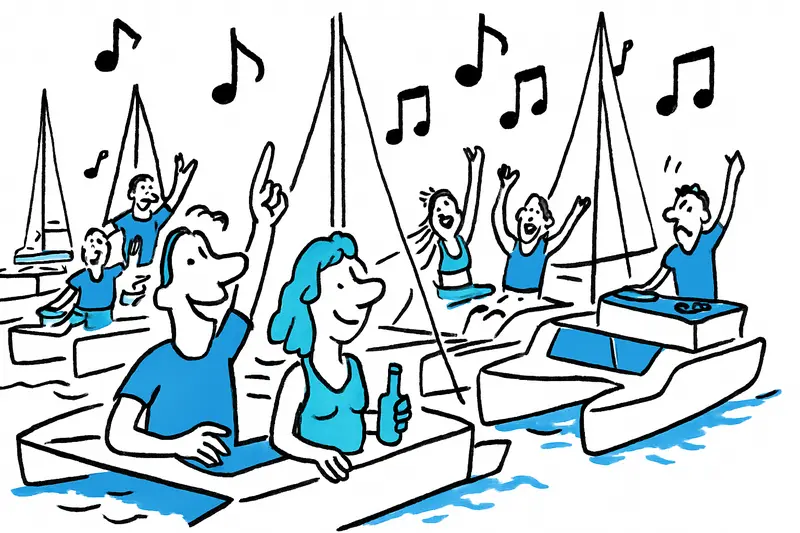
In the nature reserve around Cap de ses Salines, a loud gathering of seven catamarans with around 50 revelers caused dismay. Key question: How do we protect sensitive coasts from such actions?
Seven Catamarans, a Party — on the Edge of the Protected Area
Key question: How do we protect sensitive coasts from noisy boat gatherings?
Last Thursday, around 3 p.m., according to eyewitness reports seven catamarans joined together in the area of Cap de ses Salines and played loud music for hours. Around 50 people are said to have taken part. This is more than just an embarrassing scene for several reasons: it is a test of the rules, respect and controls along our coasts, as seen in When the Catamaran Came in Too Far: Banyalbufar.
Starting with the legal side: events at sea are not prohibited per se. For larger gatherings or the mooring together of several boats, however, a permit from the Capitanía Marítima may be required, especially when an area is considered ecologically sensitive. Cap de ses Salines is one of the specially protected zones at Mallorca's southern tip — precisely where many marine species need calm and certain activities are restricted.
Critical analysis: the incident reveals not only thoughtlessness but also a gap in everyday enforcement. Eyewitnesses noticed noise and unrest; some boats tied up alongside each other, forming an improvised platform. Such manoeuvres are not without consequences: close formation increases the risk of leaks, waste disposal becomes more difficult, and the noise disturbs animals as well as other recreational users. Authorities can impose fines, but only if violations are detected and documented.
What is often missing in public debate is an honest look at coordination between the bodies responsible for the coast. Capitanía Marítima, local environmental agencies, municipal offices and boat rental companies must share information and act more quickly. Equally important is prevention: many skippers do not know exactly where the boundaries of protected areas lie or what behaviour is required — that is not an excuse, but a deficiency that can be corrected, as incidents such as Trouble over license-free boat rentals: When Es Carbó becomes a racetrack illustrate.
An everyday scene I often observe: around 4 p.m. in Colònia de Sant Jordi. Fishermen mend nets on the quay, an elderly couple sits with ice-cold water in hand, children build sandcastles, and in the distance the bass from a party boat slowly approaches — loud enough to make the seagulls tilt. The noise that disturbs the calm there is not an abstract nuisance; it is audible, tangible and changes how people experience their coastal space.
Concrete approaches, without promising thick brochures: 1. Clear zoning and visibility: precise digital maps with geofencing displayed to skippers when renting boats or on navigation apps. 2. Increased presence: targeted patrols by the Capitanía Marítima during sensitive summer months, supported by mobile cameras and boat inspections. 3. Fines and sanctioning practice: faster, transparent procedures so that illegal mooring of boats or noise does not go unpunished. 4. Responsibility of rental companies: boat renters must include clear prohibitions and notices about protected areas in their rental agreements and be held liable for violations, illustrated by Drunk Boats, Battered Bays: When Private Boat Rentals Put Mallorca's Coasts at Risk. 5. Citizen participation: a simple reporting function for eyewitnesses, coupled with GPS data so that complaints are actionable.
Practically feasible would also be information boards in harbours and landing places that briefly point out protection rules in several languages, as well as short training videos shown to skippers before departure. Technology is not a cure-all, but geofencing with automatic warnings can deter those who act out of ignorance.
Pointed conclusion: the scene with seven catamarans is more than a summer slip-up. It shows that protected areas need better visibility, enforcement and coordination. If we continue to watch short-term fun taking place where long-term natural values are located, in the end we all lose — not only the seagulls and fish, but the people who come to find quiet on our coasts, as local disputes such as Conflict in Banyalbufar's Cala: When Is Enough Boat Traffic Too Much? demonstrate. Authorities, rental companies and users must come together now: not with a wagging finger, but with clear rules and reliable control.
For Mallorca this means: respectful treatment of landscapes that give us daily recreation, and the recognition that freedom at sea ends where protection begins. Otherwise the phrase “That’s Mallorca” will quickly become a sad label for carelessness.
Frequently asked questions
What is the best time to visit Mallorca for outdoor activities like hiking or cycling?
What should I pack for a Mallorca trip to stay comfortable and prepared?
Can I swim and sunbathe on Mallorca beaches most of the year?
How easy is it to get around Mallorca without a car?
What are some must-try Mallorcan foods?
Are there family-friendly activities and beaches in Mallorca?
Do temperatures vary a lot between day and night in Mallorca?
Is Mallorca a good destination for a first-time visitor?
Similar News

"Fifth Season" in Port d'Andratx: A glass-bottom pool that makes passersby stop
An unusual superyacht with a dark hull and a partially glazed infinity pool is currently at the Yacht Club of Port d'And...

Newark–Ibiza: What the new direct flights mean for Mallorca
United will operate four weekly direct flights from New York–Newark to Ibiza with the A321XLR from May 2027. For Mallorc...
Body in the Basin of Port Adriano: Who Protects People During Crossings?
In the morning, just before noon: employees of a luxury marina discovered a floating body in the basin of Port Adriano. ...
Raised from the Sand: A Late Antique Merchant Ship Tells of the Sea off Can Pastilla
A 1,700-year-old Roman merchant ship was raised off Can Pastilla. Finds such as sail fragments and amphorae provide rare...
After the Storm: Why Many Fish Died at Riuet de s'Illot — and What's Still Missing
After the severe storm, numerous dead fish were found in the Riuet de s'Illot wetland. Who is affected, why it may have ...
More to explore
Discover more interesting content

Boat Tour with BBQ along Es Trenc Beach

Private transfer from Mallorca Airport (PMI) to Pollensa
