
Large shark in the Bay of Palma: What does the sighting mean for sailors and beachgoers?
Large shark in the Bay of Palma: What does the sighting mean for sailors and beachgoers?
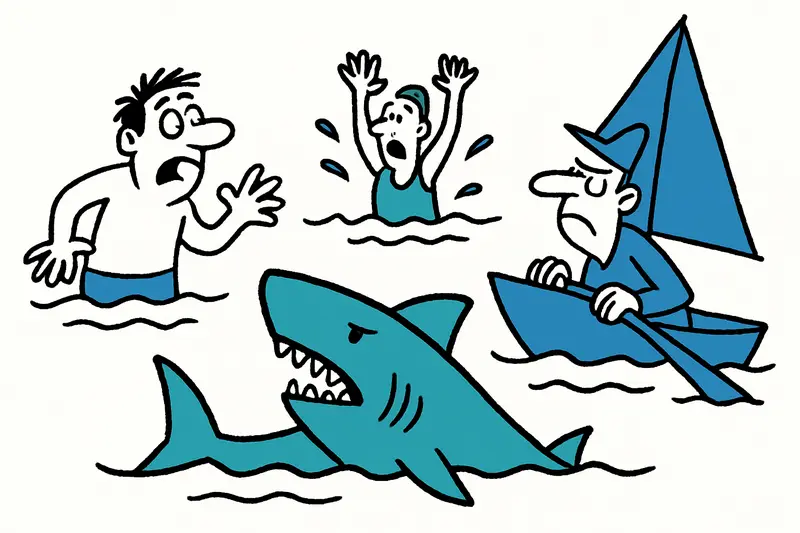
During a regatta in the Bay of Palma, a several-meter-long shark was filmed up close by an escort boat. Experts suspect a great white or mako shark. Why the encounter is no reason for panic, but does call for smarter procedures.
Large shark in the Bay of Palma: What does the sighting mean for sailors and beachgoers?
Recorded during a regatta: close to the surface, brief encounter, a lot of uncertainty
On Friday afternoon, in the middle of regatta activity in the Bay of Palma, a large predatory fish suddenly began circling near the surface and was filmed by an escort boat. The mood on the water changed quickly: from the routine rustle of sheets and clattering along the Paseo Marítimo to tense listening as engines were throttled down and people on deck stared silently at the spot in the water.
Key question: How dangerous is this sighting actually — and how should regatta organizers, sailors and beachgoers react in the future?
The footage shows a powerfully built animal with light coloring staying close to a group of surfers and sailing boats. According to observers there were no incidents; the animal disappeared after a short time. A shark expert who reviewed the recordings considered features consistent with either a great white shark or a mako shark. Such assessments are important, but they must be treated with caution: from a distance body proportions, snout length and fin shape cannot always be distinguished clearly.
Historically, sightings of large great white sharks in the western Mediterranean are rare but documented: in past decades there have been isolated captures and scientific encounters — most recently, an expedition in 2018 filmed an approximately five-meter specimen near Cabrera, and a 2023 report described an about two-meter juvenile whose DNA analysis was confirmed by a state oceanographic institute. The last documented catch around Mallorca apparently dates back to the 1970s. This shows that large predatory sharks do not appear here regularly, but they are not mere legend either.
Critical analysis: public debate often swings between fear and fascination. Two things are regularly missing: first, clear and reliable reporting channels for eyewitnesses to notify authorities and researchers immediately about a sighting; second, practical rules of conduct for events on the water. Without official confirmation through investigations any identification remains uncertain. At the same time, sensational reports can trigger unnecessary panic on beaches and in harbors, as in Dead Shark on the City Beach: What the Large Wound Reveals About Mallorca.
What is rarely mentioned in the discussion is the perspective of people on site. Imagine the everyday scene on a regatta-heavy weekend — the motor noise of escort boats, race officers calling on the radio, guests on the mole standing by cafés and looking out to sea. For most people a brief sighting of a large fish is exciting, but for the crew of a small dinghy it can be potentially dangerous if panic leads to loss of control. This is exactly where sober rules are needed instead of headlines.
Concrete solutions that can be implemented immediately: organizers should define a simple reporting line before the start of a regatta (for example a direct phone number to the Capitanía Marítima or a central regatta hotline) and briefly describe in the participant briefing how to react (keep the engine running, maintain distance, no feeding, take photos and note the GPS position). Escort boats could be equipped with handheld radios and GPS devices; drones offer an additional quick monitoring option without endangering people. On the authorities' side, clear protocols would be helpful: record the sighting, if necessary open an observation window for scientists, coordinate warning notices to bathing areas. Local incidents have underlined this need, for example Dead Shark at the Paseo: A Wake-up Call for Better Coastal Protection in Palma.
Additionally: promote reporting systems for marine sightings. Citizen-science apps and existing networks should be advertised more widely so that photos and videos can be collected centrally and evaluated by marine biologists; local reports, like Dead shark on Palma's city beach: a sign of a bigger problem?, could then be assessed quickly.
What must not happen here is reflexive scapegoating of wildlife. Large predatory fish fulfil an ecological function; their appearance can indicate changes in the food chain or migration movements. Instead of reflexive demonization the response should be factual: ensure people's safety, collect data, involve experts.
Conclusion: the encounter in the Bay of Palma is no call for panic, but it is a reminder of how little prepared recreational communities on the water still are in individual cases. A few practical measures — clear reporting channels, short rules of conduct in regatta materials, use of simple technology — would greatly ease the situation. And finally: a large shark off Palma is spectacular, but it must not rob us of the ability to act thoughtfully and informed.
Frequently asked questions
Are sharks in the Bay of Palma dangerous for swimmers and sailors?
What should sailors do if they spot a large shark near Mallorca?
Can you still swim at beaches near Palma after a shark sighting?
How rare are great white shark sightings around Mallorca?
What should regatta organizers in Mallorca do if a shark is spotted?
Should a shark sighting in Palma be reported to local authorities?
Why do large sharks sometimes appear near Mallorca?
Is it common to see large sharks off the coast of Mallorca?
Similar News
Palma, Palma de Mallorca, Palma‑Mallorca: What is it really about?
The debate over the city's name is more than grammar: it concerns identity, law and branding policy. A sober reality che...
Warning to Bathers: Nipping Fish in Cala Major and Other Coves — a Reality Check
In Cala Major and several beaches around Mallorca, bathers report painful “nips”. Who are the animals, why are they gett...

Rental Car Theft in El Arenal: What This Incident Reveals About Our Gaps
A teenager steals a running rental car in El Arenal, flees on foot, climbs over walls and is caught by the Guardia Civil...

Red Rope in Palma's Library: What Helps Against Selfie Tourism — and What's Missing
Palma's city library cordoned off an area with a red rope to keep selfie tourism away from reading and working activitie...

Fort San Carlos: Museum, Harbor Dispute — and a Conflict That Demands Answers
The military museum at Fort San Carlos sits right on Palma's harbor, with unexpectedly quiet rooms filled with cannons a...
More to explore
Discover more interesting content

Can Cap de Bou

Townhouse Lleo 72
