
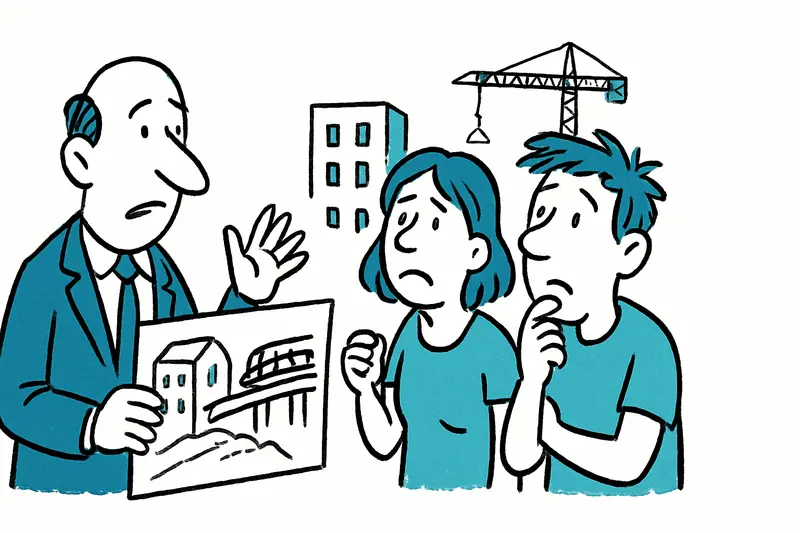
Son Gotleu: Redevelopment Plans Between Hope and Questions
Son Gotleu: Redevelopment Plans Between Hope and Questions
The city and regional government presented an extensive plan for Son Gotleu: new schools, renovated housing and a rail link to Llucmajor (construction 2028–2032). A reality check: what's missing from the announcements, and how will it affect people on the ground?
Son Gotleu is facing a major change – but for whom?
Yesterday Palma city hall and the Balearic government presented a package meant to profoundly transform Son Gotleu: a new school building, modernization of existing schools, renovated apartments, improved infrastructure – and a rail connection to Llucmajor with a stop in Son Gotleu. Work on the line is scheduled to start in 2028 and be completed in 2032. On paper it reads like a fresh start. On the plaza in front of a small bakery in Son Gotleu, however, you first hear the children's shouting, the bus rumbling around the corner, and neighbors talking about rent. The key question is therefore: will the neighborhood's residents be the beneficiaries of the plans—or will they be the collateral damage?
Critical analysis: what the announcement leaves open
The list of planned measures is concrete, but it remains vague on central points. There is no published breakdown of funding, concrete schedules for individual projects, or binding guarantees for permanently affordable housing. Likewise, on the question of how to house people during renovations and the rail construction, the announcement contains only declarations of intent so far. Such gaps are not trivial: when apartments are modernized or buildings demolished, clear rules against forced displacement and clear compensation mechanisms are needed.
What is missing from the public discourse
In discussions about infrastructure and new school buildings, two topics often fall into the background: the social support for restructuring and the fine-tuning of traffic planning. Who will be allowed to rent the apartments after renovation? What rents will apply? How will small shops and local service providers that make up the neighborhood today be protected (see Major operation in Son Gotleu: 60 police officers, many questions)? And: how does the new rail line fit into the city's transport plan — will transfers with buses, bike paths and pedestrian routes be made accessible? Public debates have so far left too little room for these everyday questions.
Everyday scene from Son Gotleu
Walking down the street you meet the greengrocer, the teenager with headphones, the older woman feeding pigeons. In the evening families sit on the steps, children play with a ball (incidents such as Fall in Son Gotleu: A dramatic morning and the question of roof safety underline the importance of safe, accessible public space). These are not slogans but the details by which the success or failure of a project should be measured. When traffic axes are relocated or construction sites block access to squares for years, this very life shifts—often into a less favorable reality.
Concrete approaches to solutions
Turning the announced improvements into real quality of life requires more than lip service. Concrete proposals that would help locally include: binding quotas for socially bound housing in all renovations; a temporary renovation tenant protection program guaranteeing replacement housing at socially acceptable conditions; accompanying employment programs giving priority to residents for renovation and construction jobs; a transparent finance and schedule register that is publicly accessible; and the establishment of a permanently staffed citizens' platform of neighbors, schools, associations and transport experts that accompanies each construction phase.
Brief look at the rail plans
The planned line to Llucmajor with a stop in Son Gotleu is potentially a gain: better connection to the periphery, shorter commuting times, less car traffic. But the benefits depend on details: service frequency, accessibility of stations, safe walking and cycling routes to stations and a fare model that suits middle and low incomes (and broader road-safety issues highlighted by Crash in Son Gotleu: Five Injured — How Safe Are Palma's Intersections?). Without these pieces the rail remains above all a symbolic project.
Conclusion: seize opportunities, prevent risks
The announcement is an opportunity for Son Gotleu. But opportunities are not realized in the neighborhood by plans on paper, but by concrete rules and support. If financing, tenants' rights, employment commitments and citizen participation are not regulated as binding, upgrading threatens to become displacement. It is now the task of politics to follow the noise of announcements with action — and to make the barrio not only more beautiful but above all fairer.
Frequently asked questions
What is the weather usually like in Mallorca in May?
Can you swim in Mallorca in May?
Is May a good time to visit Mallorca?
What should I pack for Mallorca in May?
Is Palma de Mallorca worth visiting in May?
What is the sea temperature like in Mallorca in May?
What can you do in Mallorca in May besides going to the beach?
Is Port de Sóller a good place to visit in Mallorca in May?
Similar News

More water than last year: Mallorca's reservoirs breathe easier
September rain refilled the Tramuntana's reserves: overall fill around 35 percent, Cúber at 40.42 percent, Gorg Blau at ...
Three Luxury Hotels in Banyalbufar: Lots of Money, Many Questions
A Danish investor plans three exclusive accommodations in Banyalbufar — including the historic Son Valentí. The announce...
2.1 tonnes of cocaine on sailing yacht off Spain's coast – a reality check for the coastguard
A 14-metre yacht was seized with 2.1 tonnes of cocaine. Who monitors the ports, how does the international hunt succeed ...

Heat Bonus in Mallorca: 100 Euros Extra for Outdoor Staff at MarSenses
MarSenses pays employees who worked outdoors in August an extra €100 as recognition. Lighter uniforms, reduced hours for...
Renovating in Mallorca: What You Really Can Do Without Neighbour Consent
Many think they can do whatever they want in their apartment. That's partly true — but only as long as structural elemen...
More to explore
Discover more interesting content

Can Cap de Bou

Townhouse Lleo 72
