
Son Real: Does the necropolis really have to move to escape the sea?
Son Real: Does the necropolis really have to move to escape the sea?
The coastal necropolis of Son Real near Can Picafort is under pressure: archaeologist Jordi Hernández proposes rebuilding the graves a hundred metres inland. What argues for it — and what is missing from the debate?
Son Real: Does the necropolis really have to move to escape the sea?
Key question: Is dismantling and rebuilding the Son Real necropolis a hundred metres inland the right response to rising sea levels — or would that sacrifice the place itself to save its stones?
Why the discussion is being held at all
The site near Can Picafort comprises 109 graves, dated to the 7th to 1st centuries BCE. Archaeologist Jordi Hernández has put forward a radical proposal: because the necropolis sits directly on the coast and has already suffered damage, the entire site should be dismantled and rebuilt on higher ground in the municipal land of Son Real. According to him, waves and coastal erosion have affected around 30 percent of the structures; earlier campaigns from 1957 to 1969 led by Miquel Tarradell already resulted in at least one grave being recovered and taken to the Museu de Mallorca, and the vulnerability of coastal heritage has been highlighted elsewhere, as in Alarm in Son Bauló: When an escar loses its roof.
Critical analysis of the relocation proposal
The idea is technically possible — restorers and conservators know this. But it raises a number of professional and ethical questions. First: loss of context. A monument is not just a pile of stones but an ensemble of location, landscape and relationship to the sea. Moving it would irrevocably change the original constellation. Second: documentation. A haphazard dismantling could destroy information about construction techniques, stratigraphy and grave goods. Third: costs and liability. Who pays for the complex excavation, storage, reconstruction and long-term maintenance? Fourth: precedents. There are examples of successful relocations — but also failed attempts where authenticity and local meaning were lost, and the planned piecemeal recovery of a wreck off Playa de Palma, discussed in Roman Wreck off Can Pastilla: Piecemeal Recovery Raises Questions for the Island, raises similar questions about conservation versus context.
What is missing in the public debate
Public debate often reduces the issue to a simple slogan: save it or not. What is missing are concrete figures, responsibilities and timelines. There is no reviewed report on coastal stability, reliable long-term sea-level measurements for Son Real, or a cost–benefit analysis that weighs conservation values against tourism, research and the public interest. Alternatives are hardly discussed publicly either: temporary coastal protection measures, controlled reburial, extensive digital recording, or a staged approach beginning with a pilot project.
An everyday scene from Son Real
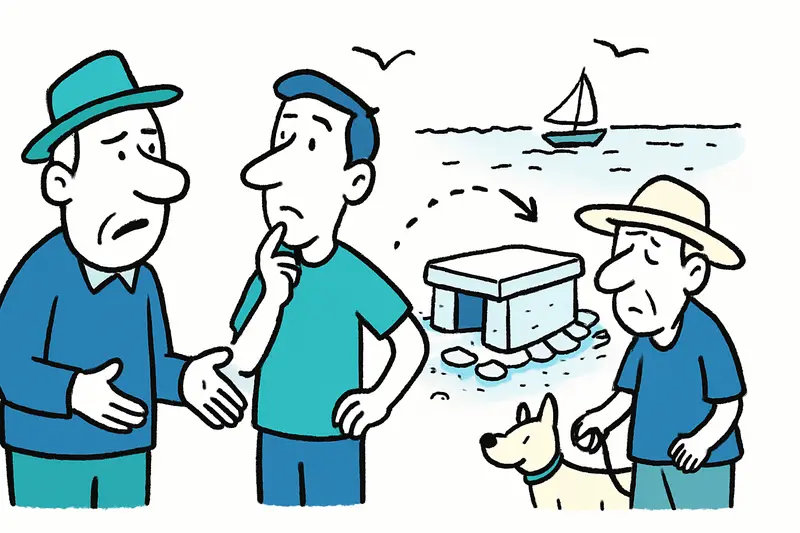
On a hot morning, walking the sandy path along the Camí de Son Real, you hear the cries of seagulls, the chirr of cicadas and occasionally the rustle of pebbles hitting the edges of the graves. Dog walkers, retirees with straw hats and a few fishermen inspecting their boats on the shore form the small local audience. This scene shows that this is not only about science, but about a place in the island's everyday life, a reality intertwined with local pressures over coastal use as described in Between Concrete and Surf: Squatters at Espigol Beach — Where Should the People Go?.
Concrete solutions — practical, phased, transparent
1) Immediate measure: complete digital recording. High-resolution 3D scans and photogrammetry of all graves as well as geophysical subsurface surveys preserve information even if the physical structures are lost. 2) Monitoring: installation of tide gauges, LiDAR overflights and periodic surveys so that rates of change are reliably known. 3) Pilot project: carefully dismantle a few selected, already heavily endangered graves, label them and rebuild them at a test site, accompanied by archaeologists, conservators and the Museu de Mallorca. 4) Coastal protection where sensible: a combination of natural dune protection, sand nourishment and temporary barriers, as long as these measures are scientifically justifiable. 5) Legal and financial clarification: the Consell de Mallorca, the Ajuntament de Santa Margalida and the Govern should develop joint criteria and a financing plan; possible EU funding for cultural heritage should be explored. 6) Public outreach: information events on site, transparent records, and involvement of local residents.
Why a hasty "dismantle and move" is risky
Excavating a site may save physical objects, but the site's narrative remains vulnerable. The rows of graves, sightlines to the coast and soil layers — all these form the evidential value for research and education. Relocation should only be a last resort, and even then based on tests and a clear protocol for documentation and reconstruction.
Conclusion: The idea of moving Son Real inland is not an absurd impulsive notion — it has practical reasons in view of erosion and sea-level rise. But it requires an open, scientifically supervised debate, fair allocation of costs and a staged plan with digital documentation, pilot projects and citizen participation. If we save the graves, we must not forget what we might be sacrificing: the place itself and its stories. Before the excavator moves in, measurements, tests and clear rules must be in place.
Frequently asked questions
What is the best time of year to visit Mallorca for warm weather and plenty of sun?
What should I pack for a trip to Mallorca in spring or autumn?
Is the sea in Mallorca suitable for swimming year-round?
What activities are popular for families in Mallorca?
What can I do in Palma, Mallorca's capital?
Is Cap de Formentor worth a visit for views in Mallorca?
Which Mallorca beaches are best for families with calm waters?
When is Mallorca busiest and how can I avoid crowds?
Similar News
Failed before the first flight: How Fischer Air's plans for Palma were ground down
Announced routes, repeated postponements and now apparent insolvency: Why the Fischer Air project for Mallorca is not me...
Seconds in the Water: 19-year-old Fights Her Way Out of Flooded Car in Palma
A 19-year-old managed to rescue herself from her half-submerged car after sliding under the Verge de Lluc underpass. Res...

Between Dream and Reality: Thorsten Legat and the Challenges of FC Germania Mallorca
The former Bundesliga pro has assembled a colorful squad in a short time. But how realistic is the grand plan for promot...

Arrest warrant at check-in: Why two travelers at Cologne/Bonn Airport suddenly had to pay
At Cologne/Bonn Airport, federal police in mid-September found two German passengers subject to enforcement measures. Bo...
Balearic Islands as a New Route: A Reality Check on Rising Boat Migration
For the first time the Balearic Islands are ahead of the Canary Islands in boat arrivals. What do the numbers really say...
More to explore
Discover more interesting content

Can Cap de Bou

Townhouse Lleo 72
