
Storm on the Radar: Why Palma's Airport and We Are Not Fully Prepared
Storm on the Radar: Why Palma's Airport and We Are Not Fully Prepared
Orange warnings, strong gusts and initial flight cancellations: anyone flying to or from Palma today should expect delays. Our reality check — what's missing, what helps.
Storm on the Radar: Why Palma's Airport and We Are Not Fully Prepared
A reality check after the first morning chaos
Key question: Are the current procedures of the airport, authorities and airlines sufficient to prevent travelers from ending up in an information and organization vacuum during such severe weather?
The Wednesday morning began on the island with an atmosphere rarely seen in late summer: dense clouds, occasional rumbling and already arriving reports of significant flight delays at Palma airport. Aemet orange warning for the Balearic Islands: locally up to 40 liters of rain per square meter in an hour and, during thunderstorms, gusts over 90 km/h. The warning period runs during the day, roughly between 10 a.m. and 9 p.m. Additionally, a yellow warning is in place along the coasts because of high seas and strong gusts of wind up to about 70 km/h.
The result on the tarmac and in the departure halls: first cancellations and delays, especially on routes to the Spanish mainland, but also on flights to and from Germany (Severe weather disrupts Palma Airport — what this means for travelers). Some airlines already responded on Tuesday with rebooking offers — a small attempt to avoid queues at the counters. For many travelers, however, the question remains open: When will I reliably find out whether my flight will operate?
What is missing in the public discourse: the perspective of ground crews and passengers on site. It's good that warning levels are announced, but that does not explain how long check-in desks will remain open, how many flights can be processed on a heavy rain or wind day, or which procedures apply when runways and taxiways are wet. Details on compensation, transfers to the city or the provisioning of waiting passengers are often hard to find.
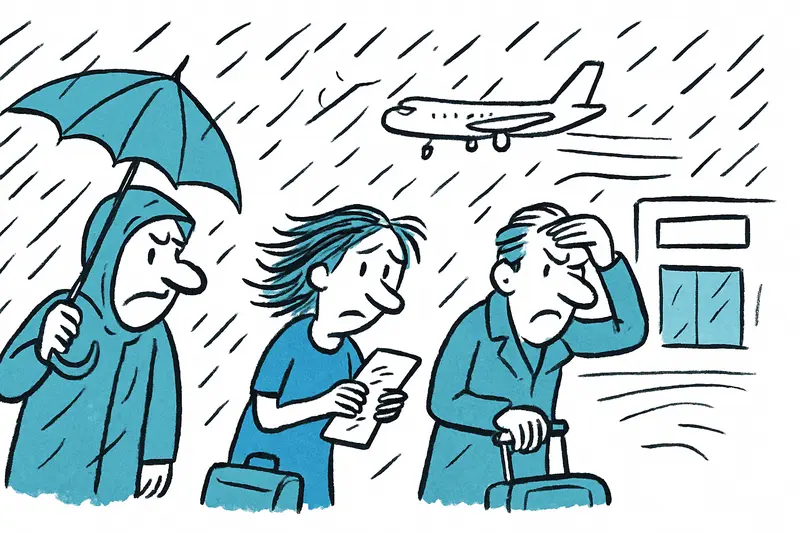
Everyday scene from Palma: On the forecourt you can see taxi drivers in raincoats, the smell of coffee from the machines, the clack of wheeled suitcases on wet paving stones and the tired faces of holidaymakers holding damp boarding passes in front of the automatic doors. In the terminal you hear an announcement that oscillates between reassurance and sparse information; outside the wind whistles obliquely through the rows of parked cars. These everyday images explain better than figures how much infrastructure and people can be pushed to their limits (Storm Chaos in Palma: Why a Storm Slows the Airport So Much — and What Needs to Change).
Critical analysis: There are three pain points that repeatedly show up in such weather conditions. First: information. Airports, airlines and authorities do work with warnings, but not in sync: passengers receive different information depending on which channels they use. Second: physical resilience. Drainage systems, parking stands, loading zones and safety plans for ground staff are not everywhere designed for extreme rainfall and gusts. Third: empathetic logistics. In case of delays, there is often a lack of simple solutions: weatherproof waiting areas, clear contact persons, uncomplicated alternative transport offers.
Concrete solutions: Airports and airport operators should agree on binding information 'rules of play' with airlines (e.g. uniform status messages within 30 minutes). Displays in terminals and a central hotline specifically activated for weather disruptions would help. Technically, targeted investments in better drainage on taxiways, wind-protected shuttle ramps and weatherproof marshaller zones could make operations more stable. And: emergency plans must be regularly drilled with ground staff and taxi associations so that alternative transfer chains take effect faster (Storms in Palma: Why Takeoffs and Landings Are Stalling — and What Helps Now).
For passengers the practical advice is immediate: check the airline's email/push notifications before leaving, contact your tour operator/insurer and build in enough time. Anyone with tight connections should arrange alternatives early — and ask the airline for written confirmation.
Pointed conclusion: You cannot train the weather. But you can improve communication, infrastructure and procedures. The morning in Palma showed: we are not powerless — but we are too often poorly networked. If the airport, authorities and airlines learn the lessons from days like this, future storms can be less likely to become a communication and travel chaos. Until then, only this helps us: get informed early, stay calm and carry a Plan B in your luggage.
Frequently asked questions
When is the best time to visit Mallorca for pleasant beach weather and fewer crowds?
What should I pack for a Mallorca trip in spring or summer?
Are there Mallorca beaches that are suitable for families with calm water?
How can I get around Mallorca without renting a car?
What natural sights should I add to my Mallorca itinerary?
What language and etiquette should I know when visiting Mallorca?
Is Mallorca safe for travelers and what should I watch out for?
How can I experience authentic Mallorca away from the tourist crowds?
Similar News
Defendant Allegedly Deceived Court with Fake Payment Receipts – Reality Check from Palma
A German real estate entrepreneur must answer in Palma: he is accused of presenting forged payment receipts to erase an ...

'We can't sell a beer for two euros' – Why rents are crushing gastronomy in Mallorca
High concession fees, speculative landlords and tourist hotspots: restaurateurs in Mallorca complain about a development...
First flight cancelled, then told to pay for the hotel yourself? The case of a British family at Palma airport
A British family was stranded at Palma airport at the end of August: cancelled return flight, instructed to find their o...

Brabus Bodo Convertible in Palma: 1,000 HP, Yacht Stage and a Touch of Luxury on the Pier
The new Brabus Bodo Convertible was unveiled in the port of Palma: 1,000 hp, open-top driving pleasure and a spectacular...
Cala d'Or: Helping becomes life-threatening – Why a street altercation escalated
A man intervenes to assist a harassed woman — and suffers a skull fracture after an associate struck him with a glass bo...
More to explore
Discover more interesting content

Boat Tour with BBQ along Es Trenc Beach

Private transfer from Mallorca Airport (PMI) to Pollensa
