
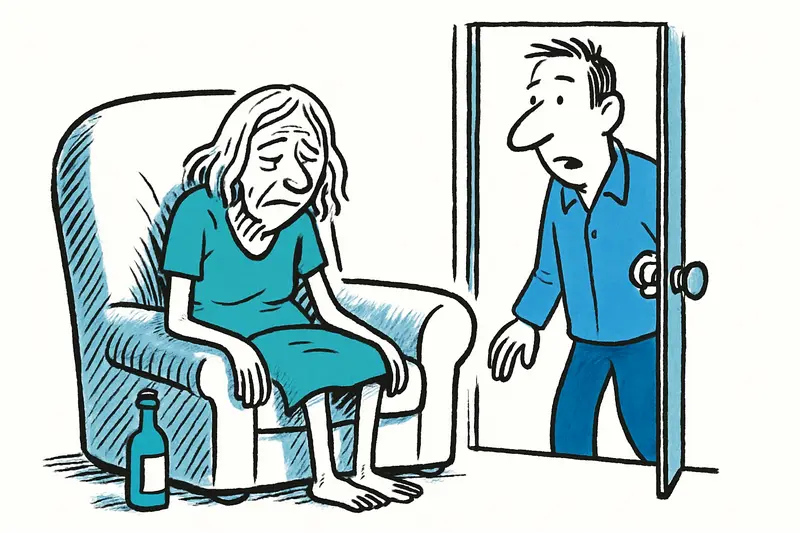
Dying at Home — a Free Choice or Societal Failure?
Dying at Home — a Free Choice or Societal Failure?
In Cala Llombards a 73-year-old woman died after months of refusing food. The facts raise questions about medical care, legal assessment and social support for older foreign residents on Mallorca.
Dying at Home — a Free Choice or Societal Failure?
Key question: Did relatives, doctors and authorities do enough to prevent or properly accompany the death of a 73-year-old in Cala Llombards?
At the end of December rescue workers found a woman in a small flat on Calle sa Platja, severely emaciated, weighing about 30 kilograms. According to emergency personnel she had taken almost no solid food for months and drank only small amounts of wine. A family doctor had examined the patient a few days earlier and, given her poor condition, recommended admission to hospital. The woman refused and signed a declaration. Her husband alerted the ambulance service and the Guardia Civil when she began to have severe breathing difficulties. A medical examiner pronounced the death. The circumstances are the subject of an ongoing investigation and mirror other reports such as Fatal Discovery in Son Macià: A Case Raising Questions about Protecting Older People.
These sober facts meet a place that radiates calm on the surface: Cala Llombards, pine trees on the slope, the quiet sound of the sea, narrow streets, houses without much tourist traffic. It was exactly there, where many residents from Germany and Switzerland spend extended periods, that this woman's life ended alone in her own home.
The case analysis requires more than pity: first, there is the question of the duty to check by medical professionals when patients make life-threatening decisions. A recommendation to be admitted to hospital was apparently given. But how systematically was her decision-making capacity assessed? Was there a psychiatric evaluation, interpreter assistance or a discussion about palliative options on site? Documents proving advance directives or powers of attorney are not apparent from the publicly available facts.
Second, the public discourse lacks the perspective of the role of the environment: neighbors, general practitioners, social services, the Santanyí municipality and consular offices. A husband can be a relative, carer or overwhelmed. Was the municipality informed? Were social services or home visits by palliative care teams arranged? In many cases regular checks prevent gradual starvation; here there appears to have been a gap. Questions about local help and intervention have been raised elsewhere, for example Playa de Palma: Death at Balneario 2 – How good is Mallorca's help for people in need?.
Third, the question of language and cultural barriers arises. Among older residents from abroad, language problems play a role in understanding medical recommendations or legal forms. If a patient communicates in English with her partner, that is often not sufficient for complex decisions about refusing life-sustaining measures. Similar demographic challenges have appeared in reporting on other island incidents, such as Mourning in Port de Sóller: 87-year-old dies while swimming.
What is missing so far in reporting is a clear naming of action options that could catch such situations earlier. Concrete proposals from everyday life on an island like Mallorca:
1. Better networking of general practitioners with mobile palliative teams: A standardized reporting point for GPs to report patients refusing food would enable rapid support. Mobile teams could provide home care, hydration and psychological assessment.
2. Clear procedures for capacity assessment: When patients express refusal of life-sustaining measures, a mandatory accompanied assessment by a second physician or psychiatrist should take place — including interpreters.
3. Social-service case conferences: In municipalities like Santanyí a low-threshold mechanism could be established: reports by neighbors, doctors or police, followed by a rapid case conference with social work, medical staff and, if necessary, consular contact.
4. Information and advisory offers for older residents: Brochures, hotlines and information evenings on advance directives, powers of attorney and local palliative services in German and English, distributed in pharmacies, town halls and community centers.
5. Training for emergency personnel and the Guardia Civil: Sensitive assessment of domestic cases where autonomy on the one hand and obvious life endangerment on the other hand collide. Protocols for immediate involvement of medical assessors should be available, as debated in coverage of other local emergencies like Port de Sóller: Family meal ends in death — what is missing on our beaches?.
An everyday scene in Cala Llombards makes the urgency clear: the neighbor walking his dog on Calle sa Platja notices changes — a roller shutter stays down longer, the smell of an unheated flat changes. Such small signs are often the first alarm, but without binding contact points they fizzle out.
The right to self-determination is a high value. Someone who, while of sound mind, decides not to go to hospital should be respected. Nevertheless, the state is obliged to examine the condition of people with potentially impaired decision-making capacity. On an island with many older foreigners this tension requires clear rules and local structures.
Conclusion: The death of the 73-year-old in Cala Llombards is tragic and calls for more than sympathy. It must be a reason to review and improve local processes: better networking, mandatory capacity assessments, low-threshold palliative offers and improved information services for residents. Otherwise it will remain well-intentioned advice while people die alone at home.
Frequently asked questions
What should families in Mallorca do if an older relative refuses hospital treatment but is clearly very frail?
How can doctors in Mallorca assess whether a patient is still able to make a life-changing medical decision?
What support is available in Mallorca for people who are too frail to care for themselves at home?
Why can language barriers matter so much for older foreign residents in Mallorca?
What should neighbors in Cala Llombards do if they suspect someone is living in dangerous conditions?
Are there palliative care options for people who want to stay at home in Mallorca?
What legal documents should older residents in Mallorca have in place for medical emergencies?
Why are cases of older people dying alone at home such a concern in Mallorca?
Similar News
Eviction in El Arenal: Who protects neighbors — and who protects the homeless?
A vacant hotel on Carrer Girona was cleared and secured. The neighborhood breathes a sigh of relief. But the action trea...
'La Tapita' loses its home: Who will protect Palma's last affordable meeting places?
The bar 'La Tapita' on Simó-Ballester Street will close at the end of December. For neighbors, police officers and small...

Million Heist at Bulgari: Who Is Responsible for Palma's Security Gaps?
Three men stole jewelry worth around one million euros – the crime series began at the end of September and was likely c...

Who pays the bill? Tourists, prices and the reality in Mallorca
Rising costs are felt by travelers and locals alike. A walking observation through Palma's old town shows how tourists e...
Phone robbery at Playa de Palma: Two juveniles arrested — a reality check
On Monday morning three young women were attacked at Playa de Palma; two youths snatched a phone from one of them. The N...
More to explore
Discover more interesting content

Can Cap de Bou

Townhouse Lleo 72
