
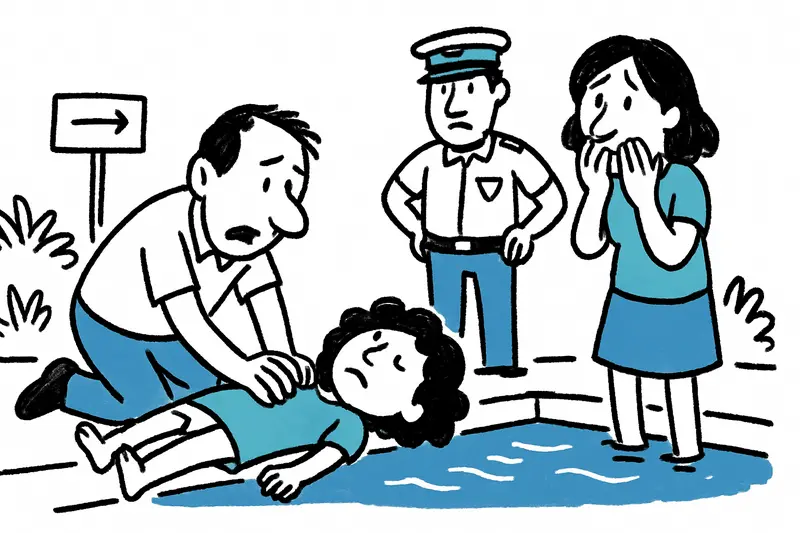
Three-year-old girl dies after pool incident at Llenaire — How safe are holiday villas really?
Three-year-old girl dies after pool incident at Llenaire — How safe are holiday villas really?
A three-year-old British child was found lifeless in the pool of a villa near Port de Pollença and later died at Hospital de Son Espases. The Guardia Civil is investigating. A look at the safety gaps and what is missing in holiday accommodation safety.
Three-year-old girl dies after pool incident at Llenaire — How safe are holiday villas really?
Late one afternoon during a sultry week in June, a family from the United Kingdom had their holiday shattered: their three-year-old child was found in the private pool area of a villa in the Llenaire area near Port de Pollença. The parents reacted immediately and began resuscitation. Emergency services of 061 and Guardia Civil officers continued treatment and took the girl to Hospital de Son Espases. She died the following evening.
Key question
How can it happen that such a small child in a supervised holiday accommodation ends up in a situation from which it cannot be rescued?
Critical analysis
The facts are sparse but clear: the child was found floating in the water; the parents discovered her unconscious and face down in the pool. There was a quick on-site resuscitation and then transport to the hospital. The Guardia Civil has taken over the investigation. What appears to be missing is a transparent breakdown of the circumstances before the accident: What was the supervision situation immediately before the incident? Which technical protective measures (fence, alarm system, cover) were in place? Was the villa booked through a landlord, an agency or privately — and what information did the parents receive about pool safety?
What often gets overlooked in public debate
People quickly talk about blame and fate, but rarely about everyday matters that decide things on Mallorca: the contractual culture of holiday rentals, the responsibility of intermediaries to provide safety information and owners' routines for childproofing their pools. First aid is also rarely discussed: how many holiday guests know the basic sequence of CPR? How many hosts provide a rescue kit or an accessible emergency phone plan? Many conversations and public debate miss all of this. Local reporting has documented similar cases, for example Careless Moment in Llucmajor: Family Rescues Two-Year-Old from Pool.
A typical local scene
Imagine the road: narrow country lanes, oleander bushes, a small wooden sign at a driveway. The heat is heavy; in the distance you can hear motorboats and the bell of the chapel of Port de Pollença. The villa, like so many here, has a sun terrace, palms and an inviting blue pool — perfect for a family photo, but not automatically safe. On neighboring properties towels often hang over fences in summer and children run barefoot along the paths. This familiar picture is deceptive when a moment of inattention is enough.
Concrete, immediately implementable proposals
- Mandatory listing information: every holiday rental ad should clearly state whether a pool is present and which protective measures (fence, cover, alarm) are installed.
- Minimum standards for private landlords: secure enclosure at least 1.2 m high, lockable gate, child-proof covers or pool alarms should be recommended or required.
- Duty to inform: landlords and agencies must provide written information on risks and first-aid measures at key handover, as well as an emergency plan (emergency numbers, nearest hospital, concrete steps in case of drowning incidents).
- First aid courses for tourism staff and hosts: CPR courses should be heavily subsidized so more people in Mallorca learn the basics.
- Visible rescue equipment: holiday properties should have at least one lifebuoy, a rescue pole and a clearly visible emergency telephone number.
- Municipal inspections: municipalities could carry out spot safety checks of holiday properties and issue recommendations.
Why this matters now
We often talk about beach rescue and crowded coves — and forget private pools hidden behind hedges. Recent reports of deaths at Cala Blava: A Day at the Beach Ends in Death and Can Picafort: Death on the Beach underline the wider problem. Holiday accommodations are normal for many families. If standards and information duties are missing there is an incalculable risk. The quick work of parents, neighbors and rescuers can save lives — but it does not replace preventive measures.
Conclusion: The death of a child is a tragedy that calls for concrete action: better information duties for holiday rentals, technical protective measures and wider dissemination of first aid knowledge. Showing sympathy is not enough; we must change the routines that make such accidents possible. The Guardia Civil will clarify exactly what happened. For neighbors, hosts and holidaymakers the urgent question remains: are we doing enough to prevent a repeat?
Frequently asked questions
What safety features should a Mallorca holiday villa have to protect children near the pool?
How can I check a Mallorca villa's pool safety before booking?
What information should landlords share with guests about pool safety in Mallorca?
Which safety standards are recommended for private pool enclosures in Mallorca?
How is Mallorca addressing pool safety in holiday rentals through authorities?
What role do agencies play in improving pool safety for Mallorca holidaymakers?
What rescue equipment should you expect at a Mallorca holiday home with a pool?
Why is preventive pool safety important for Mallorca families during holidays?
Similar News

Micaela Schäfer: Between Playa de Palma and a Berlin Law Firm — New Calm, an Old Tomcat and Solid Finances
The party artist from the Ballermann scene appears surprisingly down-to-earth: a new relationship with a Berlin lawyer, ...
At Playa de Palma: Fire in Residential Building – six people rescued on the roof, what is missing in prevention?
In the evening a fire broke out on the first floor of a five‑storey building on Calle Trasimé. Six residents fled to the...
New License Requirement for Mini-Boats in Mallorca: Protection Measure or Tourism Brake?
From October 1 renters of small recreational boats in the Balearics must present a boating license. Critical questions r...
After the Storm: Mallorca Breathes Easy — Warm Weekend with Short Showers
The thunderstorm left its mark, but calm returns for the weekend: sun, summer temperatures around 32 °C, isolated shower...
No More 'Just Hop on a Boat': Mallorca, Mandatory Boating License and the Open Questions
From October 1, the Balearic Islands will require a boating license for small rental boats under five meters/15 hp. A tr...
More to explore
Discover more interesting content

Boat Tour with BBQ along Es Trenc Beach

Private transfer from Mallorca Airport (PMI) to Pollensa
