
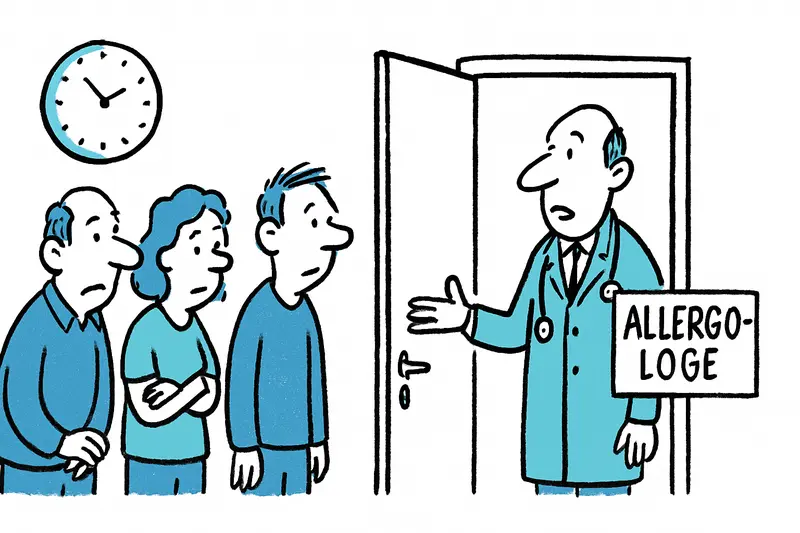
Too Few Allergists on the Balearic Islands: Who's in the Queue?
Too Few Allergists on the Balearic Islands: Who's in the Queue?
According to the professional association, the Balearic Islands have far too few allergists in the public healthcare system. Three specialists are not enough, waiting times remain long — and what is lacking is a feasible plan.
Too Few Allergists on the Balearic Islands: Who's in the Queue?
Key question: How can allergy care in the Balearic Islands be improved quickly and sustainably?
In the foyer of Son Espases a woman sits with a bag of tissues, next to her a boy who repeatedly blinks with reddened eyes. The scene has been visible for months at various appointments: crowded waiting rooms, exhausted patients, and only very few specialists capable of treating the cases.
According to the national professional association for allergology, around two years ago there was only one specialist physician in the public system across the entire archipelago. Currently, the association reports that three allergists are active; a fourth position has been advertised. By contrast, the professionally justified demand is: the region would need roughly 24 allergists for adequate care. At the end of 2024 a public allergology service was established at Son Espases, but this apparently is not enough to close the gaps.
Critical analysis: The numbers tell a simple story. Three specialists for several hundred thousand residents and visitors are mathematically untenable. Patients already report extended waits of several months for first appointments, as highlighted in waiting lists in the Balearic Islands. For people with severe asthma, food or insect venom allergies such delays are more than a nuisance: they mean unsafe everyday situations, repeated emergency contacts and increased burden for general practitioners and emergency departments.
What is missing in public discourse: clear assignment of responsibility and a time horizon. It is said that a position has been advertised, Son Espases has set up a service, and the professional association calls for expansion. Concrete target figures, deadlines and funding solutions are rarely mentioned. Nor is there much debate on how to bridge acute shortages in the short term without waiting years for the training of new specialists.
Everyday observation: On a Tuesday morning on Avenida Mateo Alemany in Palma you hear more snippets of conversation about long waiting times than about city life. Pharmacists report patients who repeatedly rely on allergy emergency kits because specialist appointments come too late, a situation compounded by problems with appointment scheduling on the Balearic Islands. Parents exchange recommendations: private examinations, teleconsultations with mainland doctors or the often demoralizing hope that a short-notice appointment will become available.
Concrete solutions, immediately implementable: First, temporarily increase consultations via telemedicine with allergists on the Spanish mainland to enable initial assessments and emergency checks. Second, create financial incentives and fixed-term contract models for allergists working on the islands — for example relocation assistance, allowances or part-time models that appeal to families. Third, target training posts in regional hospitals to allergology: teaching cooperations with universities could raise numbers after a few years. Fourth, mobile specialist clinics and rotating assignments between Mallorca, Menorca, Ibiza and Formentera so that smaller communities are not completely cut off from care. Fifth, clear transparency: IB-Salut should publish target figures and a timetable so patients know what to expect, a transparency also discussed in Balearic clinics prepare — is that enough for the flu wave?.
Another component: promote close exchange between general practitioners and allergists, for example through joint case conferences and standardized rapid tests in primary care facilities so urgency is correctly assessed and emergencies are prioritized.
Conclusion: This is not a cosmetic problem but a care issue with tangible everyday consequences. The current staffing numbers are simply insufficient. Anyone living in the Balearic Islands or needing medical care there needs more than declarations of intent. A publicly visible plan with deadlines, resources and short-term bridging measures is required. Son Espases has taken a first step — but for now too many people remain in the queue, hoping more names will soon be added to the list.
Frequently asked questions
What is the weather like in Mallorca at the end of May?
Is the sea warm enough to swim in Mallorca in late May?
What should I pack for a trip to Mallorca in late May?
Is late May a good time to visit Mallorca for outdoor activities?
What is the weather usually like in Palma de Mallorca in late May?
Is Cala Pi a good beach to visit in Mallorca in late May?
Is late May a good time to visit Alcúdia in Mallorca?
How busy is Mallorca in late May compared with summer?
Similar News
Smoke over the UIB: Who is responsible for the fire on the roof?
On Saturday afternoon a fire broke out on the roof of the Arxiduc Lluís Salvador building at the University of the Balea...

Short Getaway with Sea View: Inmood Aucanada among Spain's Top Hotels for Dinner Breaks
A small hotel on the coast of Alcúdia was highlighted by a Spanish experience platform as particularly suitable for shor...
Cala Pi crowned Mallorca's most beautiful beach: A morning at the rocky cove
The travel portal Holidaycheck praises Cala Pi as Mallorca's most beautiful beach: a narrow, romantic cove, clear water,...
Injured captain, big plans: Germania Mallorca before the away match in Consell
The newly founded FC Germania Mallorca travels to Consell on Saturday. Captain Bastian Müller is out injured, but coach ...
Palma, Palma de Mallorca, Palma‑Mallorca: What is it really about?
The debate over the city's name is more than grammar: it concerns identity, law and branding policy. A sober reality che...
More to explore
Discover more interesting content

Can Cap de Bou

Townhouse Lleo 72
