
Traffic Light Update for Pedestrians: Mallorca Brings Clarity to Intersections
Traffic Light Update for Pedestrians: Mallorca Brings Clarity to Intersections
From 1 October 2026, flashing yellow for vehicles may no longer light at the same time as pedestrian green. What this means for drivers, pedestrians and municipalities in Mallorca.
Traffic Light Update for Pedestrians: Mallorca Brings Clarity to Intersections
From October 2026 certain pedestrian crossings will no longer show simultaneous signals — a step that especially protects vulnerable road users.
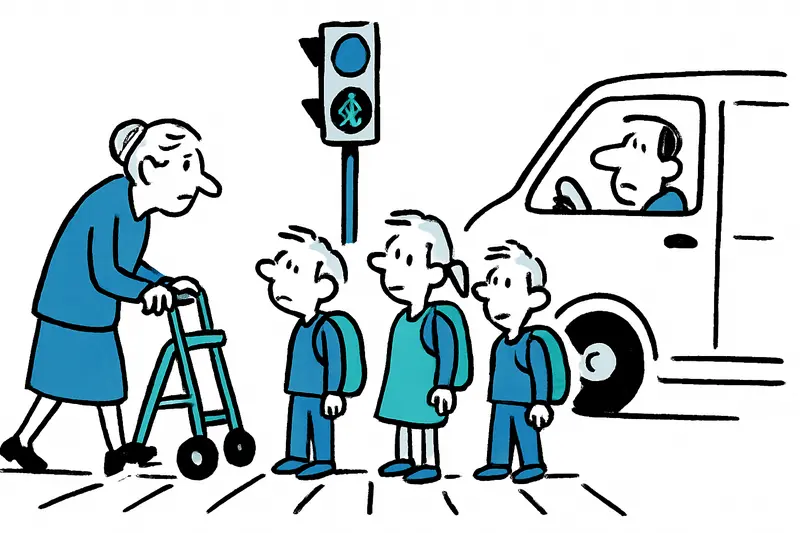
On Passeig Mallorca early in the morning: delivery vans rumble past, a pensioner with a walker feels her way to the traffic light, next to her three children with schoolbags. The scene is familiar. What will change from 1 October 2026 concerns exactly that moment of uncertainty — when different traffic light signals are interpreted differently by drivers and pedestrians.
The General Directorate for Traffic (DGT) has decided on an amendment to the traffic regulations, which will be implemented in Mallorca: when pedestrians have a green signal, there must no longer be a simultaneously flashing yellow for drivers. Previously, there were places where drivers interpreted a flashing yellow as "caution, but continue", while pedestrians were already crossing the street. This temporal overlap should no longer occur.
Important to note: a steady yellow for vehicles does not mean "speed up", but generally to stop at the stop line, unless safe braking is not possible because of being too close to the traffic light. This rule already existed — now the coordination of vehicle and pedestrian phases will be changed so that conflicting signals occur less often.
For Mallorca this means specifically: municipalities have until October to adapt their traffic light systems. In Palma or at busy crossings along Playa de Palma and in Port d'Andratx, technicians will review the timing plans; in other places traffic signal controls may need to be modernized, see New Traffic Signs in Mallorca: Smaller Design, Clearer Signals. The implementation period is intended to prevent rushed work on site while allowing time for sensible planning.
Why is this good news? On the roads you often see how small misunderstandings can have big consequences: a hasty lane change, a child turning around, an older person misjudging the timing. If the signals are clearer, the risk of someone reacting incorrectly decreases. Children, people with mobility impairments and older pedestrians will particularly benefit — precisely those who cannot quickly manoeuvre out of a dangerous situation.
Practical steps that should follow now: clear markings at pedestrian crossings, additional countdown displays for pedestrians, information campaigns by municipalities (for example at schools and neighbourhood centres) and training for the local police to monitor particularly dangerous intersections, a topic covered in New red-light cameras in Palma: safety measure or hidden revenue source?. Such measures are not a luxury but help turn the technical rule change into real safety.
A look at possible stumbling blocks: the transition costs money and time. Smaller municipalities without a large technical budget face the challenge of setting priorities. There will also be a phase in which drivers and pedestrians must get used to the new procedures. Patience and good communication are the most important tools here.
On Mallorca you sometimes hear the screech of brakes on Avinguda Argentina or the murmur of voices at Mercat de l'Olivar. Those sounds carry a reminder: the streets belong to all of us. The new rule shifts the emphasis away from technical grey areas and onto protection and clarity.
My tip to everyone who lives here or is visiting: it's not only the technology that changes — we can all help. Approach more slowly, make eye contact with people waiting, show children the right behaviour before crossing. Small habits, big impact.
Conclusion: The legal change may seem like a technical detail at first glance. For people in Mallorca it means less confusion at traffic lights and therefore more safety at pedestrian crossings. If municipalities follow up now with markings, information and enforcement, a bureaucratic correction can become a tangible gain for everyday life.
Frequently asked questions
When is the best time to visit Mallorca for a beach vacation?
What should I pack for a trip to Mallorca?
Are there safe swimming beaches for beginners in Mallorca?
What is the weather like in Mallorca throughout the year?
What are the must-see natural or cultural highlights in Mallorca?
Is it easy to travel around Mallorca without a car?
What should I know about local etiquette and language in Mallorca?
What family-friendly activities are available in Mallorca?
Similar News

From the Reality Studio to the Pitch: Aleks Petrovic Makes Mallorca His Base
The former participant in numerous TV shows moves from Dubai to the island and launches a project with FC Germania Mallo...
When the Phone Falls Silent: Concern for Sarah Joelle in Mallorca — and What It Reveals
After days without a response, the TV personality's unreachability in Mallorca sparked concern. Shortly afterwards an al...

Ultraluxury on the Ground: Four Seasons Jet in Palma — a Reality Check for Formentor and the Island
A high-priced flight crosses Mallorca and its guests stay for days at the Formentor resort. What does the island get bes...

Death of a Witness and the Justice Backlog: Why the Kegel Brothers Trial Matters in Mallorca
A witness in the Playa de Palma fire case has died, and the trial against eight German holidaymakers has been delayed un...

Champagne Reception, Red Carpet and Mini Originals: The Pre-Nit del Art at Gallery Mensing
Almost 400 guests, champagne, pop-art feats by Tom Boston and a raffle for the Parkinson's foundation: Gallery Mensing t...
More to explore
Discover more interesting content

Can Cap de Bou

Townhouse Lleo 72
