
Gray Giant Yacht off Puerto Portals: Luxury Vessel or Shadowy Visitor?
Gray Giant Yacht off Puerto Portals: Luxury Vessel or Shadowy Visitor?
The 71-meter yacht 'Skat' recently lay off Puerto Portals — painted in battleship gray with its project number code clearly visible. A look at the owner, construction and the questions that occupy us on the waterfront.
Gray Giant Yacht off Puerto Portals: Luxury Vessel or Shadowy Visitor?
Who docks a warship in front of our favorite harbor — and why does no one notice?
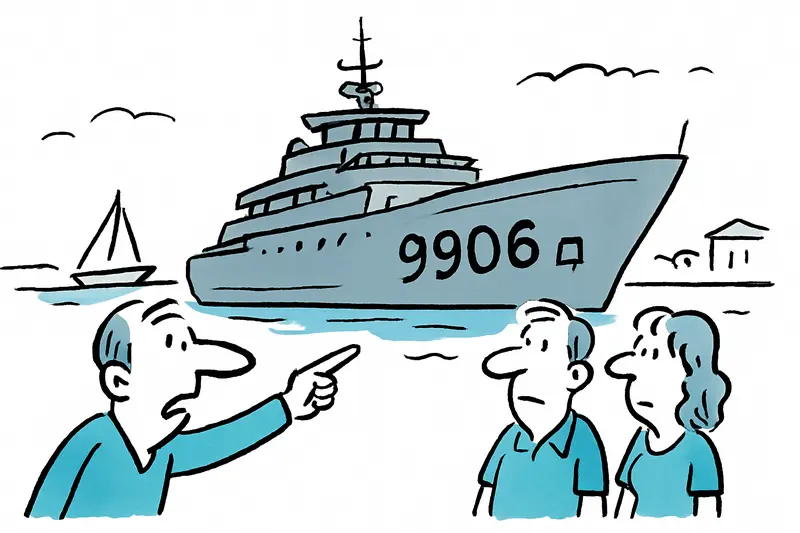
Off Puerto Portals these days an unusually low-key presence drifted: a 71-meter yacht in a matte gray tone, with a large number – 9906 – painted on the hull. From afar one might think a military ship had wandered into the holiday port, recalling the coverage of the Giant at Anchor: US Aircraft Carrier Sparks Debate in Palma. Approaching the paseo, instead of cannon fire you hear only the quiet hum of tender engines, the clatter of fenders and the murmur of passersby.
The facts are clear: the vessel was built as project 9906 at the Lürssen shipyard; the project began in November 1999 and the yacht was launched in 2002. It formerly belonged to computer scientist Charles Simonyi; today Kjell Inge Røkke is associated as the owner. The yacht is equipped with an elevator across four decks, a leisure platform with a hot tub, a gym beneath the mast, a helipad for a McDonnell Douglas 500N, two jet skis as well as motorcycles and a corresponding lift.
At first glance this seems like a piece of the luxury world that briefly docks and then disappears. But it also raises questions we discuss on the promenade while the sun slowly sinks behind the cathedral-like silhouettes of the superyachts: Who owns the public maritime space in front of our harbors? What rules apply to parking machines with a military look in civilian areas? And what does it mean for residents, fishermen and tourism when such vessels anchor? Similar questions were raised when the Black Pearl in Puerto Portals: Luxury Sailing Yacht, Sustainability Promises and Open Questions was moored.
Viewed critically, at least three problem areas emerge: first the visual presence — a gray hull with a clear project number sends signals that unsettle; second the use of aircraft: a helipad temporarily turns a yacht into a landing site, whose noise and safety issues affect the surroundings. Local coverage of the "Yasmine of the Sea" in Palma: Luxury, Noise and the Bill for the Island documented similar complaints; third environmental concerns: the size and engines of such yachts bring consumption, emissions and waste-management issues that passersby cannot immediately assess in terms of responsibility.
The local perspective is often missing from the public debate. On the paseo people sit with shopping bags, pensioners argue about berth fees, boat owners look on curiously — but concrete rules or demands for transparency are rarely made. Authorities and port operators are involved, yet it is not very visible how they balance the conflict between exclusive use and public interest.
Concrete solutions can be discussed without new laws: clear and publicly accessible anchoring and berth plans, a reporting requirement for helicopter landings with nighttime restrictions, mandatory environmental and waste-management plans for yachts above a certain size, and tiered berth fees that reflect local infrastructure costs and environmental risks. Also useful would be an easily accessible information sheet at the harbor explaining which rules apply and where complaints can be directed.
In Mallorca the harbor is not a purely technical space but a social place: children feed seagulls at the quay, fishermen sort their nets, cafés fill with voices. A yacht like 'Skat' can provide fodder for conversation — if we turn it into an opportunity for transparency and practical rules rather than a nuisance. By contrast, stories such as the Former king's yacht between Ibiza and Mallorca: Luxury, history — and who actually pays? show how history and cost shape public interest. That is the challenge: coastal luxury is now everyday, but decisions about it should not be made behind closed cabin doors.
Conclusion: The gray 'Skat' is technically and historically notable. But it is also a mirror for questions Mallorca must increasingly ask — about visibility, responsibility and the handling of exclusive space. Who decides what may lie in front of our harbors? An answer to that should be loud, clear and visible to all — not just to those aboard.
Frequently asked questions
What rules govern large yachts in Mallorca’s harbors and how do they affect public space?
How can a yacht with a helipad affect safety and daily life near Mallorca’s coast?
What environmental concerns come with very large yachts docking in Mallorca’s harbors?
When a gray 71-meter yacht, sometimes called Skat, docks off Puerto Portals, what does that mean for locals?
What transparency measures could help residents understand how docking rules are applied near Mallorca's harbors?
What is Puerto Portals known for in Mallorca?
When is the best time to experience Mallorca’s harbor life and yachting scene?
What packing tips should I keep in mind when visiting Mallorca’s harbor towns like Puerto Portals?
Similar News

Mistaken identity with fatal consequences: Brutal assault in S'Aranjassa — what's missing in the follow-up?
At S'Aranjassa a visitor to a finca was tied up, beaten and thrown out of a van. Three men have been arrested, including...

High heel slips, car accelerates: accident on Camí de Son Hugo
A woman lost a high-heeled shoe on the forecourt of the sports facility at Camí de Son Hugo. The car accelerated, mounte...

Phone Scam: How Two Hotel Employees at Playa de Palma Lost Thousands of Euros
One morning in September, two reception employees at Playa de Palma were pressured by alleged alarm-company staff — in t...

When the Wallet Becomes a Danger: Attack in Peguera and Lessons for Mallorca
In Peguera, two women are said to have stolen the wallet from a 75-year-old German couple. When the victim intervened, t...
Plata stays Plata: Young people take over, Llonguets remain
A small bar on Carrer de l'Argenteria will continue: Tolo Serra hands the place over to young Mallorcans at the end of t...
More to explore
Discover more interesting content

Can Cap de Bou

Townhouse Lleo 72
