
More Cars, More Traffic: How Mallorca's Roads Are Coming Under Pressure
More Cars, More Traffic: How Mallorca's Roads Are Coming Under Pressure
Significantly more vehicles drive on Mallorca's main roads daily than in 2023 — the Vía de Cintura is the leader. What consequences does this have for everyday life, mobility and politics?
More Cars, More Traffic: How Mallorca's Roads Are Coming Under Pressure
Leading question: Are individual regulation plans at the port enough to get the daily increase in vehicles on Mallorca under control?
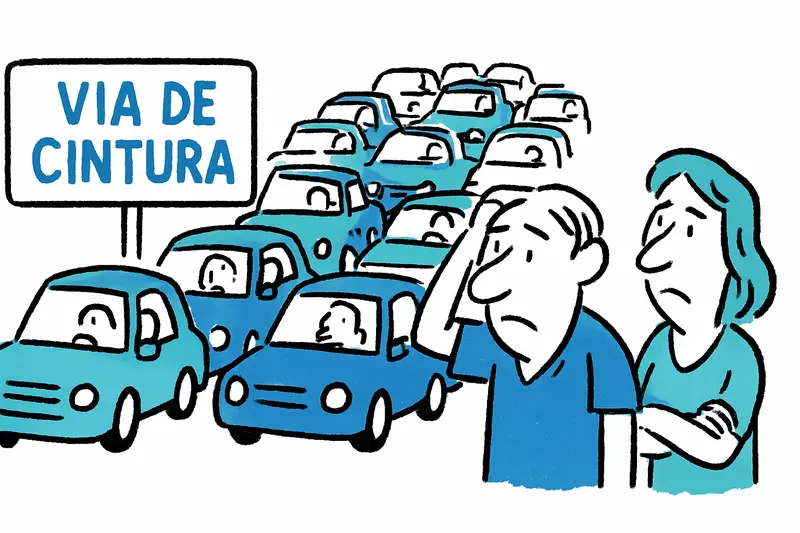
The numbers are simple: on several heavily used stretches of the island, an average of 3,000 to 5,000 more vehicles roll each day than a year ago. On the Vía de Cintura, the ring road around Palma, over 187,000 vehicles per day are now counted between the exits toward Inca and toward Sóller — about 3,900 more than in 2023. This trend is discussed in Millions for Mallorca's Roads: Many Construction Sites, Few Guarantees.
As an editor who looks out the window on Avinguda Argentina in the morning, I see the effect: the bus lane is full of small delivery vans, commuters switch the radio three lights later, the baker complains about late deliveries. In the low season you notice it less; on a weekday in January cars and rental vehicles pile up in front of Palma's port; seagulls circle, lights reflect on wet asphalt — a scene that has become everyday life in many municipalities.
Critical analysis
What the raw numbers do not show: the burden is unevenly distributed. The ring road acts as a hub, but alternative routes into the villages suffer just as much. The increase is probably a mix of more tourist arrivals, higher car use by seasonal workers and a fleet of rental cars that is noticeable in daily life — a dynamic also highlighted by Balearic Islands quieter — Mallorca stays crowded: Why the island bucks the trend. But there are still questions about the data: how much of it is transit traffic, how much are short urban trips, and how strongly do the values vary between summer and winter months? Without transparent, segmented data the discussion remains vague. Concerns about an aging fleet are explored in Too Many Old Cars in Mallorca: Why the Problem Runs Deeper Than the Exhaust.
The political response: the Island Council is working on measures to regulate the entry of vehicles through the ports. That makes sense — traffic does not stop at a barrier at the port, it shifts. In addition, concepts are still missing for staff transport (workers, service providers), for heavy delivery chains and for dealing with short-stay parkers who are only in Palma for a few hours.
What's missing from the public discourse
Public debate often focuses on rental cars and tourist vehicles; recent coverage on proposals for limits is illustrative in Rental Car Cap: Between Traffic Calming and Holiday Stress – What Mallorca Must Consider Now. The following points are rarely discussed: first, the distribution of freight traffic and supply deliveries that travel at the same times; second, the mobility needs of seasonal workers; third, concrete expansion plans for night and late public transport services. Also rarely on the agenda: structured data release so that municipalities, transport planners and citizens can understand exactly where measures are needed.
Everyday scene
Imagine: it's Monday, a damp January morning around 7:30. On the Vía de Cintura a stream of cars inches toward Palma. A city bus squeezes out of the bus lane because a delivery van blocks the entrance. At the port a Moroccan man parks his van and unloads boxes from the boat while three rental cars wait side by side at the quay for guests. The street noise mixes with the clatter of suitcases; the woman from the neighboring house swears softly because the trip to school now takes 15 minutes longer — small everyday images that explain the statistics.
Concrete, practical solutions
We need more than general calls for fewer cars. Concretely I propose:
1. Reservation and prioritization at port access: Time windows or digital reservations for freight, local suppliers and rental transfers to smooth peaks at the quay.
2. Park-and-ride with connections: Large-scale P+R facilities outside the city belt with reliable frequent buses and affordable combined tickets, especially for ferry arrivals.
3. Dynamic port fees: Higher access fees at peak times combined with incentives for low-emission vehicles and shared transfers.
4. Expand shift transport: Targeted bus lines for work shifts in tourism and logistics coordinated with employers so that seasonal workers do not all generate private-vehicle trips at the same hour.
5. Better data transparency: Publish daily, route-specific traffic numbers; this helps municipalities and businesses find local solutions.
Trade-offs and risks
Every measure has side effects. A reservation system at the port can push the search for parking into the hinterland. Park-and-ride only works with a reliable offer; if drivers or frequencies are missing, the private car remains attractive. And the rental car industry warns about effects on tourism — a legitimate concern, but not automatically a reason against regulation. What matters is that politicians, ports, providers and municipalities sit at the same table and run through scenarios.
Pointed conclusion: The higher vehicle density is more than a statistic — it is changing everyday life on Mallorca. Regulating individual ports is necessary, but not enough. A bundle of technical solutions, better data and transport offers that reflect real needs is required. Otherwise the only result will be more congestion — and we hear that every morning on the Vía de Cintura.
Frequently asked questions
Why is traffic getting worse on Mallorca roads?
Is the Vía de Cintura around Palma becoming more congested?
Does Mallorca have more traffic in summer than in winter?
What can drivers do to avoid traffic around Palma port?
Would limiting rental cars at Mallorca ports reduce traffic?
What traffic solutions are being discussed for Mallorca?
Why does traffic in Palma affect nearby villages so much?
What kind of data is needed to understand Mallorca traffic better?
Similar News

Released with Conditions: The Plus Ultra Suspicion and a Mallorcan Finca as Residence
A Dutch entrepreneur, sought in connection with the Plus Ultra case, was extradited to Spain after his arrest in Germany...

Haute Nuit in Puerto Portals: Fashion, Art and Indulgence by the Water
On October 2 the Lobster Club in Puerto Portals will be transformed into a stage for curated fashion, art and culinary e...

Magaluf: Watchtower Alarm – Lifeguards Pull Unconscious Beachgoer from the Water
After a drama in the late afternoon, two lifeguards at Magaluf beach rescued an unconscious 44-year-old man. He was stab...

Turquoise in the City: How dangerous is the color play of the Sa Riera?
The Sa Riera in Palma suddenly turned turquoise — a pretty motif, but behind the effect lies a discharge of saline waste...

Jeckliner at Sunnesching: Cologne spirit sets sail from Palma
In September 2027 the Mein Schiff 2 briefly becomes a floating carnival stage: four days with Cologne bands, comedy and ...
More to explore
Discover more interesting content

Can Cap de Bou

Townhouse Lleo 72
