
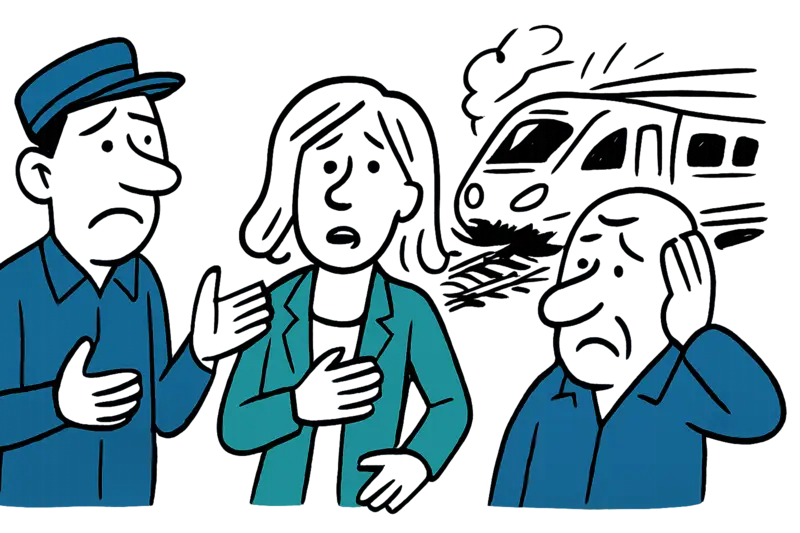
Train accident near Urda: Missing ex-minister and open questions
Train accident near Urda: Missing ex-minister and open questions
Fátima Báñez, a former Minister of Labour, was reported by party sources to have been on one of the colliding high-speed trains. Her whereabouts are unclear. Why do equally fundamental questions about safety and communication remain unanswered?
Train accident near Urda: Missing ex-minister and the unresolved questions
Leading question: How can a collision between two high-speed trains occur while basic information about passengers and rescue procedures is still missing?
The news hits like a blow: Fátima Báñez, former Minister of Labour and Social Affairs (2011–2018), was, according to party circles, on one of the trains that collided near Urda in the morning. Her whereabouts remain unclear. All that is known so far is that she was said to have been seated in a severely damaged carriage and that party colleagues could not reach her by phone. Such facts are enough to raise questions that do not only satisfy political or tabloid interest but also touch on safety standards, information policies and the care of those affected.
The first layer of this analysis concerns the technical dimension: what combination of signaling, timetable management and human decision-making led to the meeting of two high-speed trains? Railway engineers and independent investigators are needed; official records on the condition of the track, maintenance intervals and automatic protection systems must not languish behind closed doors; see Fatal accident in Alcúdia: Who is responsible — and what needs to change? Only in this way can future tragedies be prevented.
The next layer is communication in emergencies. The report that a prominent passenger is unreachable underscores a general problem — incomplete passenger lists and patchy reachability, as shown in Fatal accident near Son Castelló: Three passengers come forward — where are the gaps in responsibility? In remote sections of line, the mobile network is often weak. A driver or a team in the café at Plaça de Santa Catalina will pull out their phone and angrily find: no signal. For relatives this means agonizing uncertainty. Authorities and rail companies must set binding rules in their emergency plans for how passenger data are secured and quickly verified without violating data protection.
What is noticeably missing from the public discourse right now are two things: transparency about the exact procedures in the minutes after the collision and an honest portrayal of how reliable the technical safeguards really are. Reassuring phrases help little when people are trapped in wrecked carriages or families are waiting for information. The discussion must not sink into speculation; it needs verifiable data and external review, as after the After head-on crash in Palma: Fleeing and many questions – 31-year-old dies.
An everyday scene from Mallorca: on a cool morning a retiree sits in the café on Avenida Antoni Maura, the classic spot next to the market. The server quietly turns on the TV, two taxi drivers whisper at the counter. The headline about the missing person runs through the room. No one in the group knows technical details, but everyone feels the gap — among the public the demand for clear answers grows, not for insinuations.
Concrete proposals that belong on the table immediately: 1) Immediate establishment of an independent investigation team with access to driving data, signaling systems and maintenance records. 2) Mandatory digital, encrypted passenger registration on high-speed routes that allows authorized authorities rapid identification in emergencies. 3) Investments in mobile repeaters and emergency radio stations along remote sections of track so that rescue teams and relatives can communicate reliably. 4) Clear information cascades: a central coordinator for family support who provides reliable initial assessments within a few hours. 5) Public release of investigation results with deadlines — misconduct must be named and responsibilities clarified.
It would be naive to believe that technology alone protects. Decisions, culture and transparency are at least as important. Those who feed the public vague statements for months risk distrust instead of cooperation. And those who negotiate the next steps only behind closed doors endanger the credibility of institutions.
Conclusion: The fate of individual passengers — whether a prominent politician or a commuter — must not become secondary. This accident must be the occasion to openly name old weaknesses and promptly make improvements: check technology, secure communication, take relatives seriously. Only then will Spain avoid turning a tragedy into a lasting deficit of trust.
Frequently asked questions
What are the essential steps in investigating a rail collision to improve safety?
How can authorities balance passenger privacy with the need to identify relatives after an rail accident?
What steps improve emergency communications along remote rail sections?
Why is timely public release of investigation results important, and how should it be done?
What should I pack for Mallorca if I’m visiting, given the weather and outdoor activities?
How can travelers in Mallorca stay prepared for travel disruptions?
Why is public trust important after rail accidents, and how can Mallorca improve it?
How should authorities talk about missing high-profile passengers after rail accidents while respecting privacy?
Similar News
Return of former hotel squatters in El Arenal: Why the eviction is only the beginning
After the eviction of a squatted hotel at the Ballermann, residents again report sightings of former occupants in the ar...
Addiction in the Balearic Islands: A Reality Check on the Action Plan 2025–2032
The Plan Integral de Adicciones 2025–2032 names prevention and care. Our reality check asks: Is that enough? What is mis...
Violence on the Paseo Marítimo: Beating Allegation Against Security Guards Raises Oversight Questions
In the early hours of the morning, a young man was allegedly attacked by several security guards outside a nightclub on ...
Coaching change after six games: Panic or professionalization at FC Germania?
Thorsten Legat steps down after six games as head coach of the newly founded FC Germania and takes on a managerial role....
When the Sea Pulls: Why Mallorca's Winter Eddies Should Concern Us
New measurements off Mallorca show: small, turbulent eddies are stronger in the winter months than in summer. What this ...
More to explore
Discover more interesting content

Can Cap de Bou

Townhouse Lleo 72
