
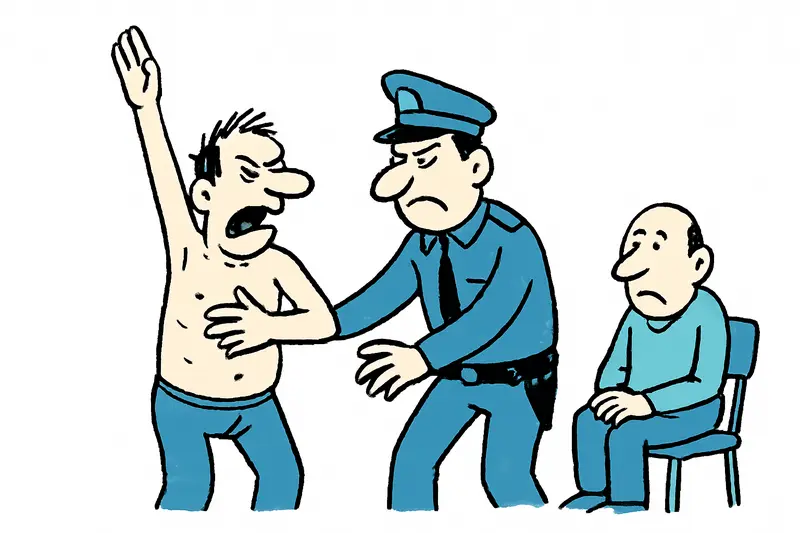
Troublemaker in Ravensburg: Hitler salute, indecent exposure, clinic — what's missing in the response
A 22-year-old man living in Spain caused a deployment in Ravensburg: he exposed himself in a café, gave the Hitler salute and attacked police officers. After a night in a cell he was admitted to a specialist clinic. What does this say about prevention, policing and available support?
Troublemaker in Ravensburg: Hitler salute, indecent exposure, clinic — what's missing in the response
A single incident, many open questions: alcohol, extremist symbolism and the gap between security and care
Late on Saturday evening a 22-year-old man who is registered in Spain got into a violent conflict with passers-by and police in downtown Ravensburg. According to the authorities, the young man exposed his genitals in a café, then gave the banned Hitler salute and put up strong resistance during his arrest: he kicked at officers and struck a female officer in the head. The heavily intoxicated man spent the night in a cell; in the morning he refused to leave the station and was ultimately taken to a specialist clinic. Several investigations are now underway against him, including for the use of unconstitutional/extremist symbols and for assaulting enforcement officers.
Main question: What goes wrong when an incident of this kind not only becomes a criminal matter but also signals that preventive and care measures are missing? In a small town like Ravensburg the impact of a single, public outburst quickly reveals a system that needs not only law enforcement but also healthcare provision.
Critical analysis: At first glance the offenses are clearly punishable. The combination of indecent exposure, the use of National Socialist symbolism and assault results in several legal issues. But legal punishment is only one side of the coin. Alcohol intoxication and obvious psychological abnormalities — and the police decision to take the man to a specialist clinic — suggest an acute health situation that apparently was not sufficiently intercepted earlier. Is there a lack of low-threshold help at night? A lack of clarity about responsibilities when someone is registered abroad but shows up as a problem here?
What often gets lost in public debate: the person's origin (the man lives in Spain) is quickly used as an attempt to explain or blame. That is dangerous. The discussion should not drift into a national or cultural debate. Rather, a sober view is needed: How do people with addiction or mental health problems in crisis get help, regardless of where they are registered? Are there night services, street workers or mobile crisis teams that can be mobilized in smaller towns? Legal and cross-border follow-ups are not uncommon, as seen in Trial in Essen: Four Germans charged over alleged incident in Mallorca.
An everyday scene from Mallorca: on a grey morning in Palma locals and expatriates sit close together in a café on the Plaça Major. Conversations about news from the German-speaking area mingle with the sound of cups and scooters. Many say, "This can happen anywhere" — meaning that it is a matter of services and organization. On the Passeig del Born guests at a bistro loudly discuss how quickly an incident can affect the feeling of safety, while the city police do their rounds in the afternoon and social service workers hand out flyers with phone numbers. Such simple neighborhood actions can build bridges between law enforcement and care; immediate arrests after incidents have been reported in cases such as Handcuffed Straight from Palma: Cross‑Border Manhunts, Mistakes and Mallorca's Image.
Concrete approaches that would also be relevant for Ravensburg:
1. Expand night and crisis intervention: Mobile crisis teams that support police when mental health crises or substance problems are the cause. These teams should be reachable around the clock and, if necessary, offer a medical assessment on site.
2. Training and equipment for responders: De-escalation and basic health training for police and municipal enforcement staff, as well as equipment for gentle restraint techniques to avoid injuries and reduce legal risks.
3. Cross-border cooperation: When people have their main residence abroad, clear information and cooperation channels are needed between authorities, social services and embassies so that care and responsibilities are not left unclear.
4. Prevention against glorification of symbols: Education in schools, clubs and public institutions, combined with consistent enforcement of laws against extremist propaganda — in a way that pairs punishment with education.
These points may sound technical, but they are present in everyday life: in Palma it is common for tourism industry workers, neighbors and social workers to stand together during alcohol-related excesses. On Mallorca as in Baden-Württemberg, short-term responses and long-term services must go hand in hand; similar holiday-related arrests have been documented in reports such as From the Beach to Handcuffs: Mallorca Holiday Ends with Arrest at Düsseldorf Airport.
Pithy conclusion: The Ravensburg case reveals a twofold weakness: the need for effective public order on the one hand and the gap in care for people in acute crises on the other. Those who only punish merely shift the problem; those who only provide help omit the necessary legal consequence. Both belong together. For municipalities this means: night duty, rapid crisis help and better links between police, health services and administration. Until such bridges are built, cases like this remain test cases for a system that must deliver both security and humanity.
Frequently asked questions
What should Mallorca visitors know about public intoxication and aggressive behaviour in town centres?
How are extremist symbols or Nazi salutes treated in Spain and Mallorca?
When does a police incident in Mallorca turn into a health issue as well?
What help exists in Mallorca for someone in an acute crisis at night?
What happens if someone involved in a Mallorca incident is registered abroad?
What role do police and social workers play during alcohol-related incidents in Mallorca?
What should visitors in Palma do if they see a violent or unstable person in public?
Why do Mallorca towns need better links between police, clinics and crisis services?
Similar News

Micaela Schäfer: Between Playa de Palma and a Berlin Law Firm — New Calm, an Old Tomcat and Solid Finances
The party artist from the Ballermann scene appears surprisingly down-to-earth: a new relationship with a Berlin lawyer, ...
At Playa de Palma: Fire in Residential Building – six people rescued on the roof, what is missing in prevention?
In the evening a fire broke out on the first floor of a five‑storey building on Calle Trasimé. Six residents fled to the...
New License Requirement for Mini-Boats in Mallorca: Protection Measure or Tourism Brake?
From October 1 renters of small recreational boats in the Balearics must present a boating license. Critical questions r...
After the Storm: Mallorca Breathes Easy — Warm Weekend with Short Showers
The thunderstorm left its mark, but calm returns for the weekend: sun, summer temperatures around 32 °C, isolated shower...
No More 'Just Hop on a Boat': Mallorca, Mandatory Boating License and the Open Questions
From October 1, the Balearic Islands will require a boating license for small rental boats under five meters/15 hp. A tr...
More to explore
Discover more interesting content

Boat Tour with BBQ along Es Trenc Beach

Private transfer from Mallorca Airport (PMI) to Pollensa
