
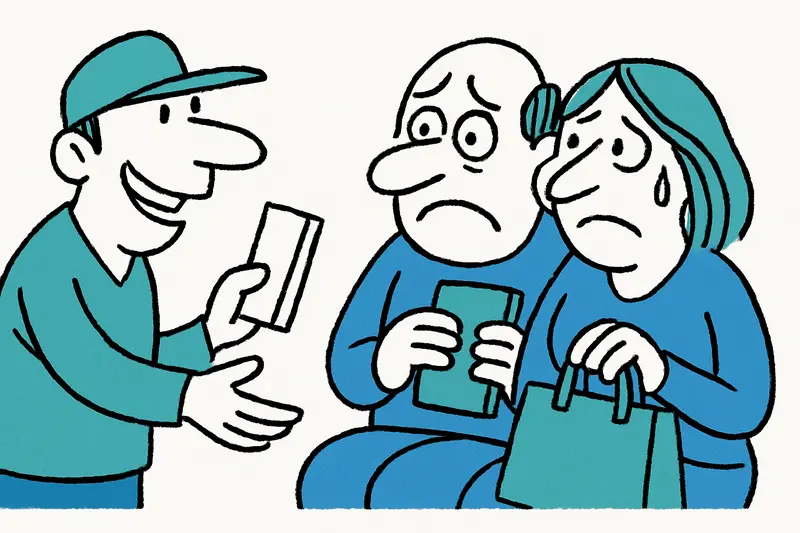
Trust Betrayed: How an Alleged Ticket Seller Took €7,905 from a Couple
Trust Betrayed: How an Alleged Ticket Seller Took €7,905 from a Couple
A man from the school community is alleged to have defrauded a couple in Palma of €7,905 with fake flight tickets and forged transfer receipts. An investigating judge is looking into the case.
Trust Betrayed: How an Alleged Ticket Seller Took €7,905 from a Couple
A case from everyday school life – and the protection gap for particularly vulnerable people
Central question: Why do scammers repeatedly manage to take lifelong savings from even well-known neighbors or acquaintances, and what practical steps can affected people in Mallorca take to prevent this from happening again?
The investigating court on Avenida Alemanya in Palma has a case on its desk whose brazenness sounds bitterly familiar: a man from a family's immediate circle is alleged to have offered four purported round-trip flight tickets and other trips, received a total of €7,905, and never delivered. The amount is concrete, the scene is everyday life – the schoolyard, where children come and go, parents bring coffee in thermoses, and mothers and fathers strike up conversations while waiting.
According to the complaint, the accused used this environment to gain trust. He first offered tickets, then additional flights supposedly on behalf of relatives, along with all-inclusive stays in the Maldives. Payments were made partly in cash and partly by bank transfer. To sustain the deception, he presented manipulated transfer receipts; one even bore a date from 2024 – a mistake that ultimately helped reveal the fraud. The victims report health consequences: anxiety, sleep disturbances, headaches. That the accused is said to have already been convicted for similar offenses and that several proceedings are ongoing makes the situation even more bitter, echoing cases such as Trust on the Plaça: 55,000 Euros Missing — When Collegiality Becomes a Risk.
Critical analysis: This case is not an isolated phenomenon but highlights several vulnerabilities at once. First: the immediate social environment – school, sports club, neighborhood – is an ideal breeding ground for confidence fraud. Second: cash payments and informal agreements make reclaiming funds difficult, a problem seen in other local schemes including Employee allegedly defrauded company in Palma with forged invoices for €150,000. Third: a lack of routine in verifying travel documents – for example, checking booking references directly with the airline – facilitates deception.
What is often missing in the public discourse: we talk a lot about "internet fraud" and phishing, but less about everyday, analogue forms of deception in our neighborhood; even high-profile online investment cases such as Palma: How a crypto scheme nearly swallowed €68,000 — and why victims became helpers show how varied and damaging these crimes can be. Also underemphasized are the psychological and health consequences for victims, which make it harder for them to reach out for help. An older couple who hands over their life savings in good faith often feels humiliated and ashamed to file a complaint. The fact that a fraudster comes from their own circle of acquaintances intensifies the isolation.
Everyday scene in Mallorca: in front of the schoolyard on Avenida Alemanya a woman sits with a shopping bag fanning herself while her son clutches his backpack to his chest. A father, a familiar face here, chats with other parents about the upcoming trip. Such encounters are warm and trusting – and precisely for that reason not a suitable place for financial transactions that require thorough checks.
Concrete solutions (practical and locally implementable): 1) Always request the booking reference (PNR) for ticket offers and immediately verify it online with the airline yourself. 2) Do not hand over large sums of cash; for transfers only after presentation of an original booking confirmation from the carrier and successful verification. 3) Be suspicious of excuses like "my parents cannot travel" or "the insurer will change the names" – these are phrases that must be checked. 4) Manipulated receipts can often be detected by the date, the logo, or missing reference numbers; if in doubt, ask the bank to trace the transaction. 5) File a report immediately with Policía Nacional or Guardia Civil and notify the local consumer office (e.g. Oficina Municipal de Información al Consumidor) to increase the chances of prompt investigations. 6) Actively inform seniors and particularly vulnerable people: schools, neighborhood associations, and pharmacies can distribute flyers and simple checklists.
Structural responses are also needed: banks should raise stronger alerts for unusual patterns of small but frequent transactions; travel providers must provide clear digital proof that cannot be easily forged; and counseling centers should offer low-threshold support for the psychological consequences of fraud. At the municipal level, information stands at parent evenings or the town hall market could be organized – short notices are often enough to trigger healthy skepticism before money changes hands.
Concise conclusion: mistrust is not rudeness but self-protection. Anyone trying to sell flight tickets at a school coffee morning should expect buyers to ask for proof. For the victims in this case, the main task is for the justice system and authorities to act quickly so that lost money does not disappear forever and victims are not left alone. And at the next corner of the schoolyard we should all be a little more vigilant – without immediately suspecting everyone, but with clear rules for handing over money.
Frequently asked questions
How can I avoid travel ticket scams in Mallorca?
Is it safe to pay for flights in cash in Mallorca?
What should I do if someone in Mallorca shows me a suspicious transfer receipt?
What are the warning signs of travel fraud in Mallorca?
Why are schoolyards and neighborhood chats in Mallorca risky places for financial deals?
What can victims of fraud in Palma do first?
Can fake travel offers in Mallorca affect health as well as finances?
How can older people in Mallorca be protected from ticket scams?
Similar News
More water than last year: Mallorca's reservoirs breathe easier
September rain refilled the Tramuntana's reserves: overall fill around 35 percent, Cúber at 40.42 percent, Gorg Blau at ...
Three Luxury Hotels in Banyalbufar: Lots of Money, Many Questions
A Danish investor plans three exclusive accommodations in Banyalbufar — including the historic Son Valentí. The announce...
2.1 tonnes of cocaine on sailing yacht off Spain's coast – a reality check for the coastguard
A 14-metre yacht was seized with 2.1 tonnes of cocaine. Who monitors the ports, how does the international hunt succeed ...
Heat Bonus in Mallorca: 100 Euros Extra for Outdoor Staff at MarSenses
MarSenses pays employees who worked outdoors in August an extra €100 as recognition. Lighter uniforms, reduced hours for...
Renovating in Mallorca: What You Really Can Do Without Neighbour Consent
Many think they can do whatever they want in their apartment. That's partly true — but only as long as structural elemen...
More to explore
Discover more interesting content

Can Cap de Bou

Townhouse Lleo 72
