
V‑16 Alone Is Not Enough: What to Do in Mallorca If Your Car Breaks Down
V‑16 Alone Is Not Enough: What to Do in Mallorca If Your Car Breaks Down
Since January, carrying the V‑16 warning light has been mandatory in Spain. A fine case shows: without activating the hazard lights, much higher penalties can apply. A pragmatic guide for Mallorca.
V‑16 Alone Is Not Enough: What to Do in Mallorca If Your Car Breaks Down
Key question: Is the new V‑16 warning light sufficient, or can you still face fines and dangerous situations if your car stops on Mallorca’s roads?
The answer is clear and sobering: no, the V‑16 does not replace the hazard lights. A recent case in Spain, in which a driver was fined €200 because he only installed the required V‑16 light during a breakdown but did not activate the hazard lights, has shaken many people awake. On the island, where the roads between Palma, the Vía de Cintura and the coast are often narrow, such a mistake can quickly become expensive and dangerous.
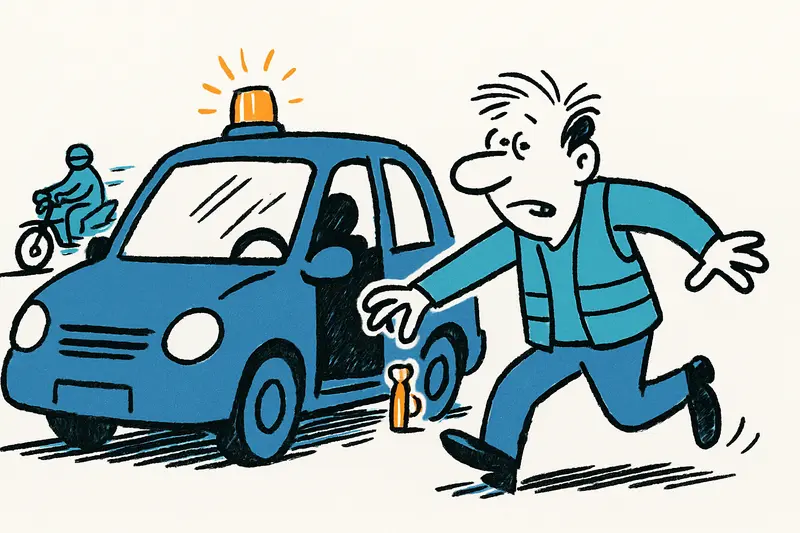
You see the scene almost every day: on Avinguda Joan Miró a small car slowly pulls over to the right, tourists pack their suitcases, a motor scooter whistles by. Without the flashing lights, the stationary car reads less like a breakdown and more like an obstacle — especially when fog or rain reduce visibility. This is exactly where the rule comes in: the V‑16 is visible from a long distance, but the classic hazard lights are the immediately understood signal for the driver behind you.
Critical Analysis: What Doesn’t Work in Practice?
The new requirement to carry a V‑16 has revealed a gap: many drivers believe that the small, bright light is all that is needed. Authorities warn that the device is intended as a supplement. In practice, clear routines are often missing: where is the light stored? How do I attach it safely? And above all: who remembers in the stress to also switch on the hazard lights?
Enforcement practice is therefore important: it costs €80 if the V‑16 is missing or an unapproved model is used. If, however, a driver does not activate the hazard lights when the vehicle stands on the road, they risk fines of up to €200. The aim of the penalties is that both signals are used together — otherwise the risk of rear-end collisions increases, especially on busy stretches such as the MA‑13 or around Palma’s port.
What Is Missing from the Public Debate
The debate focuses on carrying the V‑16, but less on how people actually behave in stressful situations. Online tips and advertising for cheap lights give a false sense of security. There is a lack of simple, memorable rules of conduct, notices in parking garages, postings at car rental agencies and short reminder loops at petrol stations — places where drivers can be reached directly.
There is also little discussion about how dangerous improper use can be: switching on the hazard lights when you are not actually stopped confuses other road users and can also lead to fines. It is a balancing act between over-warning and under-warning.
Everyday Scene from the Island
Last Friday morning on the Paseo Marítimo: rain lashed, buses puffed out diesel clouds, and a Renault with Spanish plates stopped with engine trouble on the exit to the harbour bridge. The driver rummaged in the glove compartment — the V‑16 was there, within reach. But two minutes passed before he finally switched on the hazard lights. During that time the city bus had to swerve, honked, the scene attracted looks and could have ended more peacefully with a quick, coordinated routine.
Concrete Practical Solutions
1. Prevention: Always keep the V‑16 in the same place — recommended locations are the glove compartment or a side pocket. Practice once how to attach the light so you do not have to search for it in an emergency.
2. Immediate measures for a breakdown on the road: a) switch on the hazard lights; b) move the vehicle, if possible, to the right-hand edge of the carriageway or onto the hard shoulder; c) place the V‑16 as high as possible (on the roof, if it can be done safely); d) put on a reflective vest for you and any passengers and wait behind the guardrail, not next to the stopped car.
3. Correct behaviour in heavy traffic: do not send children out of the car, remain calm yourself, call for help (breakdown service, emergency number) and place the light only if it is safe to do so.
4. Avoid misuse: do not use the hazard lights when driving slowly in a traffic jam or to reserve parking spaces. That confuses others and can also be sanctioned.
Practical Notes for Everyday Life in Mallorca
Car rental agencies, workshops and petrol stations should actively help customers sort and store the V‑16. A short note with step‑by‑step instructions in the glove compartment would prevent many mistakes. I have even seen a mechanic in a workshop in Portixol briefly show rental-car customers how the light is mounted — simple measures like these reduce risky situations.
Specific note: If you drive an older car, check regularly whether your hazard lights work. Working electrics are not a luxury but protection — and a false economy can become expensive.
Pithy Conclusion
The V‑16 is a useful addition, but not an excuse to neglect classic warning signals. On Mallorca’s roads, safety means using both, quickly and with a clear routine. Otherwise it will cost you not only nerves but, in the worst case, €200 and an unnecessary danger to you and others.
Remember: carry a V‑16, switch on the hazard lights, place the light high — and if possible move away from flowing traffic.
Frequently asked questions
What should I do first if my car breaks down on Mallorca?
Is the V-16 warning light enough when a car stops on the road in Spain?
Can you get fined in Mallorca if you only use the V-16 and not the hazard lights?
Where should I keep the V-16 light in my car?
What should tourists do if their rental car breaks down in Mallorca?
Is it safe to stand next to a broken-down car on Mallorca’s roads?
How should I use the V-16 on Mallorca if my car has stopped safely?
What should older cars in Mallorca check before a road trip?
Similar News
Injured captain, big plans: Germania Mallorca before the away match in Consell
The newly founded FC Germania Mallorca travels to Consell on Saturday. Captain Bastian Müller is out injured, but coach ...
Palma, Palma de Mallorca, Palma‑Mallorca: What is it really about?
The debate over the city's name is more than grammar: it concerns identity, law and branding policy. A sober reality che...
Warning to Bathers: Nipping Fish in Cala Major and Other Coves — a Reality Check
In Cala Major and several beaches around Mallorca, bathers report painful “nips”. Who are the animals, why are they gett...
Rental Car Theft in El Arenal: What This Incident Reveals About Our Gaps
A teenager steals a running rental car in El Arenal, flees on foot, climbs over walls and is caught by the Guardia Civil...
Red Rope in Palma's Library: What Helps Against Selfie Tourism — and What's Missing
Palma's city library cordoned off an area with a red rope to keep selfie tourism away from reading and working activitie...
More to explore
Discover more interesting content

Can Cap de Bou

Townhouse Lleo 72
