
Vacationers at Ballermann: How the Latest Pickpocket Tricks Work — and What Really Helps
Vacationers at Ballermann: How the Latest Pickpocket Tricks Work — and What Really Helps
An Instagram video from Playa de Palma shows how groups of thieves exploit older and intoxicated holidaymakers. What’s behind the methods, which gaps remain open — and how can guests really protect themselves on site?
Vacationers at Ballermann: How the Latest Pickpocket Tricks Work — and What Really Helps
Guiding question: How can holidaymakers and authorities stop the schemes at Playa de Palma without turning the beach into a police zone?
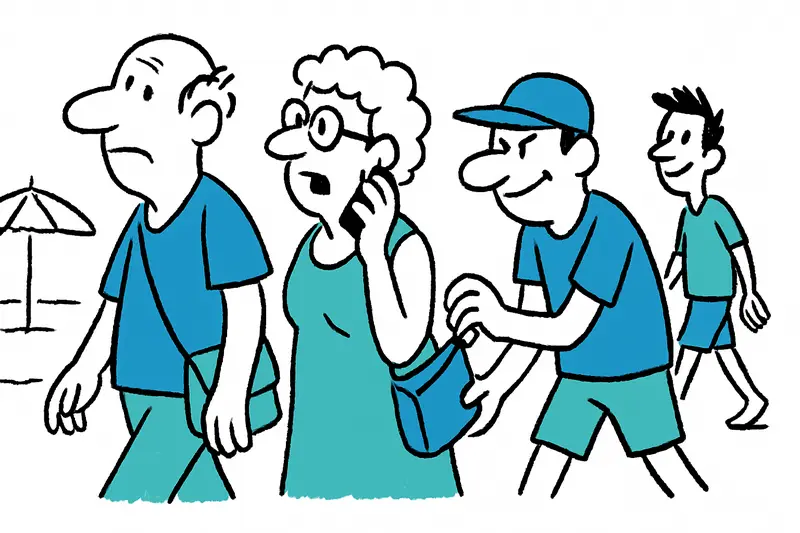
A clear picture: In a video recently shared online you can see a group of young people casually following an older couple from behind along the shore. The man notices nothing, keeps walking — and a short time later his wallet is gone. Instagrammer Óscar Álvarez recorded the scene and passed the clip on to security forces. Such cases are not isolated at Playa de Palma; the usual targets are often intoxicated or elderly people who absentmindedly carry their valuables.
Critical analysis: The tricks are simple and efficient; see New Tricks at Ballermann: How Pickpockets Exploit Playa de Palma — and What Actually Helps. Usually several perpetrators work together: one distracts, another grabs, a third provides an escape route or shields the crowd. The offenders exploit typical holiday situations — people with open pockets, sunglasses, phones in hand, bags on the beach chair — and the soundscape of music and voices. It is especially effective when victims meet in groups, after returning from the beach, in front of chiringuitos or at bus stops. Important: these are not Hollywood-style methods but routines that keep working as long as victims’ routines remain unchanged.
What is often missing in public discussion: hard numbers and clear responsibility. There is a lot of talk about individual cases, as noted in Ballermann in Focus: How safe is Playa de Palma really?, but rarely is it made transparent how often reports are filed, how many returned items end up back with owners through initiatives like Álvarez’s, or how language barriers slow down reporting. Another problem: prevention structures are fragmented. Hotels, beach bars, bus companies and police sometimes act in isolation, while offenders precisely exploit these gaps — a pattern visible in cases described in Disguised as a Tourist: How an Alleged Thief Stole Suitcases and Watches in Palma.
An everyday scene: It’s early evening at Playa de Palma. Life is in the air along the Avinguda — music drifts from the bars, waiters call out orders, children run barefoot across the sand. An older German couple strolls along, the man carrying an open shoulder bag, the woman speaking loudly on her phone. Between parasols and ice-cream vans you hear the clinking of bottles and laughter. In the bustle a group approaches, reads the carelessness from a distance — and acts. Seconds pass in which the balance between holiday bliss and loss tilts.
Concrete solutions — straight to the point: For holidaymakers: carry bags closed, distribute valuables discreetly (keep a copy of your passport separate from the original), carry cash in small bundles, leave bank cards in the hotel safe, keep your eyes open especially at bus stops and in the evening. Do not visibly show obvious "tourist valuables"; keep your bag on your body when taking photos. For hosts and hospitality: place information sheets in German in rooms and at counters; train staff to report suspicious behavior; use simple codes among waiters to call for help without alarming guests.
For authorities: more visible presence in the most affected sections of the beach, flexible patrols in the evening hours, targeted prevention campaigns in multiple languages. A realistic second step would be the establishment of mobile information stands during the season where tourists can learn simple rules of conduct in German, English and Spanish. The often-requested use of German-speaking interpreters at police stations would be useful — not as a luxury, but as a pragmatic means to record reports quickly and correctly and to investigate. Also: better networking between hotels, taxi companies and police; a digital reporting platform for found items with photo upload could speed up returns.
What can be done immediately and at low cost: signage at busy points with short safety tips in German and English; cooperation with bus operators to make announcements over loudspeakers; training lifeguards to recognize and report suspicious patterns. Technically possible but more complex are temporary cameras at hotspots or increased video analysis by the police — this requires legal coordination and personnel.
Conclusion: The tricks of pickpockets at Ballermann are as old as mass tourism itself — but they only work because people are distracted and structures have gaps. Small, practical measures can achieve a lot if authorities, businesses and guests work together. And one more appeal: eyes open, bags closed — and if something is found, act like Óscar Álvarez: return it instead of passing it on. A little consideration and some organization are often enough to make the promenade safer.
Frequently asked questions
How can I protect myself from pickpockets on Mallorca's Ballermann beaches?
What are common pickpocket tricks to watch for at Playa de Palma?
What can hotels and bars do to help prevent theft on Mallorca's beaches?
How should authorities improve safety in Mallorca’s popular beach zones?
What immediate, low-cost steps can be taken to reduce theft risk on Mallorca beaches?
If you lose something on Mallorca’s beaches, what should you do?
Are there language resources to help Mallorca tourists stay safe?
Why pickpocket tricks work and how can visitors stay alert on Mallorca?
Similar News
Stolen Motorcycle in Palma: Fatal Crash in Coll d'en Rabassa Shortly After Theft
A motorcycle parked on Plaza Miquel Dolç in Son Gotleu was reportedly stolen in the early hours. Hours later two men cra...
When More Guests Mean Less: Mallorca's Restaurants at the Limit
Despite record visitor numbers, the revenues of many restaurants are shrinking. Why more visitors don't automatically me...
Ballermann 2026: Heat, crowded promenade and rising prices – how much longer?
Bright sunshine, over 35 degrees in the shade and busy venues at Playa de Palma: Tourists enjoy the parties, restaurateu...
Stolen motorcycle, high-speed escape, deadly crash: An accident in Palma that raises questions
A motorcycle stolen in Son Gotleu ended up hours later on the Cardenal-Rossell in Coll d'en Rabassa in a deadly collisio...

Found dead in Son Gotleu: Dog walk ends fatally — what is missing in the investigation?
A 68-year-old man was found dead on Sunday morning on Tomás Rullàn street in Son Gotleu. According to his partner, he ha...
More to explore
Discover more interesting content

Boat Tour with BBQ along Es Trenc Beach
Private transfer from Mallorca Airport (PMI) to Pollensa
