
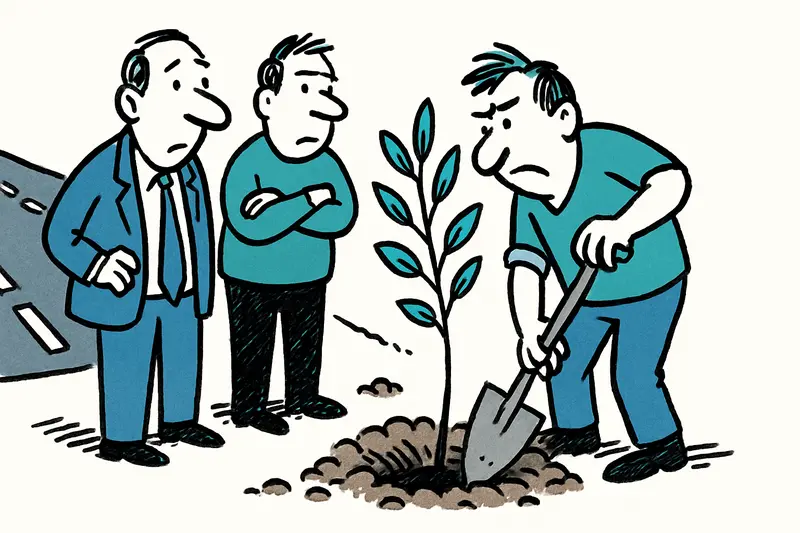
Plants instead of asphalt? A reality check on the green belt idea for the Vía de Cintura
Plants instead of asphalt? A reality check on the green belt idea for the Vía de Cintura
The PSOE wants to partially tunnel the MA-20 and create a continuous green belt on the surface. A bold vision — but how realistic is it technically, financially and politically?
Plants instead of asphalt? A reality check on the green belt idea for the Vía de Cintura
Key question: Is the idea of relocating most of Palma's ring motorway, the Vía de Cintura, underground and creating a green belt in its place feasible — or will it remain a pleasant campaign promise for the opposition benches?
Summary
The social-democratic councillors propose to put large parts of the MA-20 underground and concentrate traffic there; the space freed up on the surface is to become a continuous green area. The goal: to better connect neighborhoods like Son Gotleu, La Soledat and Rafal Vell with the city centre and to create an 'urban lung'. The proposal hits a nerve. At the same time, the question arises whether technology, money and daily reality will cooperate.
Critical analysis
Technically, this is not rocket science, but it is also not a walk in the park. Tunnel solutions exist in many European cities — for a local example see the Island Council's revised ring road plans; however, they are expensive, require ongoing maintenance and cause significant disruption during construction. For a ring road like the MA-20 this means months if not years of restrictions for traffic, detours through already overloaded side streets and a burden on residents from construction noise and dust.
Financially, the hurdles are high: tunnelling in an urban area consumes public funds. The PSOE mentions a feasibility study as a first step in its proposal — correct, but a study also costs money and cannot force political majorities. Without clear commitments from regional or central government and without prospects for EU funding, the initiative on a municipal level will remain difficult to implement.
From an urban-planning perspective, the question of traffic management arises. Will the tunnel route give cars the same amount of space? Or is the project linked to measures to reduce traffic (parking management, expansion of public transport, driving bans at peak times)? Anyone who believes the same volume of traffic can simply be moved underground risks that the surface becomes green while the city remains dominated by car traffic — only with less visible infrastructure.
What is missing from the public debate
So far the public debate has often focused on symbolism — 'healing the scar', 'connecting neighborhoods' — but few questions have been clearly answered: Which concrete construction sections will be tackled first? Who will bear the operating costs of the tunnels (lighting, ventilation, pumps)? What is the plan for construction traffic so that side streets do not collapse? And: are there binding rules about how much of the freed-up area will actually become publicly accessible green space rather than new residential or commercial plots? Similar tensions have appeared in other local projects such as the Portixol redevelopment.
A scene from Palma
Early on a Tuesday morning, the frosty air at Plaça España barely breaks, and you can hear the Vía de Cintura like a distant machine: buses, delivery vans, the beeping of reversing cameras. Two elderly women with shopping bags wait on the curb, coffee still steaming in paper cups. They see the idea positively but also ask: 'And who will pay for it?' This question is often heard on the street corners of Palma — between Passeig del Born and Son Gotleu, from market sellers to young parents with prams, and near recent projects like Paseo Marítimo's new green oasis.
Concrete solutions
1) Phased planning: A realistic approach is a staged plan with clearly defined priorities. First, calm sections where social fragmentation is greatest, then gradually tackle larger tunnel passages.
2) Financing mix: Combine municipal funds, a regional co-financing share, EU cohesion or climate funds and public-private partnerships — but only with strict conditions that forbid converting the areas into anything other than municipal green space.
3) Traffic strategy: No tunnelling without a plan to reduce motorised private traffic. Expanding commuter rail/tram connections, bus lanes, safe cycling corridors and incentives for car sharing can help to permanently lower traffic volumes.
4) Social regulation of freed spaces: Reserve land for affordable housing, neighborhood centres, playgrounds and non-profit facilities. Otherwise there is a risk that lucrative edge plots will be swallowed up by investors.
5) Citizen participation before construction starts: Local workshops in affected neighbourhoods, a clear timetable, noise protection concepts and compensation mechanisms for those directly affected. Planning needs acceptance, otherwise every step will be legally contested and delayed.
Conclusion
The vision of a green ring is appealing and could make Palma more livable — provided it is not pursued solely as a prestige project. Without robust financing models, honest measures to reduce traffic and protection of public use, a chance could turn into a failure that leaves the city with nothing but pretty renderings. The PSOE has started a debate; now it comes down to details, hard numbers and the willingness of all levels to cooperate beyond party logic. Otherwise the Vía de Cintura will remain what it has always been: loud, divided and hard to cross.
What needs to be done: An independent feasibility study, a financing concept with access to EU funds, binding social use of the freed spaces and accompanying measures to reduce car traffic — then a utopia can become a plan that is tangible in the streets of Palma.
Frequently asked questions
Is it realistic to put Palma’s Vía de Cintura underground and turn the surface into green space?
What would a green belt around Palma’s ring road actually change for the city?
How much disruption would building tunnels under the MA-20 cause in Palma?
Would reducing car traffic be part of a plan to cover Palma’s ring road?
Who would pay for putting parts of Palma’s Vía de Cintura underground?
What happens to neighbourhoods like Son Gotleu or La Soledat if the ring road is covered in Palma?
Why do feasibility studies matter for major projects in Palma?
What should residents in Palma ask before supporting a green-ring project?
Similar News
Released with Conditions: The Plus Ultra Suspicion and a Mallorcan Finca as Residence
A Dutch entrepreneur, sought in connection with the Plus Ultra case, was extradited to Spain after his arrest in Germany...

Haute Nuit in Puerto Portals: Fashion, Art and Indulgence by the Water
On October 2 the Lobster Club in Puerto Portals will be transformed into a stage for curated fashion, art and culinary e...
Magaluf: Watchtower Alarm – Lifeguards Pull Unconscious Beachgoer from the Water
After a drama in the late afternoon, two lifeguards at Magaluf beach rescued an unconscious 44-year-old man. He was stab...
Turquoise in the City: How dangerous is the color play of the Sa Riera?
The Sa Riera in Palma suddenly turned turquoise — a pretty motif, but behind the effect lies a discharge of saline waste...

Jeckliner at Sunnesching: Cologne spirit sets sail from Palma
In September 2027 the Mein Schiff 2 briefly becomes a floating carnival stage: four days with Cologne bands, comedy and ...
More to explore
Discover more interesting content

Can Cap de Bou

Townhouse Lleo 72
