
Water Turned Off: What’s at Stake on Calle Concepció
Water Turned Off: What’s at Stake on Calle Concepció
In Palma’s Calle Concepció, around 40 people are reportedly being kept without water — apparently to pressure them to leave. Who protects the most vulnerable?
Water Turned Off: What’s at Stake on Calle Concepció
Key question: Who intervenes when basic services are used as leverage?
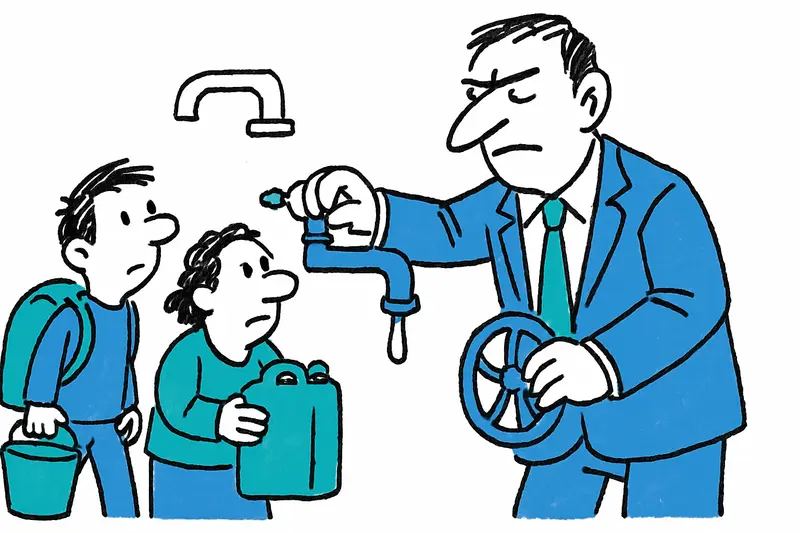
In Calle Concepció, in the middle of a neighborhood marked by newly renovated old buildings, real estate agencies and five‑star hotels, an odd silence has reigned for days: no water from the tap at a house with the number 22. Around forty people, including nine children, instead grab buckets and canisters and walk the few minutes to the nearest fountain to wash or cook. The scene is hard to reconcile with the expensive facades just a few steps away — and that is precisely what makes the situation so explosive.
The people affected say they continued to pay rent, mostly in cash and without written contracts or receipts, about 500 euros per household. According to their account, the property management shut off the water after the building was bought by a foreign investment fund, apparently with the aim of forcing the residents to move out. The Spanish ombudswoman has already described the measure as unlawful. What remains is an obstinate everyday picture: children with school backpacks, adults with colorful canisters, a delivery van honking at the corner — and above it all the clock of a nearby hotel, ticking on indifferent.
Critical analysis: legality, power relations, and protection gaps
Deliberately interrupting a basic service like water runs counter to legal principles protecting public health and the rights of minors. Even if an eviction procedure is underway, that usually does not justify cutting off vital services. Yet law and reality diverge: tenants without formal contracts have weaker legal positions. Cash payments without receipts make later proof more difficult. Added to that is an imbalance of resources: owners and investors have lawyers and means that residents do not.
Another point: the situation of those affected — many without regular residency status, in precarious jobs as cleaners, construction helpers or mechanics — makes them particularly vulnerable. They fear that filing a complaint will draw authorities' attention and lead to other problems. At the same time they are at the mercy of a market in which empty properties in prime locations wait for buyers who prioritise returns over social responsibility.
What is missing from the public debate
Public perception is often dominated by two narratives: the desire for strict enforcement of laws against illegal occupations on the one hand, and the protection of investment interests on the other. Less attention is paid to the everyday reality of people living in a legal grey area. Concrete mechanisms that secure humane short‑term solutions are missing: emergency water supplies, clear reporting channels for households without rental contracts, and binding obligations for managers and buyers when ownership changes. The consequences of strict local restrictions are discussed in pieces such as Sóller turns off the tap: Showers off, pools forbidden — how the town is dealing with drought.
An everyday scene from Palma
Walking along Calle Concepció you hear the clink of coffee cups from a street café, the whir of suitcase wheels, and occasionally the church bells. In between, people lug canisters across the cobblestones, children with damp shoes after playing in the courtyard. A woman waves to another who sets off with a small child on her arm, laden with two plastic buckets. This coexistence — luxury outside, deprivation within — is unacceptable to many residents and humiliating for those affected; similar infrastructure incidents have also highlighted risks to supply, for example Burst Pipe in Palma's Old Town: Carrer Oms Underwater — A Wake-up Call for Deteriorating Pipes.
Concrete solutions
1. Immediate measure: the municipality should restore the water supply or ensure temporary provisions until it is clarified whether the shutdown was lawful. Authorities have the power to prevent health risks, as highlighted in wider regional debates such as Water alarm in Mallorca: Seven municipalities turn off the tap — is saving alone enough?.
2. Strengthen legal aid: free legal advice, for example through municipal services, NGOs or legal clinics, to document tenancies and assert possible claims.
3. Transparency on ownership changes: when purchasing multi‑family buildings in sensitive locations, mandatory transition rules for existing residents should apply, including requirements to document outstanding rent payments.
4. Social protection: social services, schools and health centers should be required to cooperate to ensure childcare, school attendance and basic medical care, regardless of residency status.
5. Sanctions and oversight: administration and judiciary must consider effective sanctions against unlawful shutdowns and identify those responsible: owners, managers or service providers.
Conclusion
If someone can turn off the water on Calle Concepció without immediate countermeasures, this is more than a neighborhood dispute. It is a test of how Palma deals with precarious housing and power asymmetries. Technically the problem is small — a tap, a valve, a letter to the municipality. Politically and humanly it is large. Those who bear responsibility must act now: for legal certainty, to protect children, and for the dignity of people who work in the city but are not allowed to live on equal terms.
Frequently asked questions
Is it still warm enough to visit Mallorca in October?
Can you still swim in Mallorca in October?
What should I pack for Mallorca in October?
Is October a good time to visit Mallorca for a quieter holiday?
What is Sineu like during the Sunday market in Mallorca?
Why do people visit Santa Maria del Camí in Mallorca?
What is Artà in Mallorca known for?
Is Mallorca still good for hiking in October?
Similar News
When the Wallet Becomes a Danger: Attack in Peguera and Lessons for Mallorca
In Peguera, two women are said to have stolen the wallet from a 75-year-old German couple. When the victim intervened, t...
Plata stays Plata: Young people take over, Llonguets remain
A small bar on Carrer de l'Argenteria will continue: Tolo Serra hands the place over to young Mallorcans at the end of t...

Unnoticed in the Luggage Compartment: How a Boy Traveled More Than 100 Kilometers in a Team Bus
A minor traveled in the undercarriage of a team bus for more than 100 kilometers until his cries for help were heard. A ...

Cap Vermell Grand: Second Michelin Key – a Gift for the East
The Cap Vermell Grand in Capdepera has been awarded its second Michelin key. For the region this elevates the luxury off...

Eurowings lets four aircraft carry names – a friendly idea that also reaches Mallorca
Eurowings is launching a campaign: four Airbus A320s are to carry the first names of people who help others in everyday ...
More to explore
Discover more interesting content

Can Cap de Bou

Townhouse Lleo 72
