
Who Really Drove? Forensics Reinterpret Crash around Port d'Alcúdia
Who Really Drove? Forensics Reinterpret Crash around Port d'Alcúdia
In the fatal crash in mid-November near Port d'Alcúdia, the Guardia Civil now points to a different driver role than originally reported. What this means for the investigation and the road at the scene.
Who Really Drove? Forensics Reinterpret Crash around Port d'Alcúdia
Key question: Who was behind the wheel — and why was the account of that night initially different?
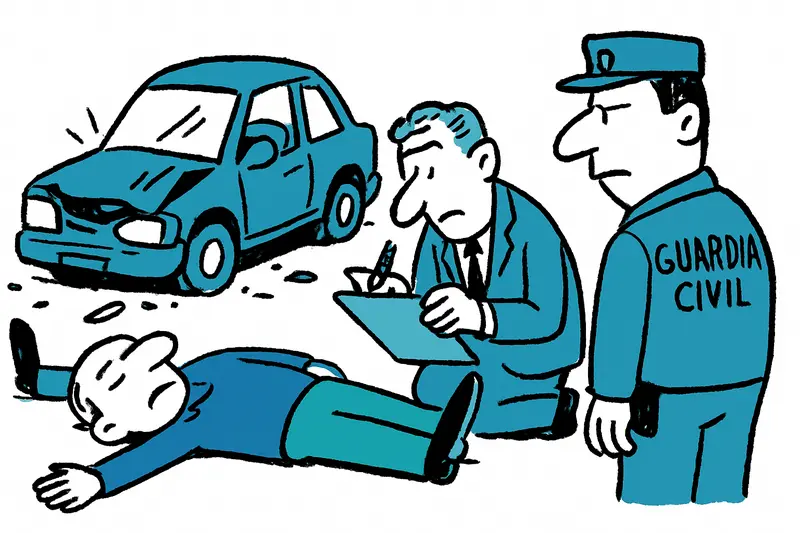
In the early hours of 15 November, a Hyundai Kona collided head-on with another vehicle near Port d'Alcúdia, as detailed in Fatal head-on crash near Alcúdia: What needs to change on the MA-3460? A 53-year-old man from the Netherlands died at the scene and several others were injured. The Guardia Civil now assumes that the deceased was not driving, but rather his 29-year-old companion. The woman is now being charged with negligent homicide and multiple counts of negligent bodily harm. She faces up to four years in prison and a driving ban of up to six years.
The turn in the investigation is, according to authorities, based on forensic results: the injuries of the deceased do not match those a driver would usually sustain in a frontal collision. There were no independent witnesses; immediately after the accident the woman said her companion had been at the wheel, a contradiction also examined in Alcúdia: Who Was Really at the Wheel? A Reality Check on Alcohol, Responsibility and Investigations. Such contradictions are at the core of the ongoing inquiry.
Viewed critically: the facts show how quickly narrative and truth can diverge. Without eyewitnesses much remains open, and forensic findings become central evidence — and part of the debate about credibility and motive. Why did the initial statement not match later findings? Was it confusion, a protective instinct, or a mistaken first impression in shock? The court must determine what can be proven; speculation helps no one. Agencies and sources such as the Guardia Civil official website provide procedural context for such inquiries.
What has so far been missing from the public discussion is a look at the road itself. Residents say the roundabout in question is problematic: coming off a long straight, vehicles approach at speed and have little room to react, a concern highlighted in Fatal accident in Alcúdia: Who is responsible — and what needs to change?. Such observations often remain marginal notes, even though they could directly help prevent future accidents; related guidance appears in European Commission road safety information.
A simple everyday snapshot: the evening before the hearing the cool air of Port d'Alcúdia drifts through the streets, the sea glitters, and at the affected corner a local bus stops; a few residents stand smoking at the stop and quietly discuss the crash site. You see the damaged streetlights, hear the distant honk of a lorry — and think: it is not enough to argue only about guilt when the infrastructure is a factor.
Concrete measures that urgently should be discussed here:
- Visible calming at the roundabout: better lighting, reflective markings, clear directional arrows and lower speed limits on the approach.
- Physical measures: speed-reducing humps or warning signs that force lower speeds, and a review of the curve radii.
- Technical support for investigations: faster access to available video and telemetry data, standardized accident reconstruction and more transparent timelines for the public.
- Prevention and education: local traffic inspections, information evenings and a hotline for residents to report recurring danger spots.
For the judiciary it is now crucial to separate the individual elements cleanly: forensic findings, witness statements and possible defects in the road layout. Only then can a robust criminal procedure be conducted — and only then can future accidents possibly be prevented.
In the end there remains a bitter line: whether the woman initially gave a different version out of fear, confusion or inattention will be decided by the court. For the people on site, however, the question of safe driving and clear road design counts. When a long straight becomes a dangerous sprint, neither confessions nor indictments help — visible measures on asphalt and at traffic lights are needed, not just at the courtroom table.
Conclusion: The investigation against the companion targets concrete accusations. At the same time, the case shows how important it is to view accidents not only legally but also in terms of infrastructure. Anyone traveling around Port d'Alcúdia should be more cautious with regard to roundabouts and long straights — and the municipality must examine how warnings can turn into real solutions.
Frequently asked questions
What happened in the crash near Port d'Alcúdia?
Why does the investigation near Alcúdia focus on who was driving?
How can forensic evidence show who was driving in a serious car crash?
Why are no eyewitnesses a problem in Mallorca traffic crash investigations?
What charges can follow a fatal road accident in Mallorca?
Is the road layout near Port d'Alcúdia considered dangerous?
What safety changes are being discussed for the roundabout near Port d'Alcúdia?
What should drivers know when passing through Port d'Alcúdia?
Similar News
After Being Admitted to Hospital Again: Heinz Hoenig and the Questions We Should Ask in Mallorca
Long-time Mallorca resident Heinz Hoenig was admitted to hospital again. A clear “what next?” is missing from the covera...
Yellow Alert: Is Mallorca Prepared for the Next Rain Band?
Aemet has issued a yellow alert for the south, southwest and the island's interior. Thunderstorms and heavy rain are for...
Kegel brothers trial postponed: Why Mallorca must wait for a verdict
The trial of 13 German holidaymakers will not begin until May 2028. The long wait raises questions — for victims, defend...
Chaos on Palma's Runway: Why the Summer at the Airport Was So Disrupted
This summer laid bare where Palma airport is faltering: only just over half of departures were on time and seven percent...
Cocaine Offer on Ham Street: Why the Open Trade Should Ring Alarm Bells
In the middle of Pare Bartomeu Salvà a tourist was offered a packet of cocaine as part of a sunglasses deal. A short int...
More to explore
Discover more interesting content

Can Cap de Bou

Townhouse Lleo 72
