
Woven Memory: Tongue Fabrics from Pollença
Woven Memory: Tongue Fabrics from Pollença
In Pollença a family has been weaving the so-called 'telas de llengües' for generations. A look into the workshop, the Ikat technique, and why these fabrics are important for Mallorca.
Woven Memory: Tongue Fabrics from Pollença
Four generations, cotton and the slow power of craftsmanship
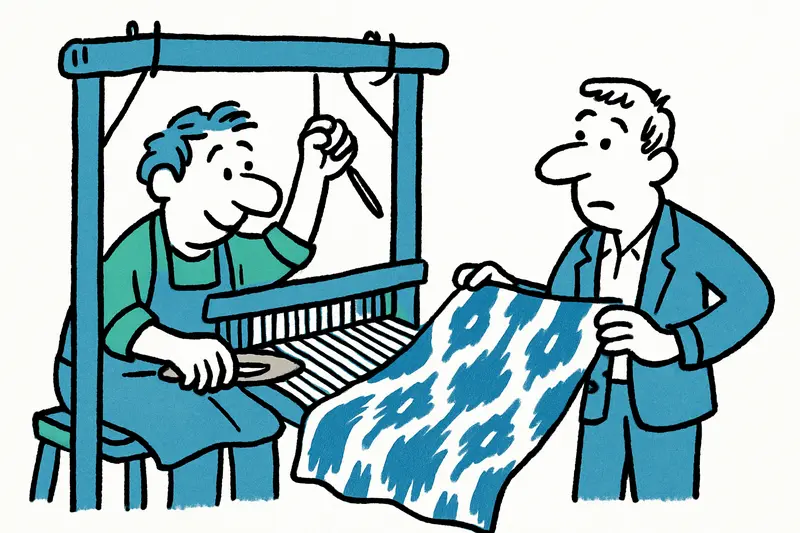
When in the morning the church bells of Pollença ring down over the Plaça Major and the scent of freshly baked pa amb oli drifts through the alleys, you can hear another, quieter sound in a side street: the rhythmic clack of looms. There a family works that has been producing the so-called telas de llengües — often simply called "tongue fabrics" in German — for decades. Anyone who enters the workshop immediately senses that it is not only products that are made here, but a culture that is being cared for.
The fabrics are characterised by their distinctive, tongue-like pattern. It is a form of the Ikat technique: strands of cotton and linen yarn are protected at certain points before dyeing so that after the dyeing process the characteristic, slightly blurred motif remains. Unlike industrial mass-produced goods, you can see small irregularities — and that is precisely their appeal. In the workshop the smell of linseed oil and cloth recalls summer evenings in the shadow of the Tramuntana; the machines, some still from the 1960s, hum alongside modern equipment, as if old and new were living together in a necessary neighbourhood.
The range of products is large: you can find tablecloths, curtains and cushions as well as bags, shirts and custom-made interior fittings. Customers are often measured at home; craftsmen come with a tape measure and a sample box, then return to the cutting room and sew tailored solutions on site. This is not a quick trade, but a service that requires time and care — and that is exactly what many locals and visitors appreciate.
Technique and material are part of the story. The work with paper strips and recycled bicycle inner tube, which are tied around the yarn strands before dyeing, is a simple, almost poetic solution to protect areas from the dye. It is a small, dirty, strenuous moment of craft: hands tying, threads knotting, the smell of dyes. Afterwards come the dyeing, the drying and the weaving — each step bears the trace of human labour.
On Mallorca there are only two other places besides this workshop where tongue fabrics are still produced in the traditional way — workshops in Santa Maria del Camí and Lloseta. It is precisely this scarcity that makes the fabrics a cultural treasure. Since spring 2025, local authorities have been working with the textile association to register the telas de llengües as a protected designation of origin with the Spanish patent office. The aim is to give producers legal protection and to make the authenticity of this craft tradition visible.
For the island this means more than a label; recent moves such as the purchase of the Fàbrica Nova in Sóller underline the commitment. It is recognition for work that does not disappear into a factory hall but is passed on in ateliers and small businesses. The effect is already noticeable in everyday life: people look more closely at Sunday markets in Mallorca, guests ask about the manufacturing process, and some interior designers deliberately order local fabrics. In a time when much seems interchangeable, such pieces give back identity — to houses, to hotels, to people.
Another aspect: collaborations with partners in the tourism sector support visibility and fair demand. Such collaborations do bring visitors into the workshops, but above all they open up new possibilities for commissions and training positions. Young people interested in textiles thus find an entry point and prospects — something that matters in rural communities.
For Pollença the tongue fabrics are an offering to everyone who wants to stay on the island without losing their own character. When you buy a piece of fabric here, you end up with not just a decoration but a piece of lived memory. And for the workshops it means: keep weaving, keep passing on, don't go too fast. A small tip for visitors: stop by early in the morning, speak briefly with the craftsmen, and if possible take a small item home. That helps ensure that the clack of the looms continues to accompany future mornings.
Frequently asked questions
What are tongue fabrics from Pollença, Mallorca?
How are telas de llengües made in Mallorca?
Can you visit a tongue fabric workshop in Pollença?
What can you buy made from tongue fabrics in Mallorca?
Why are Mallorcan tongue fabrics considered special?
Where are tongue fabrics still made in Mallorca?
Is Pollença a good place to learn about Mallorca’s textile craft?
What should I know before buying Mallorcan tongue fabrics?
Similar News

Mueller continues expanding in Mallorca: Artà in 2026, Can Picafort in early summer 2027
The drugstore chain Mueller is opening two new stores in Mallorca: a 1,400 m² shop in Artà on 5 November 2026 and a bran...
The Painter Who Lived Mallorca: Franz Taussig and His Century-Old Secret
A hundred years ago a young Viennese arrived in El Terreno, sketched the island and called himself Francis Caron. Today ...
Airport dispute: Bridge, forecasts and the question of responsibility
A video by the Spanish transport minister has ignited the dispute over DORA figures, capacities and local governance pow...
The Painter Who Invented Himself: How a Young Viennese Drew Mallorca
A hundred years ago a 19-year-old draftsman arrived in El Terreno. His diary and sheets, long known under the pseudonym ...

Released with Conditions: The Plus Ultra Suspicion and a Mallorcan Finca as Residence
A Dutch entrepreneur, sought in connection with the Plus Ultra case, was extradited to Spain after his arrest in Germany...
More to explore
Discover more interesting content

Can Cap de Bou

Townhouse Lleo 72
