
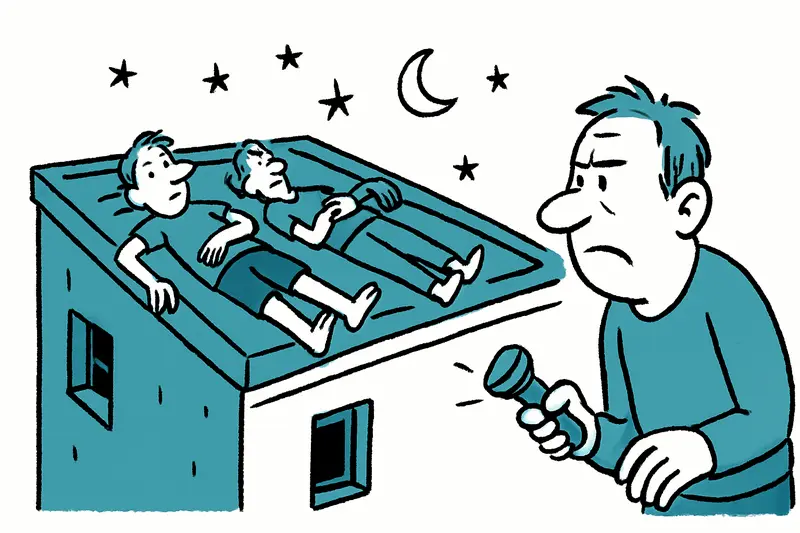
Who protects those who are unaccompanied? Young people sleep on a roof in Alcúdia — risks and advice
Who protects those who are unaccompanied? Young people sleep on a roof in Alcúdia — risks and advice
In Alcúdia several underage residents of a care facility slept on the flat roof of a house — apparently to escape the heat. A reality check: why such scenes become possible and how we can make them safer in the future.
Who protects those who are unaccompanied? Young people sleep on a roof in Alcúdia — risk and advice
Guiding question: What needs to happen so that heat doesn't lead minors to dangerous improvisations?
On a tropically hot night at the end of July, several young people in Alcúdia apparently searched for a cooler place to sleep, a phenomenon tied to wider homelessness and outdoor sleeping reports such as When work no longer protects against sleeping outdoors: Palma at a social crossroads. Local residents discovered them in the early morning hours and alerted one another. According to neighbors, the group consists of minors who are housed in a supervised residential facility run by the municipality.
At first glance the scene — young people stretched out under the starry sky, three storeys above the street — looks like a harmless summer story. On closer inspection it is worrying: one false step, a shifted roof tile, or a panicked moment could mean a fall from a great height. This is not a trivial matter but a tangible safety gap.
On the ground: voices of a late summer in Alcúdia. The tourist promenade is quiet, fishing boats sway gently in Port d'Alcúdia, and the clatter of dishes can be heard from a narrow alley, in a town recently in the news for a serious early-morning incident (Severely injured in Port d'Alcúdia: When life explodes behind closed doors). From the plaça residents feel the night air that brings little relief — air conditioners hum, fans circulate overheated rooms. Young people lie on a roof; from windows neighbors shine torches calling out, somewhere a dog barks. Such everyday scenes make visible the proximity of comfort and risk.
Critical analysis: Why does this happen? First, the heat. Tropical nights raise the discomfort level; poorly ventilated rooms and overcrowded living groups increase the urge to go outside. Then the infrastructure: supervised facilities for unaccompanied minors are often tightly scheduled, with clear rules but not always with sufficient alternatives for extreme weather. Supervisors cannot be everywhere at once. And last but not least social dynamics: young people seek free spaces, distance from rules, and group behavior gives courage for risky actions.
What is usually missing from the public debate: the perspective of the young people themselves; similarly, reporting has highlighted that No official heat protection for the homeless in Mallorca. It's not just about failures of control; often there is no simple, attractive alternative — a cool common room, extended outdoor times under supervision, or structured evening activities. Nor is it often discussed openly how local authorities concretely incorporate heat into the daily and nightly routines of care facilities. The neighborhood perspective is also underexposed: residents feel responsible but are overwhelmed when they have to react to potential dangers.
Concrete approaches — immediate and medium-term: In the short term, care providers should introduce simple protective measures: visible barriers at roof accesses, nets or railings, regular night rounds and a protocol for heat days. Cooling rooms in municipal facilities (library, cultural center, sports hall) should be made accessible to supervised youth with clear opening hours. AEMET heat warnings can be subscribed to and forwarded automatically to teams in the facilities.
In the medium term, heat routines are needed in social care: training for staff on heat stress and night supervision, flexible sleeping arrangements during hot periods, and cooperation with civil society groups that organize evening leisure activities — floodlit beach volleyball, cool project rooms, film nights in air-conditioned spaces. The city should institutionalize exchange between the neighborhood and the facility: a simple phone number or a digital chat for acute concerns prevents small observations from escalating into alarm.
Prevention can also start with the buildings: secure roofs, create non-slip and limited access points, revise emergency ladders. In new constructions of care facilities, heat protection should be part of planning: shaded outdoor areas, good insulation and adequate cooling are not a luxury but part of the duty of care, as concerns about improvised housing and makeshift shelters have recently shown (Living on the Edge of the Law: Eleven Illegal Shelters in Manacor as a Wake-up Call).
Another often neglected level is communication: open, respectful conversations with young people about risks — without moralizing — achieve more than strict bans. Participation increases acceptance: if young people are allowed to help plan what a cool evening zone should look like, they are more likely to use it.
Conclusion: The images of young people on a roof are a warning signal that concerns several responsible parties — the facility, the municipality, the neighborhood. The solution is not a bureaucratic act but a bundle of practical measures: immediate safeguards, accessible cooling rooms, staff training and genuine involvement of those affected. When another sultry night falls in Alcúdia, the answer should not be the roof, but a safe place to sleep — for the dignity and safety of those who do not have direct family supervision.
Concrete next step for the municipality: Establish an evening contact point for heat-related cases in supervised facilities and review a short-term safety protocol within 48 hours.
Frequently asked questions
When is the best time to visit Mallorca for warm weather and reliable beach days?
What should I pack for a Mallorca trip to handle sun, heat, and outdoor activities?
Are Mallorca’s beaches suitable for swimming all year, or are there better times?
What outdoor activities besides beach time are popular in Mallorca?
Where on Mallorca can families find calm, kid-friendly beaches?
How does the sea temperature vary around Mallorca?
Is Palma a good base for a short break, or should I plan longer stays on Mallorca?
What practical tips help manage heat and sun when exploring Mallorca?
Similar News
When the Wallet Becomes a Danger: Attack in Peguera and Lessons for Mallorca
In Peguera, two women are said to have stolen the wallet from a 75-year-old German couple. When the victim intervened, t...
Plata stays Plata: Young people take over, Llonguets remain
A small bar on Carrer de l'Argenteria will continue: Tolo Serra hands the place over to young Mallorcans at the end of t...
Unnoticed in the Luggage Compartment: How a Boy Traveled More Than 100 Kilometers in a Team Bus
A minor traveled in the undercarriage of a team bus for more than 100 kilometers until his cries for help were heard. A ...

Cap Vermell Grand: Second Michelin Key – a Gift for the East
The Cap Vermell Grand in Capdepera has been awarded its second Michelin key. For the region this elevates the luxury off...

Eurowings lets four aircraft carry names – a friendly idea that also reaches Mallorca
Eurowings is launching a campaign: four Airbus A320s are to carry the first names of people who help others in everyday ...
More to explore
Discover more interesting content

Can Cap de Bou

Townhouse Lleo 72
