
24 Graves in Felanitx: Who Wins — Hospital or Culture?
24 Graves in Felanitx: Who Wins — Hospital or Culture?
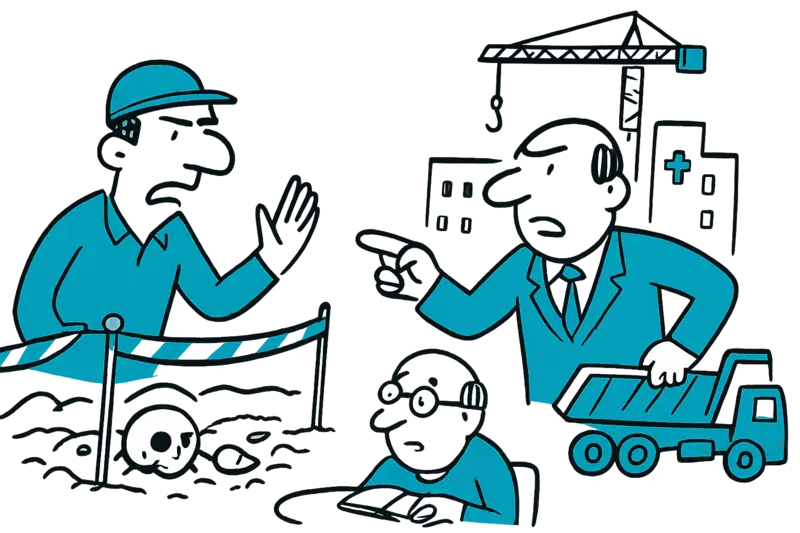
During the hospital construction in Felanitx, a necropolis with 24 graves and Islamic pottery was discovered. A test excavation turned into months of digging. Who decides now about speed and transparency?
24 Graves in Felanitx: Who Wins — Hospital or Culture?
Who decides when a public construction project in Felanitx encounters centuries-old heritage?
On the slope of Puig de sa Mola, where the scent of pine and the occasional drone of a tractor puncture the village's silence, excavators revealed more than soil: 24 burials, substantial amounts of Islamic pottery and the remains of a small stone structure with a hearth have come to light. A hospital had been planned for this site, as reported in New Hospital in Felanitx: Opportunity with a Catch — What Matters Now. Instead of two months of archaeological investigations, the work has become an excavation that has now lasted almost seven months.
The local officials – archaeologists, the health authority IB-Salut and the construction company – changed the procedure as more finds emerged. Samples were sent to the universities of Seville and Barcelona. Similar unexpected discoveries during public works have been reported elsewhere, for instance Deeper Cistern, a Thousand Shards: What the New Finds at Alaró Castle Mean. The excavation follows the directives of the island council's heritage authority. Still, tensions remain: the start of the building structure is scheduled for November, project participants speak of about five months of delay, and there is so far only a vague plan for the future preservation of the finds: part of the site is to be prepared for visits under the project's culture-percent (Kulturprozent) allocation.
Critical analysis: where the system fails
The procedure is legal but not free of conflict. The statutory requirement for archaeological trials has at least prevented the careless destruction of valuable traces. Yet practice reveals how poorly many public construction projects are prepared for archaeological finds: the original planning assumed two months of investigation, not a necropolis stretching across multiple test trenches. Decisions about how to handle the finds are often made between different institutions – the client, the archaeological team, the island council, the health authority – without neighbours, the municipal council or independent experts being obligatorily involved.
Moreover, the temporal decoupling is problematic: research results (dating, anthropological analyses) take months. On the construction site, however, the schedule is ticking. In public perception this easily creates the impression that archaeology is merely an obstacle to construction rather than a scientific and cultural opportunity.
What is missing from the public discourse
There is a lack of transparency and a tangible perspective for the population of Felanitx. There are hardly any binding statements on the expected completion date of the archaeological report, no clear figures on how the culture-percent will be used, and no public concept for whether and how the site will be permanently secured or communicated. The question of to what extent the results will be incorporated into the building planning (e.g. shifting construction areas, protecting zones) is only communicated in passing; these planning issues echo earlier coverage in New Hospital in Felanitx: Opportunity for the Llevant — but Questions Remain.
At the same time, low-threshold information offerings are missing: there are no regular local public meetings, no easily accessible documentation of the excavation results and no agreement on how human remains will be respectfully displayed or buried if permanent exposure is not possible.
Everyday scene in Felanitx
In the late morning an older man sits in front of the café on the Plaça, the newspaper set aside, church bells in the background. He looks up to Puig de sa Mola, where barrier tape and tarps mark the excavation areas. A school class conducts their project: children hold small notepads and ask the archaeologists questions, while delivery vans unload on Calle Sant Jaume. Everyday life and history sit so close together — visible and yet enigmatic.
Concrete proposals — so both can be possible
1) Immediate publication of a binding timeline: the archaeological report, anthropological results and a clear decision on which areas will be released for the hospital and which will be preserved. 2) Establishment of an independent oversight committee with representatives from the municipality of Felanitx, archaeologists, IB-Salut and a neutral expert, holding regular meetings and publishing minutes. 3) Use of the culture-percent budget for a permanent, publicly accessible presentation: an open-air information station at the edge of the construction site, virtual tours and conservation measures so that the finds are not reburied without documentation. 4) Prioritisation of fast but reliable dating methods (stratigraphy, C14, ceramic typology), combined with open communication of preliminary results. 5) Clear rules for handling human remains: dignified safeguarding, possible repatriation or burial in consultation with the community.
Conclusion
It is not a simple choice between hospital and culture. The situation in Felanitx shows that public construction projects need to be better prepared, more transparent and more participatory. A modern health centre is important — but when 24 graves and Islamic pottery come to light, the community has a right to clarity: What will remain visible? What will be conserved? And who will pay for it? If IB-Salut, the island council and the project partners act responsibly now, the delay can become a gain: a hospital for the present and a window to the past that tells the people of Felanitx something about who lived here before them.
Frequently asked questions
What is the best time of year to visit Mallorca for warm weather and swimming?
What should I pack for a Mallorca trip?
Are there family-friendly beaches in Mallorca?
How can I get around Mallorca without a car?
What are the best ways to enjoy Mallorca’s coastline without crowds?
Do I need to speak Spanish to get by in Mallorca?
Is it safe to swim in Mallorca year-round?
What day trips or longer outings make sense from Mallorca?
Similar News
Protection failed? A murder in Coll d'en Rabassa and the gaps within
A jury found a man responsible for his partner's death: 66 stab wounds, the crime carried out in front of their shared d...
Palma opens s’Aigua Dolça: New sports centre opens on October 15
The new municipal sports facility s’Aigua Dolça above the Paseo Marítimo opens on October 15 in several stages. Initiall...
Deadly accident in Mortitx: Why the Ma-10 becomes a danger stretch at rallies
At kilometre 10 of the Ma-10 a Porsche plunged into a ravine. The driver, a 63-year-old German, died and his passenger s...
Nighttime Break-in in Marratxí: Four Perpetrators, Smashed Door and Many Questions
A restaurant in Marratxí was robbed on the night leading into Thursday. Four masked perpetrators caused significant dama...
Rolex robbery in Santa Catalina: What does this attack say about Palma's safety?
In Santa Catalina, two attackers stole a Rolex worth €40,000 from a 65-year-old Swede. His pregnant daughter was shoved....
More to explore
Discover more interesting content

Can Cap de Bou

Townhouse Lleo 72
