
After a Bird Strike in the Air: How Safe Is Landing at Palma Airport Really?
After a Bird Strike in the Air: How Safe Is Landing at Palma Airport Really?
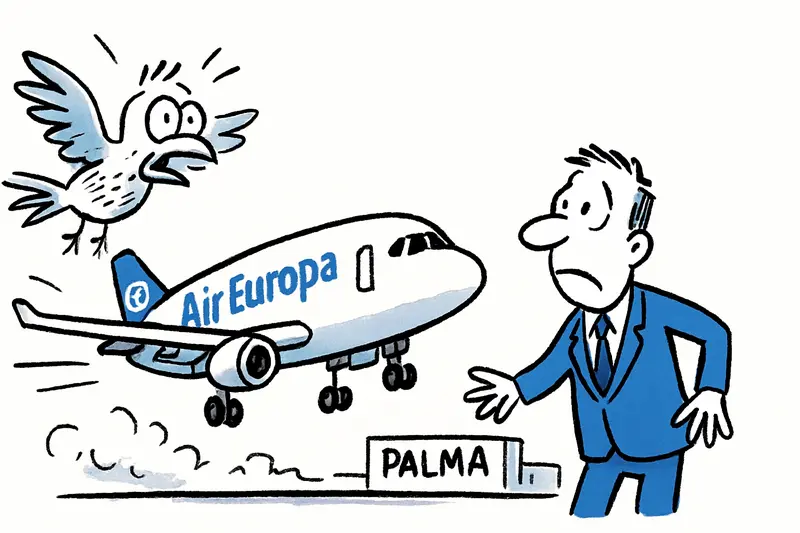
An Air Europa flight from Madrid landed in Palma after a bird strike and a brief control‑system issue. A close call — or a wake‑up call for better precautions?
After a Bird Strike in the Air: How Safe Is Landing at Palma Airport Really?
Key question: Was last night's incident just an unfortunate isolated case — or a sign that some improvements are needed at Son Sant Joan Airport?
Last night a flight from Madrid to Palma caused a brief scare for crew and ground staff: the aircraft apparently struck a bird and the pilots reported a short-lived control‑system fault shortly before touchdown, but were still able to land safely. Firefighters and technicians were on standby, and no one was injured. Flight operations were restricted for a while, some aircraft were diverted, and the situation normalized later.
It sounds like a fortunate ending — and it is. But the incident also raises questions. Bird strikes are not surprising on a Mediterranean island: seagulls, starlings, little grebes and other species are part of the coastal environment. Added to that is a steady increase in flights at Palma Airport, which increases the probability of critical encounters. If a control element then fails, you get a combination of risk and chance that makes us ask how robust the procedures really are.
Critical analysis
First point: a bird strike as the cause is plausible and known. But a hit is usually local and short‑lived — the question is how much it affected the cockpit and systems. The report mentions a fault in the control system shortly before landing. Here routine splits from emergency: do pilots have enough redundancy and alternative procedures in training to react to changed control inputs at the last minute? In many cases, yes. Still: depending on which component is affected, the landing can become more demanding.
Second point: emergency management on the ground. Fire brigades and technicians were 'immediately on site' — good. But how quickly are blocked runways cleared for use again? Why were flights diverted: because the aircraft needed inspection, because the runway had to be cleared, or because of precautionary safety buffers? These details determine how large the impact on the overall flight schedule is.
Third point: communication. Transparency is important for passengers, residents and transport companies. Short, precise information reduces speculation. The brief statement that 'flight operations were restricted' leaves many questions unanswered: Ryanair Strike Hits Palma: How Big Is the Threat to Holidays and the Island's Economy?, how long did the restriction last, and what compensatory measures were taken?
What is missing from the public discourse
1) Data on the frequency of bird strikes at Palma Airport and trends in recent years. 2) Concrete measures by the airport operator for bird control (radar, habitat management, operating hours of wildlife teams). 3) Information on maintenance cycles and system redundancies in the fleets of the affected airlines. 4) Impact on the flight schedule and passengers — not just 'diverted', but duration, notifications and compensation.
Everyday scene from Palma
The morning after, a taxi driver sits at the exit of the Estación Intermodal, a cigarette between his fingers, and talks about the loud overflight of planes along Avenida Joan Miró; the seagulls screech, fishing boats glide into the harbor, and at the small street cafés people discuss delays and missed ferries. For the airport's professional taxi drivers every traffic jam behind departing buses means less income — a small, real consequence of Strikes at Palma Airport: Why the Weekend Chaos Could Last Longer This Time.
Concrete solutions
1) Transparent incident statistics: airport operators should publish regular reports on bird‑strike incidents — numbers, times of day, and affected departure/arrival directions. 2) Radar‑based bird monitoring system: a bird radar can report critical flocks in real time and support operational decisions. 3) Habitat management around the runways: targeted drainage of standing water, vegetation management and securing waste disposal sites. 4) Regular emergency drills: practice scenarios with combined failures (bird strike plus system malfunction) so crew and ground staff can refine procedures. 5) Transparent passenger communication protocol: fast, standardized information for affected people, including guidance on connections and contact points. 6) Cooperation between Aena, airlines and Balearic authorities: coordinated measures instead of isolated solutions.
Conclusion
The safe outcome of this incident is thanks to the crew and ground staff. Nevertheless, we should not confuse a touch of luck with system stability. Bird strikes are a recurring problem, and technical faults can affect any aircraft. Those who live or work on Mallorca know the daily roar of the engines — so we know incidents happen. What matters is how transparently those responsible handle them and whether real improvements follow from each event. If the next steps bring clear numbers, better monitoring and closer coordination between airport, airlines and authorities, this will remain a wake‑up call that produces change — otherwise it will stay a lucky outcome you cannot rely on.
Frequently asked questions
What is the weather usually like in Mallorca in spring?
Can you still swim in Mallorca outside the main summer season?
What should I pack for a trip to Mallorca in shoulder season?
Is Mallorca a good destination for walking and outdoor activities in mild weather?
What is Porto Cristo like if you want a quieter base in Mallorca?
What makes Cala Mondragó a popular place to visit in Mallorca?
Is Valldemossa worth visiting on a short trip to Mallorca?
When is the best time to visit Mallorca if you want comfortable temperatures?
Similar News

When the Wallet Becomes a Danger: Attack in Peguera and Lessons for Mallorca
In Peguera, two women are said to have stolen the wallet from a 75-year-old German couple. When the victim intervened, t...
Plata stays Plata: Young people take over, Llonguets remain
A small bar on Carrer de l'Argenteria will continue: Tolo Serra hands the place over to young Mallorcans at the end of t...

Unnoticed in the Luggage Compartment: How a Boy Traveled More Than 100 Kilometers in a Team Bus
A minor traveled in the undercarriage of a team bus for more than 100 kilometers until his cries for help were heard. A ...

Cap Vermell Grand: Second Michelin Key – a Gift for the East
The Cap Vermell Grand in Capdepera has been awarded its second Michelin key. For the region this elevates the luxury off...
Eurowings lets four aircraft carry names – a friendly idea that also reaches Mallorca
Eurowings is launching a campaign: four Airbus A320s are to carry the first names of people who help others in everyday ...
More to explore
Discover more interesting content

Can Cap de Bou

Townhouse Lleo 72
