
Ryanair Strike Hits Palma: How Big Is the Threat to Holidays and the Island's Economy?
From August 15 delays threaten again at Palma airport: planned walkouts at Azul Handling could bring baggage chaos, waiting times and economic consequences for the island. What travelers and businesses should do now.
Ryanair Strike Hits Palma: How Big Is the Threat to Holidays and the Island's Economy?
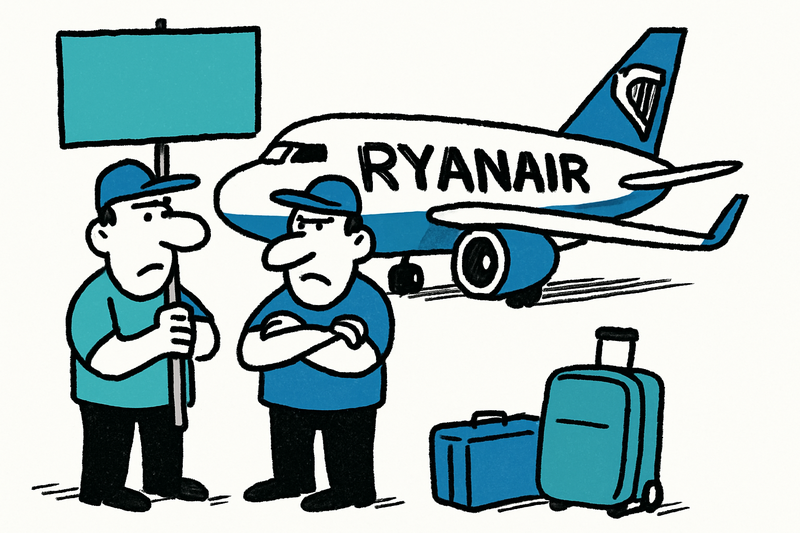
When announcements at Son Sant Joan Airport get louder in the middle of summer and travelers crowd more tightly, this is not just a logistical issue on Mallorca but part of everyday life that affects the island: From August 15 the union UGT has announced a strike at Azul Handling, the service provider that performs many ground tasks for Ryanair flights (see Ryanair Ground Staff Strikes: What Mallorca Needs to Know).
What is planned and who will be affected?
The labor action starts on three consecutive days (August 15–17) and then continues until the end of the year on four weekdays: Wednesdays, Fridays, Saturdays and Sundays. The walkouts are to take place in three shifts — early morning, around noon and in the evening — exactly the time windows when arrival and departure waves coincide. Baggage handling, cabin cleaning and other ground services are mainly affected. As a result, longer wait times, delayed departures and, in the worst case, flight cancellations are possible.
Background: Why are the employees striking?
UGT complains about sanctions against employees, for example for refusing unpaid or voluntary overtime. Some workers report months without pay or work; the dispute concerns the working conditions of around 3,000 employees across Spain (see Ryanair Strike in Mallorca: Who Pays the Price — and What Travelers Should Do Now). In addition, the union is calling for binding agreements on equality. All of this comes down to a fundamental problem: How are ground services organised — as stable, regular jobs or as easily replaceable, low-cost services?
Who is being discussed too little so far?
Public debate usually focuses on irritated holidaymakers and cancelled flights. Two aspects receive less attention: first the role of subcontractor chains through which large airlines outsource risks and costs. Second is Mallorca's seasonal structure: in high summer staff are scarce, hotels run at full capacity, and small service providers (shuttles, catering, car rentals) have little buffer for sudden downturns (read Palma before the departure chaos: Ground staff strike plans put the island to the test). The result can be a domino effect — from the baggage carousel to room occupancy.
Concrete scenarios and possible consequences
Near the terminals you can already hear the beeping of baggage tugs and announcements about gate changes. Scenarios range from delayed luggage being collected in long nighttime queues to prioritizations where only departures are serviced first and arrivals must wait. For package tourists who fly late in the evening, this can significantly sour the end of their holiday. For the island's economy it is not just a few extra hours of work: restaurants and bars in Palma, taxi drivers at the exit or weekly markets that rely on outgoing guests quickly feel noticeable revenue losses.
Are there solutions — and what role does mediation play?
It is not hopeless: a state mediation service has been involved, and dialogue remains possible (Strike at Ryanair Ground Handler: A Stress Test for Mallorca’s Summer Operations). Practical measures that could help in the short term are:
1. Better communication: Airports, airlines and tour operators should provide real-time information — via app, SMS and loudspeaker. This reduces chaos at the counters.
2. Prioritization plans: Technically it is possible to process critical flights (e.g. connecting flights) with priority to limit cascading effects.
3. Temporary help and cooperation: Airports could train local staff from other areas or activate cooperating providers — with clear working conditions so that no precarious solution emerges.
4. Digitalization: Self-bag-drop, contactless check-in and optimized baggage sorting reduce manual steps.
In the long term, however, a political debate is needed about the use of subcontractors, fair employment contracts and seasonal protections for the island economy.
What can travelers do now?
Practically speaking: arrive early, check in online, travel with carry-on only if possible, build in extra time and stay flexible. Tour operators and airlines should generously offer rebooking and assistance to affected passengers. On site this means: remain calm at the counters, but also apply clear pressure on decision-makers — because every hour of congestion at the baggage belt costs not only nerves but also euros in the cafés around the airport.
Outlook for Mallorca
The island's economy depends heavily on tourism; any sign that arrivals and departures have become less reliable affects local sentiment. At the same time, the dispute presents an opportunity: better protections for employees could lead to more reliable operations in the long run. If the airport, politicians, airlines and unions negotiate seriously now, a more robust timetable can be developed — one that not only gets the plane airborne, but also treats the people at the base fairly.
At the end of the day, when the sun sparkles over the bay of Palma and the market vendors' voices grow louder again, it will become clear whether the island will only experience a brief hiccup or whether the summer will be a little more restless than usual. For guests and residents alike: stay well informed, keep calm and focus on solutions.
Frequently asked questions
Will the Ryanair ground staff strike affect flights from Palma Airport?
What should I do if I am flying from Mallorca during the strike dates?
Why are Ryanair ground staff in Spain striking?
Could the Palma strike cause baggage delays for holidaymakers?
How could the strike affect Mallorca's tourism economy?
Is the Ryanair strike in Palma likely to continue beyond mid-August?
What kind of passengers are most likely to be affected at Palma Airport?
Can anything be done to reduce disruption from the strike in Mallorca?
Similar News
Release after bloody attack in Palma: Why the court's decision raises questions
An 18-year-old who allegedly inflicted a serious neck injury on a man at Plaza Gomila using a wristwatch wrapped around ...
Kidnappings in Inca: Three young men forced into car trunks and abused in the forest – a reality check
In Inca, three 18-year-old men were forced into car trunks by masked assailants at the Plaça des Bestiar, taken to a for...
Spreading Massification: The Brake That Still Has Much Work to Do
Marga Prohens announces limits on volume tourism. The measures sound harsh — but are they enough to save everyday life, ...

Through the Keyhole onto the Party Yacht: How Daniela Katzenberger Is Planning Her 40th on Mallorca
Daniela Katzenberger turns 40 and wants to celebrate it on the island — likely with a boat, cake and her mother. A relax...
By Boat Instead of the Road: Palma's Water Bus — a Reality Check
The 'Bus Nàutic' launches in two stages — but questions remain over interim operations, fares and environmental requirem...
More to explore
Discover more interesting content

Can Cap de Bou

Townhouse Lleo 72
