
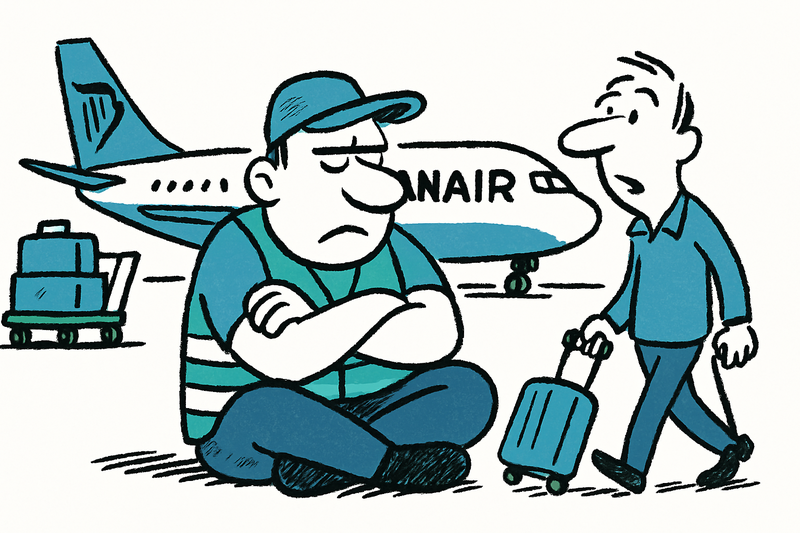
Strike at Ryanair Ground Handler: A Stress Test for Mallorca’s Summer Operations
From mid-August, employees of Ryanair handler Azul Handling plan recurring strikes — a stress test for Palma Airport, hotels and the island's tourism flow. What this means for holidaymakers and the local economy and what solutions are possible.
A stress test for Palma: Why strikes at the airport are more than just delays
The sound of rolling suitcases on the forecourt of Son Sant Joan, the muffled announcements over the departure-area loudspeakers and the steaming heat at the gate early in the morning: in August this familiar airport scene could stall more often. From August 15, the ground staff of Azul Handling, which handles many Ryanair flights in Spain, has announced a coordinated strike Ryanair Ground Staff Strikes: What Mallorca Needs to Know. Three days in a row, and then regularly at selected peak times until the end of the year, a schedule reported in Ryanair Strike Hits Palma: How Big Is the Threat to Holidays and the Island's Economy?.
The key question
How vulnerable is Mallorca's tourism if Palma Airport regularly experiences disruptions — and what measures can the island, the airport and the industry take to avoid greater damage?
What's behind the labor dispute
The unions talk about repeated violations of employee rights and insufficient working conditions. For the staff these are not abstract issues: it's about shift schedules, breaks, safety standards and being able to plan life on the island. For travelers it often reads simply as a “delay”, but for the island's economy the consequences can be far-reaching.
The overlooked risks
Public discussion usually focuses on waiting times and cancelled flights. Less in the spotlight are:
1) Chain systems in the tourism supply: Late arrivals break check-in chains, rental car reserves shrink, transfers fall through. A delayed flight in the evening can mean that travelers spend a night in transit — at the expense of small accommodation providers and bus drivers.
2) Seasonal workers: Many seasonal staff commute by air. Repeated disruptions undermine staffing plans in hotels and day-trip operators.
3) Loss of trust: If families have to rearrange plans twice, they are more likely to choose other destinations in the future.
4) Environmental and infrastructure effects: Diversions and holding patterns increase fuel consumption and noise, which raises the burden on the island, especially on high-season nights. Local reporting has highlighted how such disruptions can create departure chaos at peak times Palma before the departure chaos: Ground staff strike plans put the island to the test.
Concrete actions — not just wishful thinking
Strikes are conflictive, but they also force reflection. Some pragmatic proposals that should be discussed now:
Short term
- Better, automated communication: airports, airlines and hotels must inform passengers much earlier (SMS, push notifications, commuter displays in Palma).
- Flexible transfer solutions: shuttle providers and taxi associations should plan standby capacity for peak times.
- Contingents for delayed arrivals: hotels could reserve cheaper last-minute rooms for stranded travelers.
Medium to long term
- Diversification of ground handlers: airport operators could review contractual arrangements to reduce dependence on a single service provider.
- Arbitration mechanisms: an independent mediation body could provide quick solutions to labor conflicts before the high season is fully affected.
- Transparency obligations: standardized information for travelers about rights, possible compensation and alternatives would make it easier to handle disruptions.
What travelers can do
For those traveling to Mallorca in the coming weeks: arriving early at the airport remains sensible. Keep tickets ready in digital form as well. Check trip cancellation or travel insurance; for critical connections consider alternative routes early (different flight times, airports or ferries). And yes: a little extra buffer time, a second pack of snacks and a calm voice are good companions in August.
An opportunity for the island
As obvious as the disadvantages are — there is also an opportunity in the crisis. If airport operators, politicians and the local economy now work together to find more robust processes, Mallorca can emerge from the season stronger: more resilient transfer systems, better working conditions and clearer communication channels would benefit everyone in the long run — the colleagues at check-in, the families at the gate and the island's economy.
In the end, a fundamental question remains: do we want to stumble reactively through the summer — or use the disruption to make operations at Son Sant Joan more sustainable and humane? The answer will decide whether the suitcases soon roll smoothly again along the Passeig Marítim or whether the nervous clatter becomes the new summer soundtrack.
Frequently asked questions
Will Ryanair ground staff strikes affect Palma Airport in Mallorca?
What should I do if my Mallorca flight is delayed because of a strike?
Is summer the worst time for airport strikes in Mallorca?
How can a strike at Palma Airport affect hotels and transfers in Mallorca?
What can travellers do to reduce stress during a strike in Mallorca?
Why do airport strikes matter for Mallorca’s economy?
How could Mallorca reduce the impact of future airport strikes?
Does a strike at Palma Airport affect only Ryanair passengers?
Similar News

Maribel: Five Decades of Service – Housekeeper from Peguera Celebrated with a Special Honor
Over 50 years in the hotel business: María Isabel “Maribel” Molinos was honored in Palma at the Nit del Turisme by Unive...

Orange Alert over Parts of Mallorca: Are We Prepared?
Dark clouds and an announced wet spell have triggered an Orange alert in parts of Mallorca. A reality check: what's miss...

Sundair & Co.: Sale speculation and what it could mean for Mallorca
Rumors about a possible sale of the airlines Sundair and Fly Air 41, which belong to Schauinsland-Reisen — and whether b...
Anne Wünsche in Mallorca: A job offer with a catch — who fits the role of personal assistant?
Influencer Anne Wünsche has left Berlin and is urgently looking for a full-time personal assistant in Mallorca. Why the ...

Daily from New York: Palma Between Boom and Strain
United will increase the Newark–Palma route to daily flights in 2027 using Boeing aircraft (231 seats). What does the in...
More to explore
Discover more interesting content

Can Cap de Bou

Townhouse Lleo 72
