
Alarm on the Coast: What to Do When the "Asian Alga" Appears off Mallorca?
Alarm on the Coast: What to Do When the "Asian Alga" Appears off Mallorca?
The invasive Rugulopteryx is spreading across the western Mediterranean. Why early detection and local measures are now crucial — and what may be missing in Palma, the ports and among divers.
Alarm on the Coast: What to Do When the "Asian Alga" Appears off Mallorca?
Central question: Can we stop the spread of the invasive Rugulopteryx before it seriously damages the Posidonia meadows and the coastal economy?
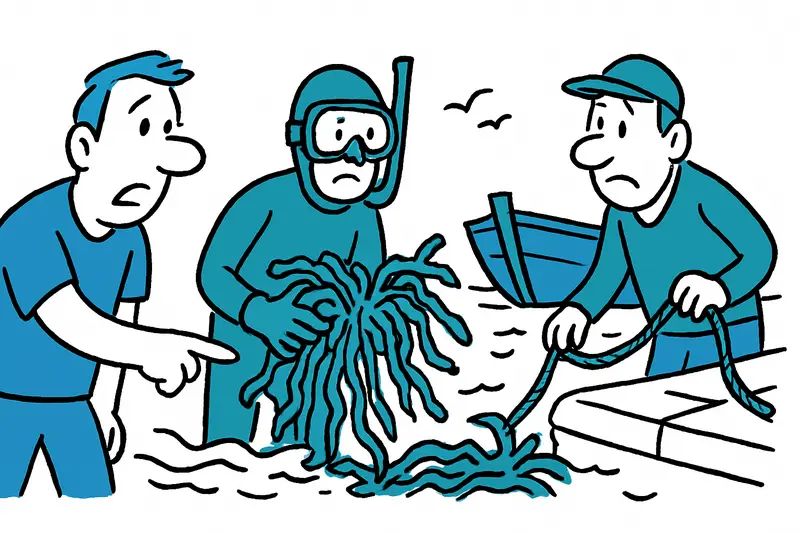
The warnings from plant scientists are on the table: an aggressive algae species, originally from the Pacific, has already occupied large areas in the western Mediterranean. Mallorca is not yet on the map of confirmed occurrences — but that is no excuse for inaction. When I walk along the Passeig on a windy morning, I hear the voices of fishermen in the harbour, see divers in wet suits and watch motorboats glide from dock to dock. It is precisely there, on quay walls, on breakwaters and in the harbours, that the greatest danger lies: transport routes for new species. Red Carpet on the Quay: Why Krill Finds on Mallorca's North Coast Are a Warning Signal
The danger is twofold: first, Rugulopteryx displaces native algae and can thereby change seabed structures. Second, it indirectly threatens the Posidonia meadows, those green carpets that keep the water clear along Mallorca's coast and protect fish, mussels and juveniles. Where several native species once lived side by side, a monotony threatens that offers little potential for compensation. Mystery at the Mole: Striped Dolphin as a Warning for Palma's Sea
Critical analysis: the measures so far — spot manual removals and occasional beach clean-ups — are reactions, not prevention. Shipping and aquaculture remain largely open as introduction pathways. Although there are international rules for ballast water treatment, controls are patchy in practice; inspections of recreational and fishing boats are rare. More Controls at Sea: Cala Ratjada in Focus — Are the Measures Enough? Dry‑dock appointments, cleaning of trawl and fishing gear or simple visual checks at piers take place irregularly. And: research and monitoring are fragmented, often short‑term projects without long‑term monitoring plans.
What is missing in the public discourse: clear responsibilities, fast communication chains and the involvement of the people who work on the water every day. Authorities like to talk about studies and recommendations Island council wants to contain the blue crab — is the new package of measures enough?, but the people on the quays ask: Who pays for regular inspections? Who organises diver teams for an initial survey when something is discovered? And why is there no local reporting point that accepts photos via an app and immediately alerts experts?
Everyday scene from Mallorca: imagine the small harbour of Portixol. A boat owner returns from shopping, ties his boat to the dock and notices greyish, fibrous deposits on the hull. He shakes his head, thinks of bureaucracy and moves on. Without an easy reporting channel, the observation remains isolated — and this is exactly how new species can spread unnoticed.
Concrete solutions, pragmatic and implementable locally:
1) Strengthen early detection: regular inspections at ports, slipways and breakwaters; standardized photo series by diver teams; use of eDNA sampling in key ports for rapid detection.
2) Citizen participation: a simple reporting app for boat owners, divers and beach visitors combined with a local hotline network; small incentives for reports, e.g. a free harbour inspection after a notification.
3) Preventive measures for vessels: mandatory checks on recreational and commercial vessels before changing ports; hull cleaning after prolonged berthing; consistent application of ballast water standards for larger shipping.
4) Rapid response: local "rapid response" teams made up of divers, harbour workers and biologists who have sound protocols for safe removal and disposal; pilot trials with gentle suction techniques for loose biomass in sheltered areas.
5) Science and monitoring: long‑term mapping of Posidonia meadows using drones and ROVs, combined visual and molecular surveys, and coordinated data platforms for the Balearics.
Funding can be mixed: EU funds for invasive species, regional budgets, port turnover levies and contributions from aquaculture operators. Without clear priority, however, funds remain sporadic and reactive.
Concise conclusion: It is not a distant scenario if Rugulopteryx reaches Mallorca; it is a question of "when" and "how fast." We do not need alarmism, but a tested handbook: detect, report, cordon off, remove, follow up. If authorities, ports and the people on the quays cooperate now, the island can keep the problem small. If not, a slow, hardly visible change of the seabed threatens — and that would cost us here more than just beach cleaners.
Frequently asked questions
What is the best season to visit Mallorca for sun and warmth?
Is swimming in the Mallorcan sea comfortable year-round?
What should I pack for a trip to Mallorca?
What are family-friendly beaches around Mallorca?
What activities can I enjoy in Mallorca besides sunbathing?
Is Palma a good base for exploring Mallorca, or should I stay elsewhere?
What should I know about Mallorca’s weather patterns by season?
How can I visit Mallorca on a budget?
Similar News

Reality, Trauma and Responsibility: Danni Büchner in a Villa on Rhodes – How Far Can Television Go?
Danni Büchner, who lives on Mallorca, is taking part in a new TV format that brings nine women together for twelve days ...
A Rescue That Kills: What the Death of a Holidaymaker on Menorca Reveals
While trying to save her granddaughter, a 69-year-old British woman lost her life on Menorca's north coast. A critical l...

On the Avenidas Against the ATM: Why the Accident in Palma Is More Than Just Property Damage
In central Palma a driver lost control and crashed into a shopfront housing an ATM. Minor injuries but major questions a...
Plastic, Bottles, Tools: Why Portals Vells Is No Longer Just a Postcard
The popular three-finger bay at Portals Vells reveals a different picture beneath its sparkling surface: systematic litt...

Elke Sommer and Mallorca: A Small, Lasting Film Glimpse
Elke Sommer has died at the age of 85. A look at her connection to the island: filming locations, a controversial bikini...
More to explore
Discover more interesting content

Can Cap de Bou

Townhouse Lleo 72
