
Alarm over Palma: Emergency Report Due to Fire Indicator – What the Announcement Really Means
Alarm over Palma: Emergency Report Due to Fire Indicator – What the Announcement Really Means
A flight from Madrid reported a possible fire indicator during its approach to Son Sant Joan. Operations were briefly reorganized and the aircraft landed without visible damage. But these incidents tell us more than the brief cockpit announcement — and raise questions about communication, maintenance and transparency.
Alarm over Palma: Emergency Report Due to Fire Indicator – What the Announcement Really Means
Short priority, long questions: An incident at Son Sant Joan Airport
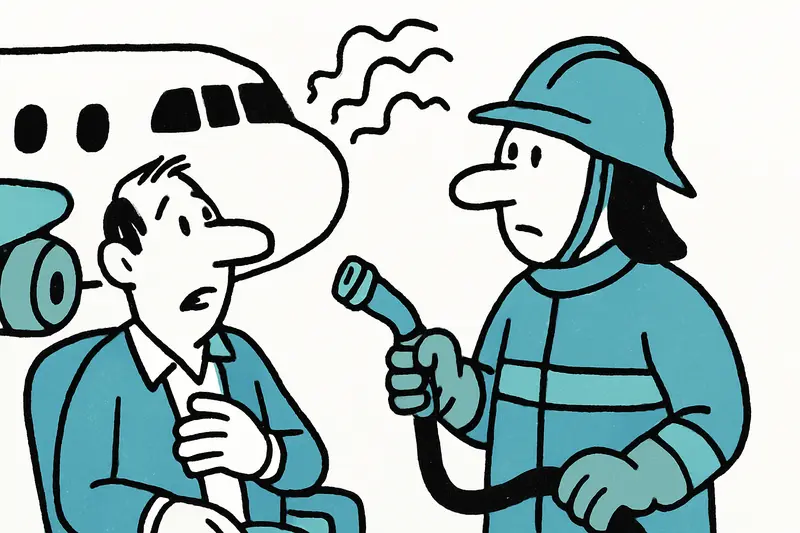
On Saturday at midday, with mild spring air over Son Sant Joan and the quiet hum of engines, a passenger aircraft from Madrid reported a possible fire situation during its approach. Air traffic control reacted immediately: the approach was shortened, runway 06L was cleared, and a rescue vehicle was allowed to take position. Minutes later the aircraft was on the runway, taxied via exit N2 and was inspected by the airport emergency services. No fire was confirmed.
Main question: Are these procedures alone enough to really make us feel safe, or does the incident reveal gaps in communication, technology and transparency?
The visible side of the operation was impeccably organized. Tower, crew and ground rescue coordinated the sequence in the airspace, holding patterns were created, and other aircraft were diverted. For passengers, this meant noticeable unrest, hushed voices in the aisle, the typical rustle of paper towels while waiting — and the matter-of-fact announcement about a possible problem. When the doors opened, passengers were only allowed to disembark after clearance. So much for the protocol, so good the practice that Saturday.
On closer inspection, however, questions remain: How often do false alarms from smoke or fire indicators occur on board such aircraft? What information do passengers receive at the moment of the alert — is a brief announcement enough to prevent panic among people with a fear of flying? And how transparent are airlines and airport operators afterwards toward travelers and the public? Similar questions arose after recent local fires such as Fire near Porto Pi: What the blaze reveals about safety in Palma.
What is often missing in public discussion is detail: the technical background of the warning sensors, how often maintenance takes place, and a clear presentation of the decision chain from alarm to runway release. Also rarely discussed is the burden on emergency personnel during peak season — when multiple simultaneous incidents could occur in an hour, as highlighted by Mallorca on Alert: Highest Wildfire Warning Level and Scorching Heat – What to Do Now. These are not dry administrative questions; they directly affect waiting times, diversions and the sense of security for hundreds of people.
A scene from everyday life here in Palma: on the terrace of a small café on the Passeig, not far from the airport office, locals and hotel porters repeatedly look toward the runway. They know the routines — colleagues on shift exchange messages by radio, guests ask about delays, suitcases roll over the asphalt. Such glances reveal: safety in the sky is a topic of conversation down here on the street.
Concrete solutions would be practical and immediately implementable. First: a mandatory, easy-to-understand information duty for crews toward passengers during alarm reports — short, clear instructions about what is happening and how long the wait is likely to be. Second: published figures on false alarms and inspection intervals; an airport office could provide monthly anonymized reports, similar to the scrutiny after incidents like Fire in Can Morro near Porto Pi: A Wake-Up Call for Mallorca's Fire Safety. Third: regular, documented joint exercises of tower, airline crews and ground rescue teams during peak season so procedures hold up under pressure. Fourth: a brief follow-up message to affected passengers by SMS or email with the results of the investigation and possible contact points for complaints or questions.
Technology naturally plays a major role: sensors are sensitive and react to smoke, steam or even hot brakes. A modern maintenance plan combined with software updates for alarm logic reduces false alarms and prevents unnecessary delays. Equally important is the question of responsibilities: who bears the costs and arranges alternatives when a flight arrives late at its destination or passengers miss connections?
Conclusion: The operation on Saturday was professional and the outcome was reassuring — no fire, no injuries. Yet we should not stop at that relief. More transparency, better passenger information and documented exercises would strengthen trust and make operations in Mallorca more resilient. In everyday life, when the roar of jets over Palma fades and the streets fill again, it is precisely this reliability we want: visible, explainable and comprehensible.
What matters now: Ask questions instead of ignoring them, insist on clarity from airlines and airport management, and demand small improvements that can make a big difference in an emergency.
Frequently asked questions
What does a fire indicator alert on a plane landing in Mallorca usually mean?
Are false fire alarms on planes common at Palma Airport?
What happens when a plane reports a possible fire while approaching Mallorca?
Will passengers on a Mallorca flight be told clearly if there is a fire warning?
What should I expect if my flight to Mallorca is diverted because of an emergency alert?
Is Son Sant Joan Airport in Palma prepared for onboard emergency alerts?
What improvements could make airport safety in Mallorca clearer to travelers?
Should travelers worry when they hear about a fire alarm on a Mallorca flight?
Similar News
Magaluf: Watchtower Alarm – Lifeguards Pull Unconscious Beachgoer from the Water
After a drama in the late afternoon, two lifeguards at Magaluf beach rescued an unconscious 44-year-old man. He was stab...

Turquoise in the City: How dangerous is the color play of the Sa Riera?
The Sa Riera in Palma suddenly turned turquoise — a pretty motif, but behind the effect lies a discharge of saline waste...

Jeckliner at Sunnesching: Cologne spirit sets sail from Palma
In September 2027 the Mein Schiff 2 briefly becomes a floating carnival stage: four days with Cologne bands, comedy and ...
Finally Home: Mike and Leyla Heiter Buy Villa with Sea View in Mallorca
The reality TV couple Mike and Leyla Heiter have bought a house in Mallorca with a roof terrace and sea view. An Instagr...
Arrest after series in Palma: Who protects apartments from repeat offenders?
The National Police arrested a man in Palma who investigators say may have broken into several apartments. In one incide...
More to explore
Discover more interesting content

Can Cap de Bou

Townhouse Lleo 72
