
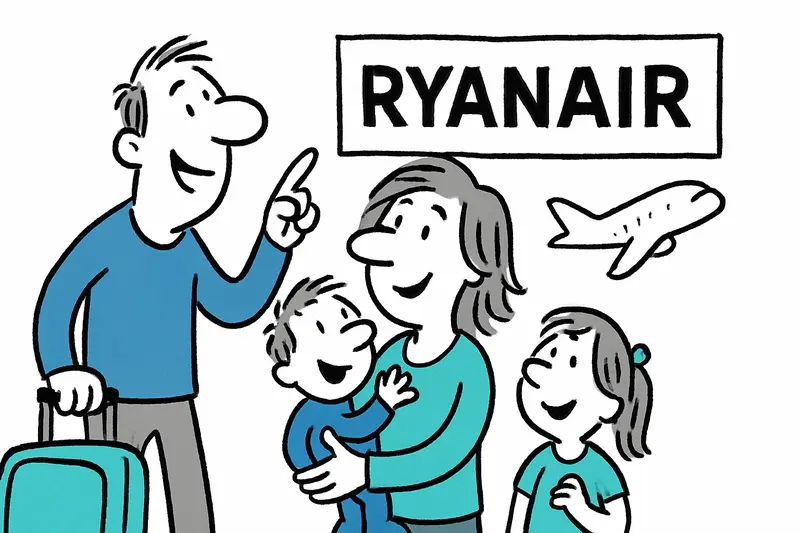
Families save: Ryanair drops mandatory paid seat reservations
Families save: Ryanair drops mandatory paid seat reservations
Ryanair has abolished the mandatory, paid seat reservation for parents traveling with children. What this means for travelers to Mallorca — and how families can make the most of it.
Families save: Ryanair drops mandatory paid seat reservations
Good news for parents, shorter walks at the airport — and a small tip from Palma
Since 25 June 2026 the Irish low-cost airline has implemented a change that should make life easier for many parents: the obligation to prebook a paid seat for children and the accompanying adult has been lifted. Families can now opt for a free, random seat assignment at check-in.
Concretely, this means: those who book flights for themselves and children no longer have to pay extra fees just to sit together. Previously, the rule was that one adult had to book a seat for children aged roughly two to eleven; up to four children could then sit next to that person for free. In practice the reservation cost averaged around eight pounds, a little over 9 euros. That requirement is now gone — at least as a mandatory condition.
From Mallorca's perspective this is a small everyday improvement with noticeable effects: more families mean more short trips, more visits to cafés at the Plaza Mayor, more ice cream sales along the Passeig des Born and more children's laughter on Palma's beaches. When parents at the arrivals hall of the airport see their children's faces, happy to have been seated without extra fees, that moment on the island quickly translates into revenue.
A word on organization: the airline points out that the free random allocation often places seats further back in the cabin — front rows are frequently reserved and are filled first. This is a practical hint: families who primarily want to sit near the forward exits may still need to actively choose seats. But those who are flexible save the fee and the hassle of preplanning.
A few practical tips for travelers starting or arriving in Palma: check in online and use the app — it speeds up processing at the desk. Arriving early at the airport pays off: the earlier the check-in, the higher the chance that the automatic seat allocation will place all family members together. Those who want certainty and are willing to pay can still reserve seats; for many families the new option is a welcome relief, even amid wider capacity shifts examined in Ryanair pulls back – what threatens Mallorca's tourism summer.
The change did not come out of nowhere. In the weeks before, competition authorities and consumer protection groups had raised questions about the previous practice, as detailed in Small Extra, Big Questions: Ryanair's New Carry-On Rule and What It Means for Mallorca. The airline has now reacted — an example of how regulatory pressure and public criticism can quickly lead to tangible improvements.
For Mallorca this mainly means: less stress when traveling with young children and possibly more spontaneous family trips. A sunny morning at Son Sant Joan airport feels friendlier when parents do not first have to decide whether to dip into the vacation budget for a seat reservation, even as authorities and businesses monitor developments such as Ryanair threatens more cuts: What it means for Mallorca. At the bus station opposite the terminal you often see mothers and fathers with children looking forward to ice cream instead of scrutinizing a seat reservation receipt.
My small forecast: the savings per family are not dramatic, but they add up. Fewer fees mean greater willingness to travel more often — which boosts cafés, small shops and family-friendly offers on the island. For families looking to save consciously, it's another reason to consider Mallorca outside the high season: milder temperatures, fewer crowds on the beaches and more relaxed spaces for children.
In short: the change is a pragmatic relief. Those who are flexible accept the automatic allocation and save. Those who want specific seats can still pay. For Mallorca it means a bit more children's laughter in the street cafés and a small stimulus for the local tourism economy. Not spectacular, but noticeable — and that counts in a summer when every family trip matters.
Frequently asked questions
What is the best time of year to visit Mallorca for good weather and fewer crowds?
Is it feasible to swim in Mallorca year round, and when is the sea warmest?
What should I pack for a day at Mallorca’s beaches?
What’s the best way to get around Mallorca without a car?
Is Palma de Mallorca worth a visit, and what can I expect there?
What outdoor activities are popular when visiting Mallorca?
When planning a Mallorca trip, what should I know about its weather and packing for the seasons?
What should I know about respecting nature and staying safe on Mallorca’s beaches and trails?
Similar News
Palma–Lyon in Winter: Two Weekly Flights Bring Fresh Momentum
From October Transavia France will connect Palma and Lyon in winter as well: Wednesdays and Saturdays, around 17,000 sea...
Budget holidays in Mallorca: What thriftier tourists really mean
Visitors are spending less: shorter stays, fewer restaurant visits, fewer excursions. A reality check for Mallorca's eco...
Mallorca gets winter link to Lyon: Transavia France flies from October
Transavia France will launch a winter direct connection Palma–Lyon from late October: twice weekly, around 17,000 seats ...
Ses Fontanelles: 1,700 Years Underwater – the Wreck That Makes Mallorca Proud
A Roman merchant ship lay hidden for 1,700 years off Can Pastilla. Now Ses Fontanelles is in the spotlight: salvage, con...
Mini-tsunamis in Mallorca: Harmless natural phenomenon — or an underestimated danger?
Two harbor towns in Mallorca recorded unusual water level fluctuations. An analysis: How rissagas form, who is at risk —...
More to explore
Discover more interesting content

Boat Tour with BBQ along Es Trenc Beach
Private transfer from Mallorca Airport (PMI) to Pollensa
