
Car limit on Mallorca: A reality check — who does the rule really affect?
Car limit on Mallorca: A reality check — who does the rule really affect?
The island council has decided on an upper limit for vehicles. How realistic is this, who has to re-register, and what are the consequences for holidaymakers, second-home owners and locals?
Car limit on Mallorca: A reality check — who does the rule really affect?
Key question: Can a blanket cap on vehicles on Mallorca solve traffic jams and parking shortages — and what does that concretely mean for Germans on the island?
In early summer the heat already lies over the Paseo Marítimo, engines roar, tourists with suitcases squeeze into the taxi ranks. Politics and administration are now talking about a new limit: the island council decided in early June on a rule that is intended to limit the number of vehicles coming to the island in the future. Rental car companies were asked to disclose their fleets, as discussed in Rental Car Cap: Between Traffic Calming and Holiday Stress – What Mallorca Must Consider Now. That sounds decisive, but implementation is more complex than a headline.
The hard numbers driving the decision: the transport authority registered about 1.14 million vehicles in the Balearics in 2025 — roughly 34,000 more than the previous year. Passenger cars and motorcycles grew particularly strongly: plus about 20,000 and around 9,000 units respectively. Mathematically, that was recently about 913 vehicles per 1,000 inhabitants. At the same time, formalities are increasing: applications to re-register vehicles with foreign license plates have more than doubled compared to 2022 — from almost 2,740 to an expected 6,273, a development linked to measures such as Palma locks out holidaymakers: Low-emission zone with side effects.
What is often overlooked here: numbers are not the same as traffic, and fewer cars do not automatically mean less congestion. A restriction affects different groups differently: holidaymakers who need a car at short notice, rental car companies competing in the market, second-home owners with legal obligations, and seasonal workers who rely on a car. Vehicle owners are already registering — presumably out of concern about facing restrictions later. That is a typical pre-effect problem that can devalue political measures before they even take effect.
Practice contains many pitfalls. Who is supposed to check that the ferries do not bring too many vehicles ashore? Because the idea foresees involving shipping companies and charging fees, an administrative apparatus will arise that needs staff, data matching and clear liability rules. Authorities would have to check at every entry whether a vehicle is within an allowable quota. Without digital interfaces and tough sanctions there will be loopholes — from wrongly declared rental cars to informal transfers between lessors.
The distribution of burdens remains unresolved. The current rule proposal: owners of holiday properties may only have one vehicle, which must be registered on the island. That could mean that older residents, craftsmen or seasonal workers experience competitive disadvantages, for example when parking or accessing certain neighborhoods. In addition, the question is not answered how short-term mobility needs should be met — from families with children to older people who find bus travel painful.
What is missing in the public debate: reliable, public monitoring of all trips. The discussion revolves around vehicle numbers, not actual miles driven, times of peak load and concrete parking behavior. A data speed camera instead of buzzwords: which routes are overloaded at peak times? How many empty trips do landlords produce? Without such insights any cap remains a blunt instrument.
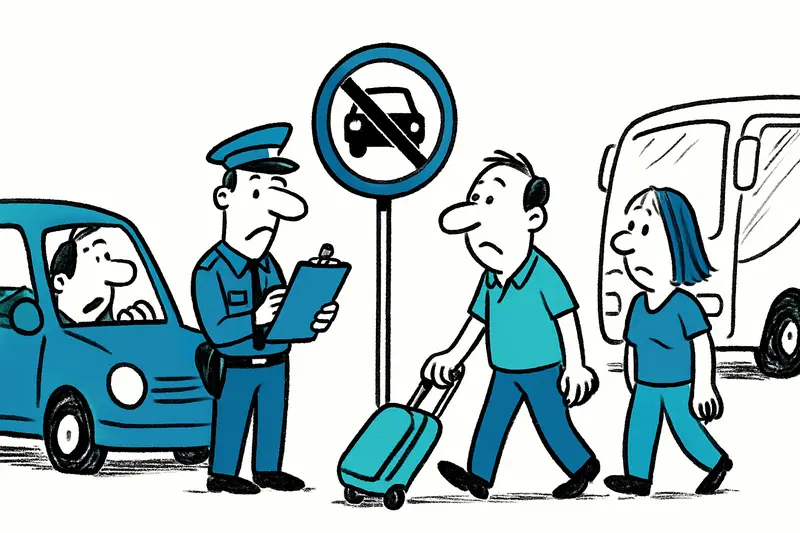
An everyday scene in mind: on the Carretera from Palma towards Playa de Palma, rush hour, delivery vans honk, a rental car from Germany with a temporary plate struggles between tour buses. A police officer stands at the roundabout, noting license plates. Things like this could become more common in future — if controls are expanded. For visitors that would mean more bureaucracy at the ferry terminal and possibly longer waiting times when picking up a rental car; holiday peaks have already prompted close attention in coverage such as Mallorca at the Limit: Will This Weekend Break the Visitor Maximum?.
Concrete approaches that achieve more than a mere cap:
- Better data management: real-time counting stations on main axes, combined evaluation of ferry passages and rental car logbooks. Only with valid data can target corridors be set instead of blanket caps.
- Dynamic ferry quotas: instead of rigid limits, time windows and variable fees could smooth peaks. Those who arrive outside peak times pay less or get priority.
- Parking management: tariff zones, short-term parking spaces for tourists, reserved areas for residents and seasonal workers. That reduces search traffic — often the real cause of congestion.
- Expansion and frequency increase of public transport: express buses to beaches and business areas, combined with last-mile shuttles. When the alternative is reliable, demand for cars falls.
- Transparent rules for rental car companies: binding fleet caps, mandatory reporting tools and sanctions for circumvention — coupled with incentives for electric vehicles (see reporting on market trends in Why Rental Cars in Mallorca Have Become Noticeably More Expensive — and What You Should Know).
Conclusion: the idea of a cap is understandable and politically effective — but implementation requires precision, balance and technical support. Without better data, clear controls and everyday alternatives the measure risks promoting displacement processes instead of reducing congestion. For Germans on Mallorca this currently means above all uncertainty: re-register, inform yourself, expect possible longer formalities when renting. Those who love the island should start thinking now: the goal is not just fewer cars, but fewer unnecessary trips and an intelligent, fair approach to public space.
Frequently asked questions
What is Mallorca considering with a car limit and who would be affected?
Will a car cap reduce traffic and parking problems on Mallorca?
How could enforcement of a vehicle cap work in Mallorca?
What are the main concerns for residents and visitors if a car cap is introduced?
What practical strategies are proposed to manage traffic besides an outright cap?
What does this mean for foreigners visiting Mallorca with non-local license plates?
Could a data-driven approach be more effective than a blanket cap on Mallorca?
What numbers are driving the debate about Mallorca's car limit?
Similar News

Mini-tsunamis in Mallorca: Harmless natural phenomenon — or an underestimated danger?
Two harbor towns in Mallorca recorded unusual water level fluctuations. An analysis: How rissagas form, who is at risk —...

Stinging jellyfish in Cala Banyalbufar: Why everyone suddenly fled the water
In Cala Banyalbufar, Pelagia noctiluca washed up in droves. A personal account of why this is no coincidence, what is of...
New low-pressure trough brings rain — and the heat remains: What's missing in Mallorca?
A short, intense window of showers hit Mallorca, yet the air remained muggy and warm. Key question: Why does rain hardly...

Klaus-Michael Kühne has died: The entrepreneur who gave Mallorca a second home
He first arrived on the island at 60; later the holiday house became Castell Son Claret – a hotel, a music venue and an ...

Buying Instead of Moving Away? Why Every Fourth Property Owned by Balearic Residents Isn't Located Here
Almost a quarter of the apartments purchased by Balearic residents are located on the Spanish mainland. A concise analys...
More to explore
Discover more interesting content

Boat Tour with BBQ along Es Trenc Beach
Private transfer from Mallorca Airport (PMI) to Pollensa
