
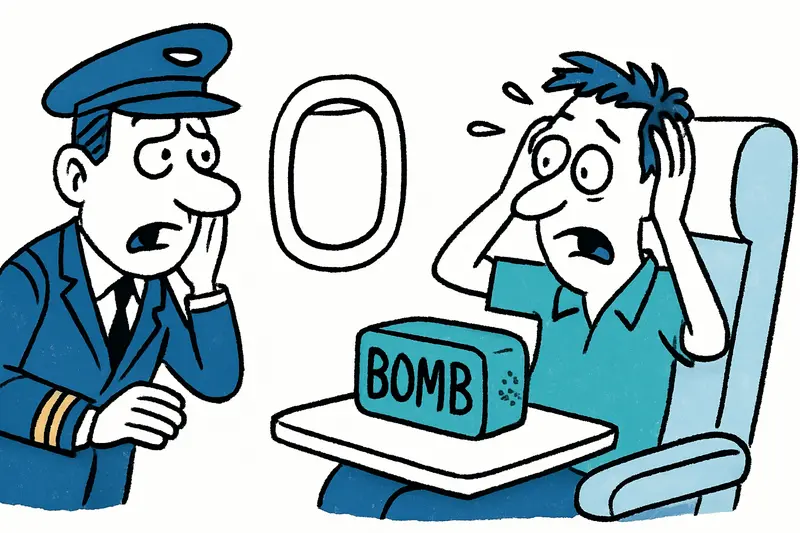
Bluetooth panic over the Atlantic: Why a 'BOMB' speaker stopped a flight
Bluetooth panic over the Atlantic: Why a 'BOMB' speaker stopped a flight
A renamed Bluetooth speaker caused a United Airlines flight from New York to return to Newark. What went wrong — and how can we avoid scenes like this in the future?
Bluetooth panic over the Atlantic: Why a 'BOMB' speaker stopped a flight
Key question: Does a creative device name become a safety risk in everyday life — or was the reaction disproportionate?
On Saturday a transatlantic flight from New York to Palma had to turn back unexpectedly. The crew had detected a Bluetooth signal identified as "BOMB." Because the origin could not be clearly assigned, the plane returned to Newark. Police and federal authorities checked passengers, luggage and the aircraft, after which the flight was able to continue. Those are the brief facts that remain.
In short: A 16-year-old passenger had apparently named his portable speaker that way. The device signal reached the on-board systems, the crew reacted according to security protocol — and the result was a controlled but time-consuming operation on the ground. On paper it sounds like a rare incident. In practice, however, it is precisely these moments in which trade-offs between prudence and proportionality must be made. Similar incidents have been reported, for example E-cigarette on board: How a small puff causes major disruptions on Mallorca routes.
Critical analysis
From a security perspective the crew's decision is understandable: any hint of a possible bomb is not taken lightly. However, several weaknesses are revealed. First: Bluetooth identifiers are freely chosen. Anyone can name their device "ALARM", "BOMB" or "Prank." The label that appears on the aircraft's display says nothing about actual danger. Second: The technical detection of radio sources on board is limited. Crews can perceive signals, but assigning them to a specific piece of carry-on luggage or seat is not trivial. Third: the subsequent procedures — not evacuating, but turning back and conducting a full check of all persons — consume time and money and put emotional strain on travelers. For many passengers this means lost hours, missed connections, and for some holidaymakers changed plans in Mallorca.
What is missing in the public debate
Reports tend to focus on the spectacular word on the display. Little discussed is how airlines, airports and regulators should handle technical false signals. There is a lack of sober debate about standards: which devices can be located more quickly on board? Is a simple visual check enough, or do crews need portable spectrum analyzers? Operational disruptions from small devices have occurred elsewhere, see Drone paralyzes Palma — why a small device makes our airport vulnerable. Moreover, hardly anyone asks how much transparency passengers can expect — are they allowed to find out exactly why they were checked upon return?
Everyday scene from Palma
While authorities debated on the aircraft over the Atlantic, a tour guide in Palma sits on the Passeig des Born with a coffee, her phone at her ear, and the regulars in the café talk about whether the tour will start late today. A taxi driver from Son Servera, who has just finished his morning shift, hears the radio, shakes his head and says: "Around here the lads like to call the Bluetooth box 'La Bomba' — it's a joke. I never thought it could trigger real checks." Such small everyday remarks show the gap between local humor and international risk perception.
Concrete solutions
1. Precise information for passengers: Before boarding, airlines could introduce a short, clear announcement: Bluetooth devices can be visible; names should not contain terms that trigger security procedures. Not moralizing, just clear rules.
2. Technical upgrades: Airports and airlines could provide easier-to-access tools for locating radio sources. Portable spectrum analyzers are not science fiction; they would speed up finding a source and avoid unnecessary returns.
3. Standardized protocols: A graduated approach — visual check, seat-focused search, targeted questions of suspicious passengers — before turning the aircraft around. Protocols should document when a return is truly necessary.
4. Staff training and scenarios: Regular realistic drills for crew and ground staff, including false alarms. This makes decisions faster and more considered.
5. Public education: A short information sheet that travelers receive before departure by email or in the boarding app — with examples of ill-advised device names and their consequences. In Mallorca, tourist information points could also address the topic.
What this means for Mallorca
Palma depends on predictable arrivals: transfers, restaurants and excursion operators schedule down to the minute. A delayed transatlantic flight means sudden replanning for hoteliers and taxi drivers. A comparable scare is described in Heart-stopping moment over Son Sant Joan: Why the Eurowings plane climbed again. Locally people are rightly annoyed, but also aware: safety comes first. The question remains how much trust travelers will retain in procedures if a teenager with a poorly chosen device name can slow down an entire aircraft.
Conclusion
The incident was banal in its cause, costly in its consequences and symptomatic of our connected age. The lesson is not to downplay every alarm, but to improve processes so that legitimate risks are detected efficiently and false alarms are quickly dispelled. For Mallorca that means better pre-trip information for guests, clearer airline protocols and a bit of common sense — on the island as much as over the Atlantic.
Frequently asked questions
Is it still warm enough to swim in Mallorca in October?
What is the weather like in Mallorca in October?
What should I pack for Mallorca in October?
Is October a good time to visit Mallorca for a beach holiday?
Can you still do outdoor activities in Mallorca in October?
Is Palma de Mallorca pleasant to visit in October?
Is Alcúdia warm enough in October for a holiday?
What is the sea temperature like in Mallorca in October?
Similar News
Body in the Basin of Port Adriano: Who Protects People During Crossings?
In the morning, just before noon: employees of a luxury marina discovered a floating body in the basin of Port Adriano. ...
Raised from the Sand: A Late Antique Merchant Ship Tells of the Sea off Can Pastilla
A 1,700-year-old Roman merchant ship was raised off Can Pastilla. Finds such as sail fragments and amphorae provide rare...
After the Storm: Why Many Fish Died at Riuet de s'Illot — and What's Still Missing
After the severe storm, numerous dead fish were found in the Riuet de s'Illot wetland. Who is affected, why it may have ...
Fire in Can Picafort: Family Rescued at the Last Minute – a Safety Check for the Promenade
A fire in a sports shop on the Can Picafort seafront forced the evacuation of a mother with four children. How safe are ...
Nine-year-old rescued after cliff fall at Cala Murada — How safe are Mallorca's coastal paths?
A boy fell roughly five meters down the rocks near Cala Murada. The dusk rescue was elaborate; a helper also had to be r...
More to explore
Discover more interesting content

Boat Tour with BBQ along Es Trenc Beach
Private transfer from Mallorca Airport (PMI) to Pollensa
