
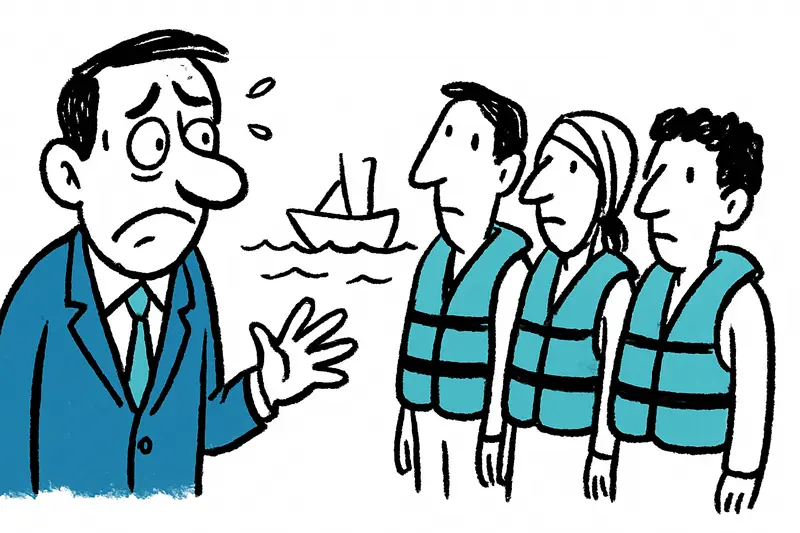
'We're on the edge': Almost 300 boat arrivals within two days strain the Balearic Islands
'We're on the edge': Almost 300 boat arrivals within two days strain the Balearic Islands
In two days nearly 300 people arrived on the Balearic Islands in small boats. The Balearic president is calling for more support from Madrid. A reality check: what is missing from the public debate, how does daily life run on the coasts, and which practical steps are possible?
'We're on the edge': Almost 300 boat arrivals within two days strain the Balearic Islands
Last weekend a new wave of crossings reached the islands: 13 boats with a total of around 233 people arrived from Friday to Sunday, and further landings brought the number to almost 300 within two days. The head of the Balearic government has appealed to Madrid, Madrid's migration emergency and aid, and is demanding a clear response.
Key question
How much responsibility can a region bear that is spatially limited and running at full tourist capacity when arrivals suddenly surge within a short period?
The hard numbers: Of the 13 boats that arrived since Friday, nine landed on Formentera, two on Cabrera, one on Mallorca and one on Ibiza. Over the weekend (Saturday and Sunday) there were, according to local reports, eight boats with 127 people; already on Friday five boats brought 106 people ashore. In total, the authorities' tally since the start of the year records 2,640 arriving people on 140 boats (More Boats, More Questions: Mallorca Under Pressure from Rising Boat Arrivals).
These figures are not just statistics. On Palma's promenades, on the Passeig Mallorca, the everyday noise mixes with conversations about the arrivals: taxi drivers stop, delivery vans honk, and in a corner bar two retirees argue about the pressure on small communities like Formentera. In Es Caló on Formentera fishermen described the scene: small boats in shallow water, phone calls with the coastguard, later the clattering of emergency blankets on the quay. These scenes show how close the crisis is to daily life, echoing episodes reported in 337 People in One Day: Between Rescue, Improvisation and Strategy.
Critical analysis: The Balearic Islands are spatially constrained. An island like Formentera has only limited reception capacity, medical staff are often scarce, and logistics — sea transport, accommodation, translation and social services — require planning, material and personnel. When dozens of people arrive within a few days, the shock absorbers break: emergency shelters fill up, health checks and registration take time, and legal advice is difficult to arrange.
The political situation is intensifying because the Balearic government presents the situation publicly as an exceptional case and is asking for more support. The debate runs on several levels: who bears the costs of reception and care? How can humanitarian assistance be sped up without undermining legal procedures? And how can we prevent small island communities from being permanently overwhelmed?
Important elements often missing from public debate: first, the perspective of the arrivals themselves. Many are traumatised and need emergency medical care and psychological support. Second, medium-term planning — short-term emergency beds are not enough if patterns repeat. Third, clear rules of responsibility between regional government, central state and European institutions: who organises transfers, who funds language and integration services, who carries out medical evacuations in severe cases?
What is visible on the ground: volunteers, port staff and local police work late into the night on Formentera and in smaller ports like Cabrera. In Palma ambulances transport the few serious cases to clinics; interpreters are connected by phone because staff are not always available on site. The sound of the surf mixes with sirens — an everyday triage that is wearing down the islands.
Concrete approaches that could be tackled immediately:
1) Rapid increase of logistical resources: mobile care teams, temporary medical tents, more interpreters. This enables securing testimonies, providing initial medical care and quickly prioritising cases.
2) Coordinated transfer key: agreed procedures between municipalities, regions and the central government so that people can be processed on the mainland quickly when needed — not as deportations, but as relief for island infrastructure.
3) European coordination: The Balearics are part of a larger migration phenomenon. Distribution mechanisms, financial aid and sea rescue require EU-wide coordination instead of national solo efforts (When Beaches Become Emergency Wards: Balearic Islands Call on the EU for Help in the Migration Crisis).
4) Legal and humane assessment pathways: rapid registration yes, but coupled with reliable legal advice and health screenings. Without rule-of-law procedures chaos arises — with human suffering and legal risks.
5) Prevention and regional cooperation: more information and cooperation with countries of origin and transit, coupled with legal alternatives to life-threatening crossings, reduce pressure on small island ports.
What many debates miss is the distinction between short-term emergency measures and sustainable solutions. Emergency responders fill gaps, but they do not replace infrastructure for health, housing and integration. At the same time, the question of the traceability of the figures must not be lost: transparency about capacities, costs and processing times would be helpful so that talks between the island government and the central state can be conducted on a factual basis.
Concise conclusion: The Balearic Islands are not an endlessly resilient reception facility. When almost 300 people land in two days, it is organizationally more than just a problem — it is a wake-up call for coordinated policy and practicable assistance. In the short term, rapidly available teams and agreed transfer routes provide relief. In the medium term, clear rules of responsibility and European solidarity are needed. And in the long term we need safe, legal pathways so that people do not have to take to small boats again.
On the Passeig Mallorca, between delivery vans and street cafés, the conversations can be heard: some want to help, others fear overwhelmed structures. Both voices belong to the island. Politics must deliver now — not with slogans, but with personnel, plans and practical, small-scale solutions for places far from the national power centre that are nonetheless at the heart of a European challenge.
Frequently asked questions
What happened with the recent surge of arrivals to the Balearic Islands?
How are emergency services handling the sudden influx in the Balearic Islands?
What are the challenges on Formentera during a surge of arrivals?
What role does coordination between municipalities, the Balearic government, and Madrid play in addressing surges?
How does European coordination factor into managing arrivals in the Balearic Islands?
What legal and humane pathways are suggested during rapid registrations?
What is meant by balancing emergency measures with long-term solutions in the Balearics?
How can residents in Mallorca help during influxes of arrivals?
Similar News

Ryanair Flight Diverted to Barcelona: An In-Flight Emergency and the Questions That Follow
A Ryanair jet from Pisa to Málaga landed in Barcelona after a passenger became acutely ill. Why these cases need more at...
Alarm in Port de Pollença: What now for the polluted bay?
Hundreds of people protested on the beach of Port de Pollença. The environmental organization Arrels Marines demands a p...

Micaela Schäfer: Between Playa de Palma and a Berlin Law Firm — New Calm, an Old Tomcat and Solid Finances
The party artist from the Ballermann scene appears surprisingly down-to-earth: a new relationship with a Berlin lawyer, ...
At Playa de Palma: Fire in Residential Building – six people rescued on the roof, what is missing in prevention?
In the evening a fire broke out on the first floor of a five‑storey building on Calle Trasimé. Six residents fled to the...
New License Requirement for Mini-Boats in Mallorca: Protection Measure or Tourism Brake?
From October 1 renters of small recreational boats in the Balearics must present a boating license. Critical questions r...
More to explore
Discover more interesting content

Boat Tour with BBQ along Es Trenc Beach

Private transfer from Mallorca Airport (PMI) to Pollensa
