
Risk of Collapse on the Country Road to Cala Tuent: Who Is Responsible for the Crumbling Retaining Wall?
Risk of Collapse on the Country Road to Cala Tuent: Who Is Responsible for the Crumbling Retaining Wall?
Cracks in a retaining wall at Cala Tuent pose an acute danger to the road. Who will pay, who will act – and why weren't traditional techniques used?
Risk of Collapse on the Country Road to Cala Tuent: Who Is Responsible for the Crumbling Retaining Wall?
Key question: Why are residents and visitors facing a potential road closure without knowing how quickly action will be taken?
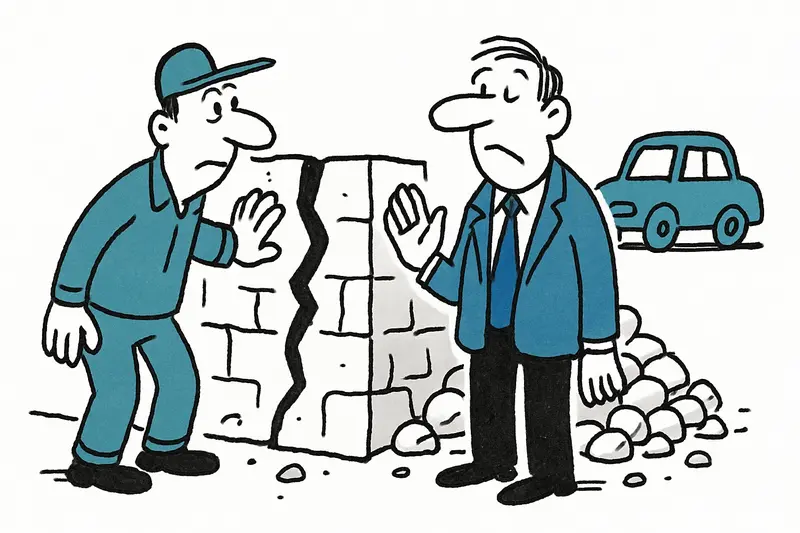
On the access road to Cala Tuent, in the harsh silence of the Serra de Tramuntana, the two gaping cracks in an old retaining wall are impossible to miss. From a distance the wall looks like a toothless guardian: brittle, with loose rubble at the edge, as if the mountain itself is struggling to breathe. Motorbikes rarely roar by here; instead you hear the jingle of cowbells, the wind through the pines and the distant, occasional honk of a delivery van echoing back along the switchbacks. People familiar with the route say this has made the road more dangerous, and the response to the hazard so far has been vague.
The structure belongs to the municipality of Escorca; the island council once stepped in around two decades ago because the municipal coffers were empty at the time. Today the questions remain: Who will take responsibility now for rapid stabilization measures? Why has the administration been silent so far, even though the risk of a partial or complete collapse is acute? Mayor Antoni Solivellas has not commented publicly to date. This uncertainty over responsibility mirrors other incidents, as discussed in Medusa Beach: Who Bears Responsibility After the Collapse?.
Experts add another important point: Lluc Mir from the Dry Stone Masons Association describes the wall as a structure that apparently was built without functioning drainage and also does not meet the criteria of traditional dry stone walls. These are not mere stylistic issues: missing water runoff and unsuitable materials can accelerate gradual failure and favor a sudden collapse.
The problem is familiar territory on Mallorca: in 2023 the access to Sa Calobra (Ma-2141) had to be closed after a large retaining wall collapsed. At that time the handling of the debris and securing of the route were visible, but the political and craft-related follow-up – the coordination between supra-municipal bodies and local authorities – left questions open, as seen in Collapse at Palma's City Wall: What Needs to Happen Now.
Critical analysis: The situation is not only a technical problem but an administrative and prioritization problem. In the short term there appears to be no joint, public course of action: a rapid hazard notice, a closure plan, an independent expert report and transparent financing. In the long term there is no strategy for maintaining infrastructure in mountainous, sensitive zones that addresses both safety requirements and local building culture.
What has so far rarely appeared in the public debate is the connection between preserving traditional retaining walls and modern safety standards. It is not just about an emergency solution with concrete and wire mesh; it is about how to preserve the Serra as a landscape without risking the road. The issue of climate change also plays a role: heavier rainfall and altered freeze–thaw cycles stress old structures more than before. Scrutiny of major works after incidents such as Wall Collapse at Palma Airport: More Than an Accident — How Safe Are the Major Works Really? underlines this point.
Concrete measures that should be implemented immediately: temporary traffic reduction or closure for heavy trucks, short-term structural stabilization (supports, erection of protective barriers), an immediate geotechnical specialist investigation including drainage inspection and a public expert report on the future use of the route. At the same time: a reconstruction concept that involves dry stone expertise, because properly built dry stone walls in the Serra are not only aesthetically appropriate but often more durable and adaptable than rigid concrete solutions. Immediate sealing and closures are common emergency steps, as reported in Risk of Collapse in Cala Major: Six Venues Temporarily Closed — What Needs to Happen Now.
Practically speaking this means: the island council and the town hall must free up a joint budget or agree on emergency financing; specialist firms for dry stone restoration must be involved; settlement and crack-width sensors should be installed to enable an early warning system. And very importantly: clear communication to residents, hikers and businesses that use this route.
Everyday scene: A farmer from Escorca passes by in the early morning with his small delivery van, stops, gets out, knocks on the wall and shakes his head. Children from the nearby school run past, curious, while a tourist with a camera tries to capture the cracks from a safe distance. These small scenes make it clear: this is not just about stones, but about routes that make daily life possible.
What is missing from the debate are binding timelines, clear rules of responsibility and the involvement of local craftsmanship. Without these elements there is a risk of a patchwork of short-term repairs that will affect the same spot again in a few years.
Conclusion: The wall at Cala Tuent is a warning signal. Naming the risk is not enough – a coordinated immediate program and a long-term maintenance strategy that combines technical safety and local building culture are needed. Those responsible for island roads must learn to think of mountain and structure together. Otherwise, when the next heavy rain series comes, we will be back at the same spot with shovels and barriers.
Frequently asked questions
Is the road to Cala Tuent in Mallorca currently at risk of collapse?
Who is responsible for the retaining wall problems on the road to Cala Tuent?
What should happen first if a retaining wall on a Mallorca mountain road starts cracking?
Why do old retaining walls in the Serra de Tramuntana fail?
Can the road to Cala Tuent be closed temporarily if the wall becomes unsafe?
Why is drainage so important for retaining walls in Mallorca?
What kind of repair is usually better for a Serra de Tramuntana retaining wall?
Has Mallorca dealt with similar road collapse problems before?
Similar News

Four goals, heart-stopping moments, a message: Germania Mallorca takes three points in Consell — questions remain
The new German club on the island won its first away game in Consell 4:3. Celebration, a 4:0 lead, then a nervous finish...

Mueller continues expanding in Mallorca: Artà in 2026, Can Picafort in early summer 2027
The drugstore chain Mueller is opening two new stores in Mallorca: a 1,400 m² shop in Artà on 5 November 2026 and a bran...
The Painter Who Lived Mallorca: Franz Taussig and His Century-Old Secret
A hundred years ago a young Viennese arrived in El Terreno, sketched the island and called himself Francis Caron. Today ...

Airport dispute: Bridge, forecasts and the question of responsibility
A video by the Spanish transport minister has ignited the dispute over DORA figures, capacities and local governance pow...

The Painter Who Invented Himself: How a Young Viennese Drew Mallorca
A hundred years ago a 19-year-old draftsman arrived in El Terreno. His diary and sheets, long known under the pseudonym ...
More to explore
Discover more interesting content

Can Cap de Bou

Townhouse Lleo 72
