
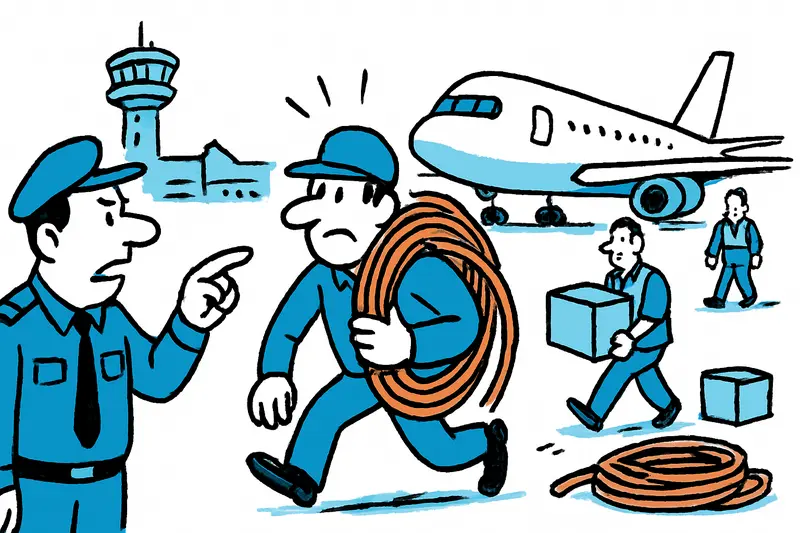
Copper theft at the airport: What the theft from Terminal D reveals about security gaps
Copper theft at the airport: What the theft from Terminal D reveals about security gaps
Two airport employees are alleged to have diverted hundreds of meters of copper cable from a restricted area of Terminal D and sold the material on the island. A look at the method, the traces left behind and the consequences for everyday life at the airport.
Copper theft at the airport: What the theft from Terminal D reveals about security gaps
Why were employees able to remove hundreds of meters of cable from a restricted area unnoticed?
In May of this year it came to light that a large portion of the electrical installation was suddenly missing in an area of Terminal D that had been closed due to renovation work. Investigators from the Guardia Civil later identified two employees with authorized access who are suspected of having stolen more than 2,300 meters of copper cable from lighting, air-conditioning and grounding systems, as reported in Arrests at Palma Airport: Two employees detained after alleged thefts. The investigation further led to purchases at several recycling centers; in total the two accused are said to have sold around 6,100 kilograms of cable and taken in about 24,000 euros, while the market value of the stolen wiring is estimated at over 73,000 euros.
Key question: How does the idea of a strictly monitored airport fit with the image that employees were systematically able to transport material out of a restricted area, as discussed in Thefts at the Airport: Two Employees Detained – How Secure Is Son Sant Joan??
Critical analysis: Investigators used access logs and checks at scrap dealers to follow the traces. This shows, on the one hand, that digital logbooks and recycling receipts can serve as carriers of evidence. On the other hand, the case suggests that these tools tend to act reactively: only when cables were missing did the review begin. Access authorizations alone are apparently not enough; if employees regularly enter restricted zones, opportunities for abuse open up. Organizational factors play a role as well: construction sites where several companies work in parallel are often chaotic, tools and materials are relocated, and controlling consumables is difficult. Once an employee has access and a truck or trailer is ready, the barrier to quickly removing material is low.
What is often missing in public debate: discussions about supply chains and interim storage on airport construction sites. There is much talk about passenger security in terminals, but less about the management of technical inventories during renovations. The debate is also too limited on how regional recycling centers handle identity and provenance documentation, a point underscored by Almost a Ton of Copper: Arrest in Palma Raises Questions About Security and Disposal. When large quantities of metal are delivered, questions must be asked: Who supplied the goods? Were documents checked? Were unusual quantities recorded and reported?
An everyday scene: early in the morning in front of Terminal D, when the sun is just above the hangar roofs and the construction noises—the shouting of concrete mixers, the clatter of scaffolding—disturb the otherwise routine airport rhythm, many workers see vans pull up, boxes are unloaded, men and women in high-visibility vests hurry across the paved apron. No one expects that amid this everyday hustle an employee with a key will slip a few hundred meters of cable into sacks and boxes while colleagues watch the schedule.
Concrete solutions: 1) Finer-grained access control: temporary permissions instead of blanket keys; limit access windows and require electronic approvals for each material removal. 2) Physical security: on-site storage for recyclable material with video surveillance and sealed containers. 3) Inventory management: continuous stock checks by independent third parties during major renovations. 4) Cooperation with recycling centers: mandatory provenance documentation and registration of unusually large deliveries; immediate reporting obligation to the Guardia Civil in case of suspicion. 5) Personnel measures: regular awareness training, anonymous whistleblowing channels and verifiable service procedures that document ownership and material flows without gaps.
There are also technical solutions: smart cable marking (RFID tags or fluorescent markers) that stand out at point of sale, or simple photo documentation on site that could be mandatory for removals. These measures cost money, but they reduce the risk of operational failures and expensive replacement work—especially at a hub where every disruption can trigger chain reactions in the flight schedule.
For the island the case has two sides: on one hand it shows that local recycling structures work and can reveal suspicious activity; that is a plus for investigative work, as seen in Electricity theft in Palma: Copper robbery leaves streets in the dark. On the other hand it reveals how easily material damage to critical infrastructure can be converted into cash. That not only undermines the perception of security, but in the worst case can also lead to disruptions if grounding or air-conditioning systems are affected.
Concise conclusion: The theft in Terminal D is not an isolated misdemeanor by an individual, but a warning signal for systemic gaps in construction and maintenance work. Anyone who takes airport security seriously must think beyond checks in passenger areas—down to the containers in the maintenance yard and the receipt books of scrap dealers. Without binding processes, such cases remain possible.
As an editor who every morning stands on Passeig Mallorca with a coffee in hand and can hear the machines of the airport, I see it every day: the airport is a living organism with loud and quiet parts. The loud failures—a canceled flight, a strike—get attention quickly. The quiet failures, the gradual disappearance of cables, remain unnoticed for longer. That is exactly where we should act.
Frequently asked questions
What lessons can Mallorca's airports learn from a copper theft case about security during renovations?
How can temporary access controls prevent material theft during renovations at Mallorca's airport?
What role do recycling centers play in spotting suspicious metal deliveries in Mallorca?
Why are on-site storage and video surveillance important for copper or metal recovery during renovations in Mallorca?
What signs might indicate a renovation site in Mallorca is vulnerable to theft?
How could authorities improve material tracking during airport renovations in Mallorca?
What is the impact of copper theft on Mallorca airport operations and passenger experience?
What practical steps can workers at Mallorca airport construction sites take to document material ownership and flow?
Similar News

Rental Car Theft in El Arenal: What This Incident Reveals About Our Gaps
A teenager steals a running rental car in El Arenal, flees on foot, climbs over walls and is caught by the Guardia Civil...

Red Rope in Palma's Library: What Helps Against Selfie Tourism — and What's Missing
Palma's city library cordoned off an area with a red rope to keep selfie tourism away from reading and working activitie...

Fort San Carlos: Museum, Harbor Dispute — and a Conflict That Demands Answers
The military museum at Fort San Carlos sits right on Palma's harbor, with unexpectedly quiet rooms filled with cannons a...
Old Town Under Pressure: When a Doorway Becomes a Sleeping and Shower Place
For months a woman has been living with a parasol, a clothes rack and personal belongings next to the social welfare off...

When Shopping Weighs Heavier: Mallorca Demands a Tax Pause on Food and Fuel
Rising prices are putting pressure on households and agriculture. The Balearic Islands are calling for temporary tax rel...
More to explore
Discover more interesting content

Can Cap de Bou

Townhouse Lleo 72
