
Court overturns heat rule for horse-drawn carriages in Palma – what’s missing now and how it could work better
Court overturns heat rule for horse-drawn carriages in Palma – what’s missing now and how it could work better
The Balearic High Court has annulled the 2022 tightened heat rule for horse-drawn carriages in Palma because a legally required equality impact assessment was missing. A reality check: why formal errors now dominate animal welfare and climate debates and which practical steps the city must catch up on.
Court overturns heat rule for horse-drawn carriages in Palma – what’s missing now and how it could work better
Key question: Can a formal procedural error invalidate a substantively justified animal welfare regulation?
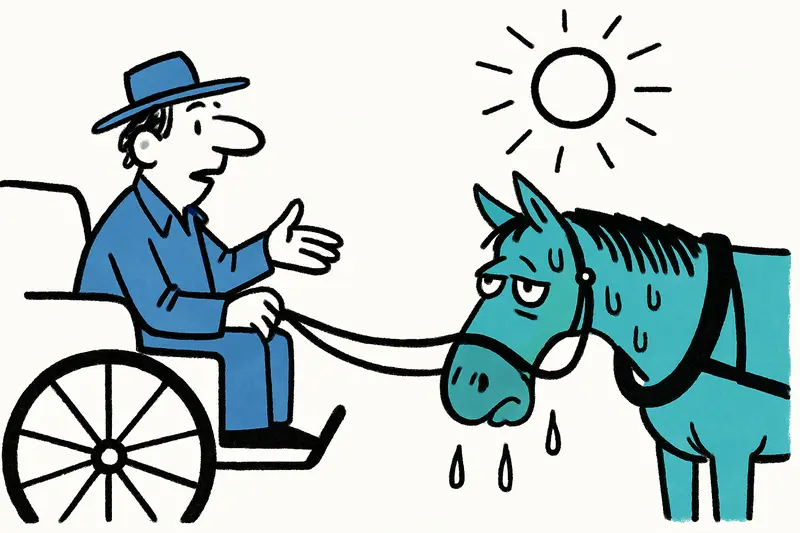
The High Court of the Balearic Islands has declared a 2022 amendment to the municipal regulation on horse-drawn carriages in Palma null and void. Reason: the legally required assessment of impacts on equality was not produced during the administrative procedure. Specifically, the annulled rule concerned driving bans for the so-called galeras during official heat warnings issued by the weather service AEMET; previously there had been a time-limited driving ban at midday between 12:00 and 17:00. The new regulation envisaged general suspensions during heat warnings as well as heavy fines and, in extreme cases, license revocation. The plaintiffs: several horse-drawn carriage operators, after incidents such as After Two Collapsed Horses: Palma Faces a Decision — Rethinking Carriage Rides. The court ordered the city to cover the legal costs, capped at 3,000 euros. The judgment is not yet final.
In short: a formal gap has shaken a measure that was motivated on substantive grounds. Legally this is correct, but in Palma it feels like a clash of two worlds – on one side arguments about animal welfare, on the other administrative law that insists on completeness.
Critical analysis: the decision shows two things. First: legal requirements for procedural conduct are not secondary. The Balearic equality law requires an assessment of possible impacts on women and men as groups for all administrative measures. If this document is missing, the administration has simply neglected a formal requirement. Second: the debate about heat and animals is being decoupled by formal errors from the substantive question of how horses can be protected in high temperatures. Both levels – legal and substantive – should have been worked on in parallel.
What is often missing in public discourse: a sober distinction between procedural errors and substantive evaluation. Many voices focused on the outcome (driving ban vs. the operators’ freedoms) or on emotional aspects (animal welfare, tradition), while the question of how a legally sound, practicable rule could look remained open. There was also too little discussion about gradations according to warning level: AEMET warnings range from yellow to red, and a blanket suspension for every warning level was problematic both substantively and communicatively.
Everyday scene from Palma: on a stifling hot morning on the Passeig del Born you hear hoofbeats between motor noises and ice-cream carts, passengers seek shade under plane trees, a carriage stands with its top open. For tourists the galeras look like postcard motifs, for residents it is an annoying carpet of noise, for animal welfare advocates a visible issue — an image that recalls episodes such as Horse Falls in Palma: Do Carriages in the Old Town Need Rethinking?. This mix shows clearly: regulations affect different groups at once – tourists, coachmen, residents, animals. No wonder the legal error is getting so much attention now, as the wider debate is captured by Palma Struggles to End Horse-Drawn Carriages: Majority but No Final Decision.
Concrete approaches to prevent a repeat:
1) Make up the equality impact assessment: The administration must promptly produce and document the legally required evaluation, even if the result confirms that there are no gender-specific effects.
2) Differentiated heat scale: Not every AEMET warning must trigger the same measures. A tiered regulation (e.g. special precautions at yellow, strong restrictions at orange, temporary driving ban at red) would be more appropriate.
3) Clear operational guidelines: Water breaks, shaded resting places, mandatory veterinary checks on hot days and compulsory temperature sensors in stables and on carriages.
4) Transparent dialogue with stakeholders: Early involvement of carriage drivers, animal welfare organizations and residents’ representatives; publish the results of the assessments.
5) Pilot projects and alternatives: Time-limited test phases with electric carriages during sensitive periods, increased inspections and an evaluation requirement after the season.
All these steps would strengthen the legal basis while keeping the goal of animal welfare in sight. The city administration had argued that an equality impact assessment was unnecessary because the measure would have no gender-specific effects. The court disagreed: the duty to assess is independent of the expected result and belongs before the final decision is made.
Pithy conclusion: this is not bureaucracy for bureaucracy’s sake, but about reliability. Anyone who wants to enforce measures that intervene in people’s everyday lives and work – while taking animal welfare seriously – must first do their homework: legal checks, transparent participation, graduated rules and practical control mechanisms. Only in this way can formal omissions be prevented from torpedoing substantive goals and ensure that the next hot days are not again used for legal rounds instead of clear, implementable rules.
Frequently asked questions
Why did a court overturn Palma’s heat rule for horse-drawn carriages?
What was the heat ban for horse-drawn carriages in Palma supposed to do?
Does a missing procedural document mean a rule is wrong in Mallorca?
What should tourists know about horse-drawn carriages in Palma on very hot days?
What is AEMET and why does it matter for Palma carriage rules?
What kind of heat rules would work better for horse-drawn carriages in Palma?
Why are the horse-drawn carriages on Palma’s Passeig del Born so controversial?
What happens next after the Palma court decision on carriage heat bans?
Similar News
Magaluf: Watchtower Alarm – Lifeguards Pull Unconscious Beachgoer from the Water
After a drama in the late afternoon, two lifeguards at Magaluf beach rescued an unconscious 44-year-old man. He was stab...

Turquoise in the City: How dangerous is the color play of the Sa Riera?
The Sa Riera in Palma suddenly turned turquoise — a pretty motif, but behind the effect lies a discharge of saline waste...

Jeckliner at Sunnesching: Cologne spirit sets sail from Palma
In September 2027 the Mein Schiff 2 briefly becomes a floating carnival stage: four days with Cologne bands, comedy and ...
Finally Home: Mike and Leyla Heiter Buy Villa with Sea View in Mallorca
The reality TV couple Mike and Leyla Heiter have bought a house in Mallorca with a roof terrace and sea view. An Instagr...
Arrest after series in Palma: Who protects apartments from repeat offenders?
The National Police arrested a man in Palma who investigators say may have broken into several apartments. In one incide...
More to explore
Discover more interesting content

Can Cap de Bou

Townhouse Lleo 72
