
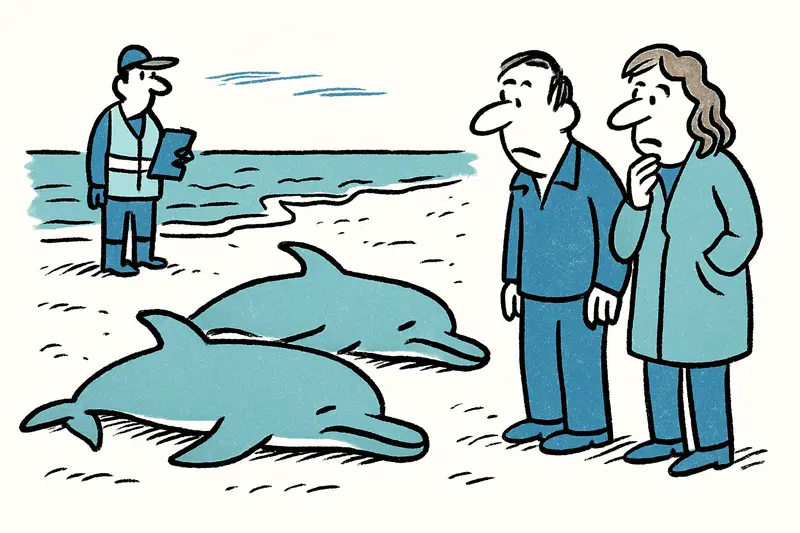
Two dead striped dolphins at Es Trenc and Cala Galdana: What do we know — and what is missing?
Two dead striped dolphins at Es Trenc and Cala Galdana: What do we know — and what is missing?
Within 24 hours, two adult male striped dolphins were washed ashore on beaches of Mallorca and Menorca. The animals were taken to Palma Aquarium for sampling. A thorough investigation is pending — but binding answers and a joint plan for the islands are missing.
Two dead striped dolphins at Es Trenc and Cala Galdana: What do we know — and what is missing?
Key question
Why did two apparently healthy, adult striped dolphins wash up on popular Balearic beaches within a single day — and is the ongoing investigation sufficient to draw conclusions for marine protection and coastal management?
Summary of facts
On 18 and 19 January, a male striped dolphin (Stenella coeruleoalba) was found on two different beaches: Es Trenc in southern Mallorca and Cala Galdana on Menorca; local reports included Two Dead on Balearic Coasts: When the Sea Withholds Answers. Both animals appeared outwardly in good condition and were brought to the facilities of Palma Aquarium for scientific sampling; the organization documented the operations on its X account and mentioned collaboration with the Es Trenc Nature Park and the Club Nàutic Sa Ràpita.
Critical analysis
Two strandings in quick succession are notable — but headlines alone do not replace cause investigation. That the carcasses "looked good" externally does not rule out internal ailments, poisoning or pathogens. Tissue samples, blood, stomach contents and bacterial cultures must be taken to investigate toxicological, parasitological and infectious causes. Important findings can easily be missed if sampling does not follow clear, standardized protocols or if laboratory capacity is limited.
What is missing in the public discourse
Public coverage often shows only the image of the animal washed ashore; beyond that many debates fall silent. There is a lack of transparency about investigation methods, timelines and who oversees the results; regional coverage, such as Two bodies on the coast: Investigations in Ciutadella and off Alcúdia – Many questions remain, highlights these gaps. There is no systematic overview of similar cases in recent years in the Balearics: were these isolated incidents or is a pattern emerging? Past incidents, for example Body Recovered off East Coast: A Sign of Larger Problems at Sea?, raise questions. And there is no clear link between findings and concrete measures — for example inspections of fishing gear, wastewater testing or analyses of ship traffic.
An everyday coastal scene
In the morning at Sa Ràpita, the dry Migjorn wind blows through the dunes of Es Trenc; gulls circle, an angler hauls a fish trap ashore, and tourists in heavy jackets ask why something like this has washed up now on a beach some call the Caribbean in summer. The volunteers in yellow high-visibility vests move in practiced coordination; they know the procedure: cover, mark, careful removal. Still, the mood is subdued — because no one likes finding a dead dolphin in the sand.
Concrete solutions
1) Standardized necropsy and sampling protocols: Balearic and national authorities should share binding guidelines so samples are comparable (pathology, toxins, microplastics, nucleic acids, stable isotopes). 2) Rapid, open reporting: Results and interim findings must be published promptly so researchers and authorities can respond. 3) Strengthen reporting and response networks: A 24/7 stranding hotline linked to designated labs would simplify procedures; volunteers and lifeguards need regular training. 4) Address causes at the source: If toxins or microplastics are detected, targeted investigations of port discharges, agricultural runoff and fishing nets must follow. 5) Review fishing and shipping activity: Data from fishers, satellites and shipping reports should be compared to rule out collisions or entanglement. 6) Promote citizen science: Beachgoers and boaters can contribute data with apps and short training sessions.
Why this matters
Dolphins are indicators of ocean health. A sick animal on the coast often signals broader problems: from pathogens to environmental chemicals to disturbances caused by humans. Without reliable data, speculation remains — and opportunities to counter threats may be missed.
Concise conclusion
Two dead striped dolphins on such prominent beaches are more than a sad photo. They are a warning sign that needs better understanding. The ongoing investigations at Palma Aquarium are a step — but Mallorca and Menorca need transparent procedures, shared standards and concrete inspections so that after mourning there is not just silence, but action.
Frequently asked questions
Why do dead dolphins wash up on Mallorca beaches?
What happens when a dead dolphin is found on a Mallorca beach?
Can a dolphin look healthy and still die from disease or poisoning?
Why are striped dolphins found in Mallorca and Menorca important for marine research?
What should be checked after a dolphin stranding in Mallorca?
Where was the dolphin found at Es Trenc in Mallorca?
Why is Cala Galdana in Menorca mentioned in the dolphin case?
What should Mallorca do after repeated dolphin strandings?
Similar News
Why the End of "Los Últimos Mohicanos" Is More Than the Closing of a Bar
With squealing tires and one last glass, an icon on the Palma–Manacor expressway closes. Why the demise of this German b...

Protest camp on Plaza España: Who asks for solutions to the right to housing?
Around 30 activists set up a tent camp on Palma's Plaza España to push for stronger tenant rights. Our analysis asks: Ar...

In the Name of a Gang: Alleged Extortion in El Molinar and What It Reveals About the Protection of Sex Workers
A man is accused of posing as a member of the Hells Angels and extorting two women at accommodation in El Molinar. The s...

When Chile Meets the Mediterranean: A New Flavor at Can Bordoy
At Can Bordoy in Palma's old town, Chilean chef Jhonatan Maldonado combines Patagonian seafood with Mediterranean island...
End of an Era on the Ma-15: Why the Biker Hangout at Son Gual Is More Than Just a Restaurant
"Los Últimos Mohicanos" closes unexpectedly. A meeting place for motorcyclists on the Palma–Algaida border is disappeari...
More to explore
Discover more interesting content

Can Cap de Bou

Townhouse Lleo 72
