
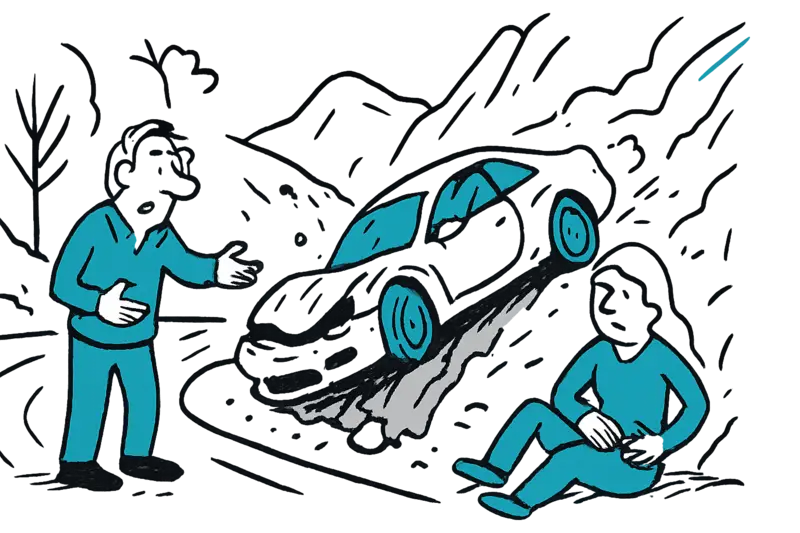
Deadly accident in Mortitx: Why the Ma-10 becomes a danger stretch at rallies
Deadly accident in Mortitx: Why the Ma-10 becomes a danger stretch at rallies
At kilometre 10 of the Ma-10 a Porsche plunged into a ravine. The driver, a 63-year-old German, died and his passenger suffered severe spinal injuries. The rally was stopped. What is missing in Mallorca's risk assessment?
Deadly accident in Mortitx: Why the Ma-10 becomes a danger stretch at rallies
Key question: How safe are rallies on Mallorca's narrow mountain roads — and what steps must follow now?
Late on a morning on Crash on the Ma-10: Bus collides head-on with a truck — What does this say about our roads?, just past the hamlet of Mortitx, the typical October light prevailed: harsh shadows, the dry scent of thyme and the distant clinking of goat bells. Between dry stone walls and rugged limestone cliffs there is a spot at kilometre 10 where the road leaves little room to manoeuvre. There a white Porsche 911 GT3 RS (model year 2023) for reasons still unclear left the roadway and fell into a ravine. The 63-year-old German driver was killed in the accident; his 39-year-old passenger suffered severe spinal injuries. Rescue teams from Inca and Alcúdia and the helicopter Sa Milana were on site; the event was stopped immediately.
Critical analysis: the facts are clear, the answers are missing. Mountain roads like the MA-10 under scrutiny: Head-on collision between intercity bus and delivery truck near Esporles connect villages and serve tourism — but they are not designed for racing conditions. Tight bends, missing guardrails in places, steep embankments and walls leave very little margin for error. Added to that are changing surface conditions after summer heat or short rain showers and the challenge of safely controlling fast sports cars on winding stretches. With this mix, a driving error or a technical fault is enough for a vehicle to slide uncontrollably into the abyss.
What has so far been underemphasised in public debate: the discussion often stays with the names of those involved and the tragedy itself. More important would be a sober investigation of the framework conditions: Which safety inspections were carried out for these road sections? How are hazard spots mapped and secured? What minimum requirements exist for vehicle safety equipment, rapid-response plans and the coordination between organisers and local rescue services? And not least: how are residents and passersby protected who use the Ma-10 in everyday life?
Concrete problem points from Mallorca's everyday life: On the Ma-10 you regularly encounter farmers, hikers and cyclists — not only race cars. The island has many narrow connecting roads, often with outdated alignments and without sufficient run-off areas. If a rally passes through there, it must take civilian uses much more into account, otherwise the risk remains high.
Concrete approaches to solutions: 1) Before each event a mandatory risk analysis must be conducted for every kilometre, including photogrammetric documentation and the identification of run-off zones. 2) Dangerous sections should be temporarily protected with robust guardrails or catch nets, not with makeshift barrier tape. 3) Minimum vehicle requirements: effective roll cages, certified safety harnesses and automatic emergency-call systems should be mandatory. 4) Rescue planning: for designated route sections, helicopter landing sites must be predefined in advance; rescue resources must be networked with marshals via GPS to save minutes. 5) Restrict particularly risky vehicles to routes with sufficient run-off areas or relocate those classes to closed circuits or test facilities. 6) Transparent review: independent investigations with publication of the results so lessons can be learned.
Everyday scene: Anyone driving the Ma-10 towards Lluc on a Saturday afternoon knows the rough limestone walls, the solitary pine outcrops, the smell of fresh olive oil from the fincas. The road is a lifeline, an excursion route and an occasional racetrack at the same time. After an accident like this, taxi drivers in Port de Pollença sit together again and swap stories about near misses — the worry remains of suddenly being in the wrong place.
What is needed now: respect for the victims and rapid, factual answers. The organisers stopped the rally — that is a first consequence. But more is needed: a thorough investigation into the cause, support for the bereaved and a process that does not stop at assigning blame but forces technical and organisational changes.
Pithy conclusion: Motorsport in Mallorca must not become a game of roulette. Passion for speed and respect for the landscape and the people must go hand in hand. The island can host rallies if organisers, authorities and rescue services implement binding safety standards that go beyond lip service. Until the causes of this accident are clarified, the debate should not make the name of the deceased the focal point — it must reach concrete measures to ensure this does not happen again.
Afterword: The caterer mentioned in connection with the accident belonged to a well-known restaurant chain that has recently also been present in Mallorca. Personal losses must not be reduced to figures and statements; respect for those affected takes priority while the authorities clarify the technical sequence of events.
Frequently asked questions
How safe are rallies on Mallorca's narrow mountain roads like the Ma-10?
What pre-event steps are essential for a rally on Mallorca’s winding roads?
What occurred on the Ma-10 near Mortitx during a rally?
Why is the Ma-10 hazardous for rally use beyond this incident?
What safety measures are proposed to prevent a repeat on Mallorca’s rally routes?
How should Mallorca balance rally events with everyday road users?
What responsibilities do rally organisers in Mallorca have for safety?
How are residents kept informed about rally safety plans in Mallorca?
Similar News

24 Graves in Felanitx: Who Wins — Hospital or Culture?
During the hospital construction in Felanitx, a necropolis with 24 graves and Islamic pottery was discovered. A test exc...
Nighttime Break-in in Marratxí: Four Perpetrators, Smashed Door and Many Questions
A restaurant in Marratxí was robbed on the night leading into Thursday. Four masked perpetrators caused significant dama...
Rolex robbery in Santa Catalina: What does this attack say about Palma's safety?
In Santa Catalina, two attackers stole a Rolex worth €40,000 from a 65-year-old Swede. His pregnant daughter was shoved....

From Fish Stall to Yacht: How Listings Really Work in Mallorca
Market stall or luxury item — on Mallorca it's often the listing, not just the product, that decides. Practical tips for...
An End to Dolphin Shows in Mallorca? The Franz Weber Foundation Demands a Ban
The Swiss Franz Weber Foundation is calling on the island council to take a clear stance against marine animal shows. Be...
More to explore
Discover more interesting content

Can Cap de Bou

Townhouse Lleo 72
