
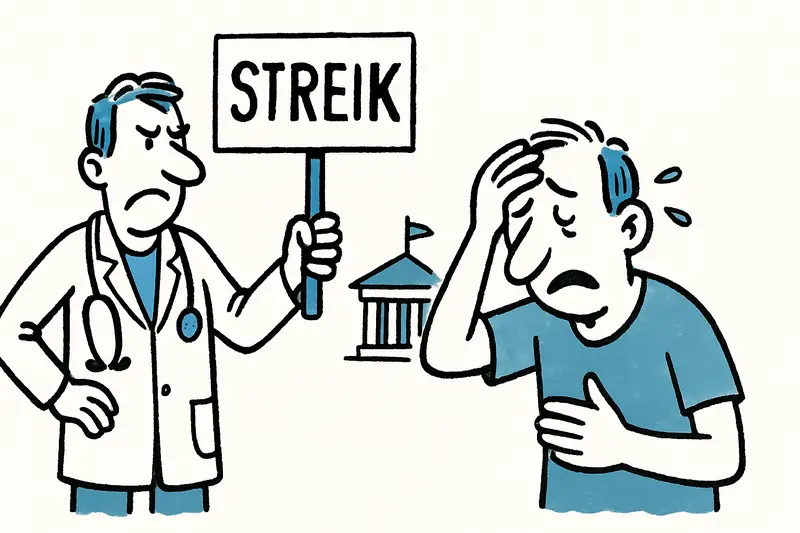
Doctors' strike in the Balearic Islands: Who bears the consequences — patients or politics?
Doctors' strike in the Balearic Islands: Who bears the consequences — patients or politics?
For five weeks doctors on Mallorca and the neighboring islands have stopped work. IB‑Salut has set minimum services, but the dispute remains unresolved. A critical assessment.
Doctors' strike in the Balearic Islands: Who bears the consequences — patients or politics?
Fifth week of the industrial action, minimum services, open questions
On the streets of Palma the same sounds have been heard for weeks: distant sirens, the hum of motorcycles and, above all, longer queues outside some health centers. The doctors' strike in the Balearic Islands has now entered its fifth week; IB‑Salut has ordered minimum services in response, as reported in Doctors' strike on Mallorca: Who gets left behind?. Emergency departments, the ambulance service 061 and on‑call centers are to be staffed continuously; according to the decree, health centers should have at least one physician and one pediatrician per shift.
The union Simebal justifies the ongoing industrial action with the planned reform of working conditions in the public health service. Central dispute points include the design of working hours and the regulations for on‑call duty — details that can have profound effects on hospital doctors, general practitioners and their families; early coverage of the strike's disruptions is discussed in Day Two of the Doctors' Strike: Why Healthcare in Mallorca Is Faltering.
Key question: Why is this dispute so entrenched, and what gaps exist between the authorities' decisions, the demands of doctors and the needs of the population?
Analysis: On one side is a health administration that must guarantee insured basic care and emergency services. On the other, many physicians feel that the proposed reforms would further worsen their working and living conditions. Anyone who watches the scene in front of Son Espases hospital — drivers nervously checking their phones, relatives sitting on benches with shopping bags waiting — quickly understands that the reforms are not just a bureaucratic debate but affect everyday reality. Similar public mobilizations were covered in Doctors' strike in the Balearics: Why the demonstration in Palma is more than a labour dispute.
What is often missing in public discourse are concrete scenarios instead of vague formulations. There is talk of "working hours", but it is rarely made transparent how a changed shift schedule would actually affect on‑call times, free weekends or childcare. Likewise, reliable figures are lacking on short‑term plannable personnel resources — how many additional doctors would need to be hired so that the planned changes can be implemented without overburdening staff?
Another blind spot is the perspective of neighborhood clinics and general practices. When parents on Palma's Passeig del Born say they postponed appointments or turned to private clinics, it shows that the burden is being shifted — often onto those with fewer reserves.
Concrete approaches: First, a transparent impact assessment of the reform, publicly accessible and with realistic personnel forecasts. Second, the establishment of an independent negotiation round with representatives from Simebal, IB‑Salut, patient representatives and external working‑time experts to define practical limits for on‑call duties. Third, short‑term relief measures: targeted deployment plans, temporary fee‑based staff for non‑emergency routine tasks and more flexible childcare options for shift workers. Fourth, a clear roadmap for building up personnel — training, recruitment and targeted incentives to relocate positions to underserved centers.
Everyday scene: Early one morning outside a Centro de Salud in the La Vileta neighborhood a mother puts a jacket on her toddler and says she is glad the emergency department is open but unsettled because the consultation was cancelled. Such small scenes are repeating across the island — not dramatic headline events, but disrupted reliability: pharmacies, privately opened short‑notice consultations, families getting up earlier.
What is needed now is not a symbolic gesture but concrete political work: clear timelines, fair compromises and interventions based on data and everyday experience. If the response relies solely on slogans and sanctions, the root causes of the problem will remain — and patients will feel the consequences first; this echoes analysis in No Submission: What the four-day doctors' strike in Mallorca really reveals.
Pointed conclusion: A health system must not be ground down between economic pressure and professional exhaustion. Authorities and physicians must return to the negotiating table — armed with data, realistic alternatives and a willingness to finance solutions instead of merely regulating. Otherwise the biggest loser will be patient care — and on an island like Mallorca that is neither practical nor acceptable.
Frequently asked questions
How does the doctors' strike in Mallorca affect everyday patient care?
Are hospitals and emergency services still open during the doctors' strike in the Balearic Islands?
Why are doctors in Mallorca on strike?
What should I do if my medical appointment in Mallorca is cancelled because of the strike?
Is it still a good time to travel to Mallorca if the doctors' strike is ongoing?
What is causing longer waits at health centers in Palma during the strike?
How are families in Mallorca affected by doctors' strike schedules and on-call rules?
What could help resolve the doctors' strike in Mallorca?
Similar News
Raised from the Sand: A Late Antique Merchant Ship Tells of the Sea off Can Pastilla
A 1,700-year-old Roman merchant ship was raised off Can Pastilla. Finds such as sail fragments and amphorae provide rare...
After the Storm: Why Many Fish Died at Riuet de s'Illot — and What's Still Missing
After the severe storm, numerous dead fish were found in the Riuet de s'Illot wetland. Who is affected, why it may have ...
Fire in Can Picafort: Family Rescued at the Last Minute – a Safety Check for the Promenade
A fire in a sports shop on the Can Picafort seafront forced the evacuation of a mother with four children. How safe are ...
Nine-year-old rescued after cliff fall at Cala Murada — How safe are Mallorca's coastal paths?
A boy fell roughly five meters down the rocks near Cala Murada. The dusk rescue was elaborate; a helper also had to be r...
How safe are tourists in the luxury marinas? After arrests: a reality check
The Guardia Civil arrested two men in Calvià who are suspected of stealing luxury watches in Port d'Andratx and Puerto P...
More to explore
Discover more interesting content

Boat Tour with BBQ along Es Trenc Beach

Private transfer from Mallorca Airport (PMI) to Pollensa
