
When the Night Hums: How Palma Can Stop Drone Deliveries to the Prison
Quiet rotor noises over Palma's prison are no longer an isolated incident. An analysis: What protects inmates, staff and the city — and which measures are realistic and legally possible?
When the Night Hums: Drones Deliver Drugs and Phones to Palma Prison
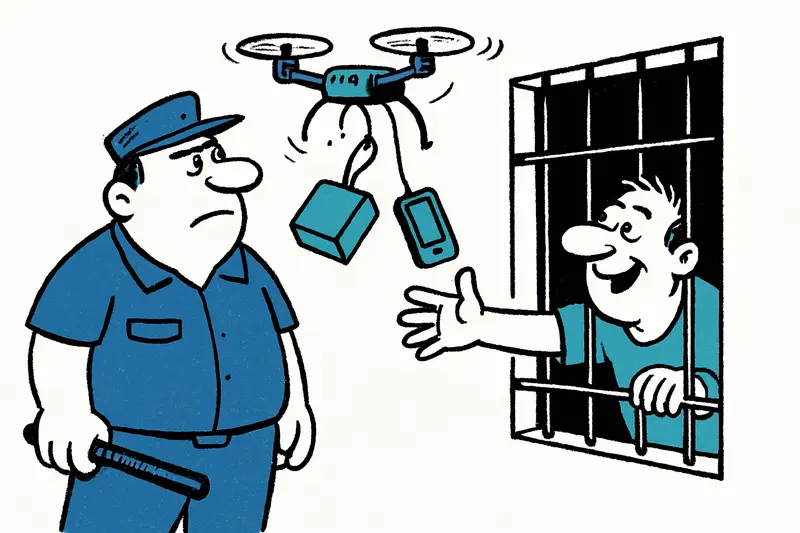
You do not need much imagination to see the picture: a small device, hardly louder than a mosquito, hovering in the warm night air on the outskirts of Palma and dropping a package at the windows of certain cells. It sounds like a bad movie, but for some time it has been reality in front of Palma's prison. The central question is: How can unmanned aircraft be effectively banned from the airspace above a detention facility?
Guards report repeated nocturnal flights, targeted procedures and even crashed deliveries with damaged packages; similar incidents once halted flights at Palma airport Drone paralyzes Palma — why a small device makes our airport vulnerable. For staff this means more stress, for relatives insecurity and for the security system a wake-up call: new technology undermines old concepts. In the cool night air, when the harbour only glitters as a distant strip of light and the pines by the fence rustle softly, you hear the hum — and you sense that more is being organized there than a spontaneous drop-off.
What has happened so far — and why the system fails
The answers are pragmatic: staff increase controls during visits, sniffer dogs are used, and some individuals receive visitation bans. All that helps at the gate. Against remotely controlled small drones, however, it is like a hole in the roof: patching the floor is not enough. Authorities report systematic flights since 2023 in internal discussions — several nights in a row, targeted approaches to specific windows. The pattern suggests there are organized networks that deploy the devices deliberately.
What is often underestimated in public debate is the logistics behind it: not only drugs but also phones and thus means of communication are delivered. A phone in a cell is more than a luxury — it is a tool for external control, coordination of deliveries and potentially for continuing criminal structures. There have even been reports of drones launched next to protected historic sites, highlighting breaches of restricted airspace Drone over Palma's Old Town: Report after No-Fly Zone Violation. There is also the underestimated danger that more dangerous goods could be transported in the future.
Why simple solutions rarely suffice
There are many proposals: radar detectors, jammers, nets, specialized counter-drone drones. But every approach has downsides. Radar and acoustic systems provide detection but not reliable neutralization. Jammers are legally tricky in densely built areas and can affect civilian communications. Nets are effective but must be installed near flight paths — this is not trivial architecturally or legally. And counter-drones are expensive and require specially trained personnel.
Purely technical upgrades would also not attack the root of the problem: as long as demand exists inside the institution and external networks smell profit, new delivery routes will be sought. There are also no clear responsibilities: who pays? The state, the autonomous government, the justice ministry, or the municipality? Night patrols mean higher personnel costs, lighting installations mean electricity costs and potential noise for residents — residents have even campaigned for a night-flight ban 'Our bedroom sounds like a workshop' – Palma residents demand night flight ban — all real obstacles in everyday life on Mallorca.
A pragmatic triad: prevention, detection, legal operability
The most effective strategy is not a single high-tech wonder weapon but a layered concept that can be applied locally:
1. On-site prevention: More lighting around the perimeter, motion detectors, better secured windows and cell-phone management in cells. Low-threshold measures cost relatively little and raise the hurdle for landing spots. Additional training hours for staff and psychological offers for inmates can reduce demand for drugs.
2. Better detection: Acoustic sensors, combined radar and RF detection systems as well as camera logic can detect nocturnal approaches without disturbing the entire radio spectrum. These systems provide evidence needed for legal action.
3. Legal and operational framework: Clear legal regulations are needed to allow targeted countermeasures (for example, targeted interruption of control frequencies with judicial authorization) while protecting civil rights. Coordination between the Ministry of the Interior, prison administration and local police is essential. Harsher penalties for suppliers and recipients as well as faster enforcement of sentences can act as a deterrent.
Opportunities for Mallorca
The island has an advantage: small areas, manageable administrative structures and research institutes such as the Universitat de les Illes Balears that could help with pilot projects. Local voices have documented drone activity in regional reporting, for example in With Drones over the Mediterranean: Palma's Voices from the Gaza Flotilla, which could inform community-based monitoring. A test field for affordable detection solutions, coupled with prevention programs in the institution, would be a realistic first step. Involving the neighbourhood — residents who report suspicious noises — can also have an immediate effect. That may sound like community patrols, but the eyes and ears of residents are often the fastest early-warning system.
Conclusion: Not a walk in the park, but a plan
The night over Palma may only bring a quiet hum, but that sound names a big problem: new technology is changing old spaces faster than laws and budgets can respond. A bundle of local, technical and legal measures can defuse the situation. It is important not just to react, but to coordinate, test and communicate transparently — so that nights become quieter again and people who work in the prison or have relatives there live with less worry.
Next time you are on the city outskirts and hear the distant hum, remember: it is more than a sound. It is a challenge for our security architecture — and an opportunity to act wisely before the technology finds more gaps.
Frequently asked questions
Why are drones a problem at Palma prison?
What can be done to stop drone deliveries to a prison in Mallorca?
Are drone jammers legal in Palma?
Why are drones harder to stop than other prison security breaches in Mallorca?
What kind of technology can detect drones near Palma prison?
Why do drones often fly at night over Palma prison?
Could Mallorca be used to test new anti-drone measures?
What can residents near Palma prison do if they hear suspicious drone activity?
Similar News

Maribel: Five Decades of Service – Housekeeper from Peguera Celebrated with a Special Honor
Over 50 years in the hotel business: María Isabel “Maribel” Molinos was honored in Palma at the Nit del Turisme by Unive...
Orange Alert over Parts of Mallorca: Are We Prepared?
Dark clouds and an announced wet spell have triggered an Orange alert in parts of Mallorca. A reality check: what's miss...

Sundair & Co.: Sale speculation and what it could mean for Mallorca
Rumors about a possible sale of the airlines Sundair and Fly Air 41, which belong to Schauinsland-Reisen — and whether b...
Anne Wünsche in Mallorca: A job offer with a catch — who fits the role of personal assistant?
Influencer Anne Wünsche has left Berlin and is urgently looking for a full-time personal assistant in Mallorca. Why the ...

Daily from New York: Palma Between Boom and Strain
United will increase the Newark–Palma route to daily flights in 2027 using Boeing aircraft (231 seats). What does the in...
More to explore
Discover more interesting content

Can Cap de Bou

Townhouse Lleo 72
