
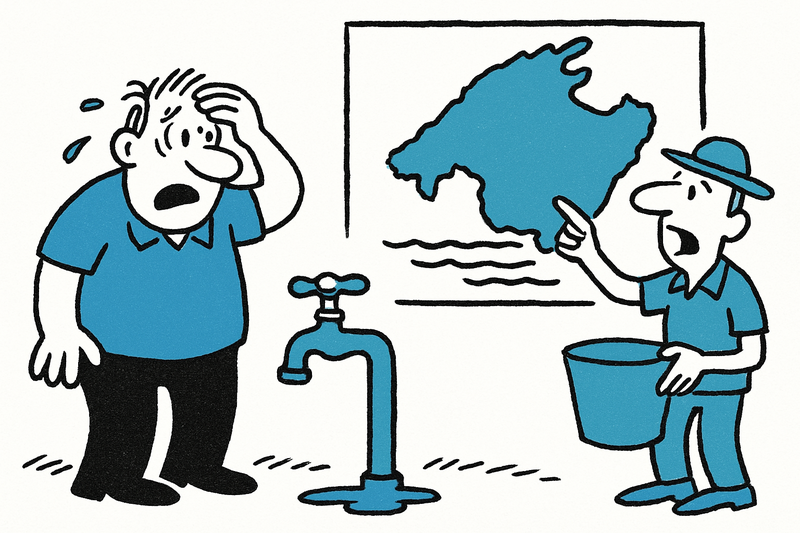
Drought alert in Mallorca: The tanker truck as an emergency exit — and what is really missing
Several municipalities are on the verge of drinking-water shortages. Tanker trucks are only a stopgap. What is needed now: storage, smart management and less waste.
The heat is more than a feeling – water is running low
On Passeig Mallorca the heat shimmers over the paving stones, the cicadas play their dry concert, and then it arrives: the official announcement that a drought alert has been declared for several central municipalities on the island, as reported in Water alarm in Mallorca: Seven municipalities turn off the tap — is saving alone enough?. This is not a bureaucratic detail but a signal that water supply disruptions threaten certain places.
Which places are on the edge
A number of rural municipalities are affected, names everyone here knows: Algaida, Ariany, Costitx, Lloret de Vistalegre, Llubí, Maria de la Salut, Montuiri, Petra, Porreres, Sencelles, Sant Joan, Santa Eugènia, Sineu and Vilafranca. These are villages with wells, small fields, chicken coops and old neighbors who still water in the morning at six and sit on the plaça in the evening. In such places scarcer water hits people directly — not just hotels or golf courses.
What the classification practically means
Formally, a drought alert means that authorities recognize a hydrological emergency. Municipalities experiencing problems can request tanker trucks so that drinking water arrives in the short term. That sounds pragmatic, but it is a symptom: tanker trucks are a mobile emergency supply, not a substitute for a permanent network. When you stand in front of a finca in Petra and hear the watering cans early in the morning, you realize: it is about everyday life, not numbers in a report; similar local measures were described in Water Emergency in Valldemossa: When the Wells Whisper.
The data are clear: the Balearic Islands closed July with reservoir levels around 43 percent. Mallorca was at about 46 percent, a decline compared to the previous month, as discussed in Mallorca: Reservoirs remain conspicuously empty despite rain and snow. Ibiza and Menorca show even worse values. In summary: this is a group-wide deterioration, not a local exception; reservoir specifics and implications for Palma are examined in Water shortage in Mallorca: As Gorg Blau and Cúber shrink — is Palma really prepared?.
The often overlooked causes
In public debate people quickly reach for buzzwords like climate change and more tourism — both play a role. Less noticed is how fragile the system of networks, reservoirs and rules is: outdated pipes with losses, private wells without control, insufficient capacities for rainwater and greywater, and agriculture that in some areas is not water-efficient enough. Added to this are uncoordinated measures between municipalities — while one place rations water, the neighboring village may still irrigate with full networks.
What this means in everyday life
For people in the affected villages there can be real restrictions: watering times are limited, plantings postponed, priorities set for drinking water — and sometimes reserves must be kept for animals. A florist from Petra said he now waters before sunrise, has reduced deliveries and lies with the watering cans early on the country road like many neighbors. Such small adjustments help, but they are no substitute for structural changes.
Concrete measures instead of symbolic politics
What helps in the short term: targeted support for households and animal keepers, coordinated tanker logistics, immediate leak detection in networks and financial assistance for replacement containers in homes. But in the long term the island needs more than this patchwork:
- Expansion and modernization of storage: Regional rainwater systems and reservoirs that buffer not just for a few weeks but for seasonal fluctuations.
- Network refurbishment: Replacing outdated pipes reduces losses. A dripping section near a well can waste liters upon liters.
- Greywater and agriculture: Systems to reuse service water in hotels and for field irrigation, as well as incentive programs for drip irrigation in agriculture.
- Transparent rules and enforcement: Ensure legal use of groundwater, sanction illegal extractions and improve the data basis for decisions.
- Think regionally: Small municipalities need better coordination. A joint emergency plan with clear priorities prevents aid from arriving where it is least needed while the most urgent places wait.
- Technology and renewables: Pilot projects for solar-powered desalination could help, but they are expensive and energy-intensive — therefore sensible only as part of a mix.
Solidarity and everyday tips
While the major investments take time: save. Fill rain barrels, report leaks immediately, reduce car washes and water in the early or late hours. In the countryside every liter saved counts. Inform your neighbors, help each other — this is not a romantic gesture, but pragmatic everyday protection.
If you live in one of the mentioned municipalities: Pay attention to local municipal announcements, prepare simple reserves and document any irregularities (time, street). Such reports help officials faster than vague complaints.
Looking ahead
The drought alert is a warning signal, not an endpoint. Mallorca needs decisions that are uncomfortable today so that tomorrow tanker trucks do not come to define our image of rural life. Investments in storage, distribution networks and efficient irrigation are costly — but calculated over the coming decades they are cheaper than permanent emergency supply. Anyone sitting on the plaça in the morning watching the dust rise knows: the time to act is now.
I will continue to monitor the situation on site. If you have concrete observations or photos, write to me with date, time and place — very often it is these small eyewitness reports that trigger larger decisions.
Frequently asked questions
What does a drought alert mean in Mallorca?
Which parts of Mallorca are most affected by the drought alert?
Can I still water my garden during a drought alert in Mallorca?
How reliable is Mallorca’s water supply during a drought?
Is Mallorca still a good place to visit during a drought alert?
What should residents in Petra do during water shortages?
Why are Mallorca’s inland villages more vulnerable to drought than coastal areas?
What can households in Mallorca do to save water quickly?
Similar News

After Being Admitted to Hospital Again: Heinz Hoenig and the Questions We Should Ask in Mallorca
Long-time Mallorca resident Heinz Hoenig was admitted to hospital again. A clear “what next?” is missing from the covera...
Yellow Alert: Is Mallorca Prepared for the Next Rain Band?
Aemet has issued a yellow alert for the south, southwest and the island's interior. Thunderstorms and heavy rain are for...
Kegel brothers trial postponed: Why Mallorca must wait for a verdict
The trial of 13 German holidaymakers will not begin until May 2028. The long wait raises questions — for victims, defend...

Chaos on Palma's Runway: Why the Summer at the Airport Was So Disrupted
This summer laid bare where Palma airport is faltering: only just over half of departures were on time and seven percent...

Cocaine Offer on Ham Street: Why the Open Trade Should Ring Alarm Bells
In the middle of Pare Bartomeu Salvà a tourist was offered a packet of cocaine as part of a sunglasses deal. A short int...
More to explore
Discover more interesting content

Can Cap de Bou

Townhouse Lleo 72
