
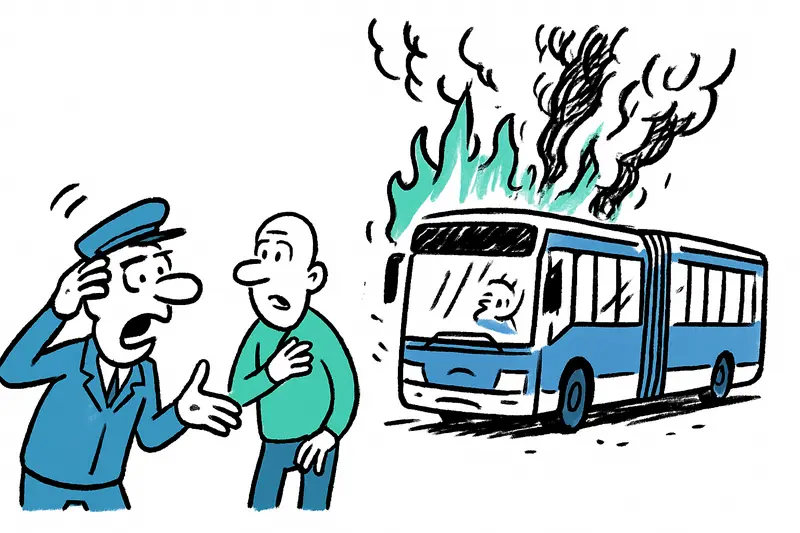
EMT articulated bus catches fire on Ma-1 near Bendinat — How safe are our city buses?
EMT articulated bus catches fire on Ma-1 near Bendinat — How safe are our city buses?
An EMT articulated bus caught fire on the Ma-1 near Bendinat. The driver and an attendant were uninjured. A reality check: What do we know — and what is still missing?
EMT articulated bus catches fire on Ma-1 near Bendinat — How safe are our city buses?
Engine fire stops bus near Calvià, no passengers on board
Last night an EMT articulated city bus caught fire just before the Bendinat exit on the Ma-1 heading towards Calvià. The blaze started in the rear engine compartment; the bus was empty, and the driver and an attendant were uninjured. Emergency crews extinguished the flames with foam; it appears the automatic fire suppression system in the engine area prevented the fire from spreading to the rest of the vehicle. One lane was closed for a short time.
Key question: Why does a modern city bus catch fire on the motorway — and what does that mean for the safety of passengers and staff? That is the issue that comes to the fore when you hear the sirens on the Ma-1 and the smell of diesel still hangs in the air.
Critical analysis: Engine fires in articulated buses can have various causes — from technical failures in turbochargers or fuel lines to electrical short circuits or cooling system problems. The fact that the internal suppression system prevented the worst is a good sign. At the same time, the incident raises questions about maintenance cycles and inspection routines. A single case proves nothing, but it is a warning signal: How tightly scheduled are inspections? What is the service life of heat-sensitive components? And how quickly do people and technology respond when flames start in the rear? Other recent incidents on the island, such as an accident on the Ma-19, underline the wider operational risks.
What is missing from the public discussion so far: concrete figures on the frequency of such incidents on the island, transparency about EMT's maintenance intervals for the fleet and information on which buses are equipped with fire suppression systems. Practical details are also lacking — for example, how drivers are trained for fire emergencies and which evacuation procedures exist specifically for articulated buses on high-speed roads. Transparency is more urgent given EMT's recent boom in passenger numbers.
An everyday scene from Bendinat: It is cool, the highway lights reflect on the wet asphalt, tourist coaches rumble by while firefighters spray foam and hoses still drip. Drivers pace nervously along the hard shoulder, residents look from Avenida Joan Miró toward the Ma-1, excited voices mix with the soft roar of the sea. Such images stay in the memory — and they show how quickly routine on the island can be thrown off balance.
Concrete solutions: First, transparent maintenance reports: an anonymized annual overview of EMT fleet inspection cycles and replaced safety-critical parts. Second, mandatory fire-safety checks for engine-near components on articulated buses before the high season and after intense winter use. Third, more routine training for driving staff with realistic evacuation drills on motorway sections, to avoid disruption similar to the chaos caused when an articulated bus broke down at the Estación Intermodal. Fourth, consider technical retrofits: thermal sensors that report critical temperatures early and regular tests of automatic suppression systems. Fifth, a hotline routine for quickly informing commuters and tourists so that uncertainty and rumors do not fill the void.
Conclusion: It is fortunate that no passengers were on board and that the suppression system worked. Nevertheless, the incident should not be dismissed as isolated. In an island region that relies on bus connections — especially in winter, when services are important for commuters — safety must be checked systematically and communicated clearly. Otherwise, after the sirens fade there is only the feeling: lucky this time, but what about next time?
Frequently asked questions
Are EMT city buses in Mallorca safe after the fire near Bendinat?
What causes a bus engine fire on Mallorca roads?
How effective are automatic fire suppression systems on buses?
What should passengers do if a bus catches fire in Mallorca?
Was anyone hurt in the EMT bus fire near Bendinat?
How does a bus fire on the Ma-1 affect traffic near Bendinat?
How often are EMT buses in Mallorca inspected for safety?
Why do bus fires raise concern for public transport in Mallorca?
Similar News

Palma, Palma de Mallorca, Palma‑Mallorca: What is it really about?
The debate over the city's name is more than grammar: it concerns identity, law and branding policy. A sober reality che...

Warning to Bathers: Nipping Fish in Cala Major and Other Coves — a Reality Check
In Cala Major and several beaches around Mallorca, bathers report painful “nips”. Who are the animals, why are they gett...

Rental Car Theft in El Arenal: What This Incident Reveals About Our Gaps
A teenager steals a running rental car in El Arenal, flees on foot, climbs over walls and is caught by the Guardia Civil...

Red Rope in Palma's Library: What Helps Against Selfie Tourism — and What's Missing
Palma's city library cordoned off an area with a red rope to keep selfie tourism away from reading and working activitie...

Fort San Carlos: Museum, Harbor Dispute — and a Conflict That Demands Answers
The military museum at Fort San Carlos sits right on Palma's harbor, with unexpectedly quiet rooms filled with cannons a...
More to explore
Discover more interesting content

Can Cap de Bou

Townhouse Lleo 72
