
Fake Emails and €320,000: How Trust in the Fruit Trade Was Abused
Fake Emails and €320,000: How Trust in the Fruit Trade Was Abused
Three men posed as a Mallorcan fruit supplier and induced a German company to transfer €320,000. A court hearing shows how easily digital gaps can be exploited — and what is missing to prevent this from happening again.
Fake Emails and €320,000: How Trust in the Fruit Trade Was Abused
Leading question: How could digital tricks so quickly undermine a traditional trade?
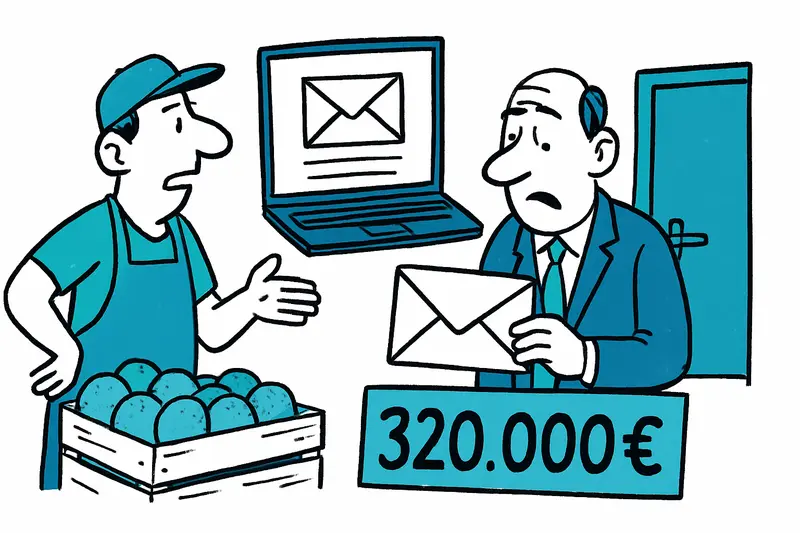
At the Mercado, when citrus sellers restack their crates and the scent of oranges hangs in the air, few people think that the same fruit could be the subject of an international scam. But that is exactly what happened: three men took over the digital identity of a Mallorcan citrus supplier and caused a German trading company to transfer a total of €320,000. The case was now heard at the provincial court, as reported in Three arrests in Mallorca: What lies behind the alleged international bank fraud, and one of the defendants must serve three and a half years in prison.
Critical analysis: Vulnerabilities that were exploited
The fraud operated via manipulated email addresses. This allowed the perpetrators to send payment requests that looked genuine to the recipients. The transfers were made in three installments (€70,000, €100,000 and €150,000) to accounts controlled by the three men. Why did it work? It was apparently a combination of technical weakness, human routine and missing verification mechanisms: 1) absent or poorly configured email authentication (SPF/DKIM/DMARC), 2) no phone or video check when payment details changed (Phone Scam by Call: Why the Scheme of Alleged Spain Transactions Also Affects Us in Mallorca), 3) trust in familiar business partners that overrode digital warning signs.
What is missing in the public discourse
Headlines usually focus on the size of the sums and the penalties. Less attention is paid to structural causes: many small and medium-sized companies operate internationally but without internal rules for verifying payment instructions, as local incidents such as Manacor: How an Alleged 80,000-Euro Outflow Shook a Community illustrate. Banks check transfers, but not always for the pattern “change of payment details for recurring deliveries.” Authorities see individual cases, but there is a lack of clear guidelines and cross-border prevention in the trade of perishable goods.
A perfectly ordinary scene in Mallorca — and why it can be dangerous
Imagine the Plaça for a moment: a van unloading crates of oranges, a seller calling out numbers, and an office in the backyard where invoices are written. The danger lies in this routine. If the bank details on an email suddenly read differently in that same office, people often weigh: “Is it a mistake or hurry?” Often haste wins. In Mallorca, where many family businesses are closely linked to German trading partners, a single unnoticed click can break the chain.
Concrete approaches to solutions — technical, organizational, legal
Prevention can be thought of on three levels: technical, internal company, and institutional. Technical: mandatory use of email authentication (SPF/DKIM/DMARC) for companies with export relations; certified electronic signatures for invoices and payment instructions. Internal company: binding verification protocols — every change of bank details must be confirmed by telephone with a registered contact person; high-risk amounts require dual approval; training employees on social-engineering risks. Institutional: banks should flag and report unusual account linkages for trading companies more proactively; chambers of commerce could offer standardized checklists and training; better EU-wide information exchange on such incidents so patterns are detected faster.
A practical example for day-to-day operations
A small business in Llucmajor could proceed as follows in the future: when a buyer sends payment details by email, the buyer’s registered phone number is called automatically; only after confirmation by a named person is the payment released. In parallel, a qualified electronic signature signs the invoice. It costs a few minutes and a few euros but protects against five-figure losses, and mirrors other local cases such as Employee allegedly defrauded company in Palma with forged invoices for €150,000.
Punchy conclusion
The case shows: digital trust is fragile — especially in trading relationships built on decades of personal reliability. Punishing the perpetrators is necessary but not sufficient. Those who really want to change things must combine technical standards, company habits and bank-side checks. Otherwise the oranges stay on the market, but the money ends up in foreign pockets.
The bitter lesson remains: a handshake at the market is far from digital security. And while the seagulls circle the harbor, traders, importers and banks should look closely — before the next email trick produces fruit that doesn’t exist.
Frequently asked questions
When is the best time to visit Mallorca for sunny days and fewer crowds?
Is it safe to swim in Mallorca’s sea, and what should I know about beaches?
What should I pack for a Mallorca trip?
What’s the easiest way to get around Mallorca?
What are the must-see sights in Mallorca?
What outdoor activities are popular on Mallorca?
What dishes should I try when visiting Mallorca?
Are there family-friendly beaches in Mallorca and places suitable for kids?
Similar News

New Hope in an Old Case: What the Search for Meisel's Murderer Can Achieve Now
Nearly three decades after the murder of Manfred Meisel at a finca near S'Aranjassa, a TV manhunt is once again focusing...
Bar Marítimo: Who will get Palma's cult pub back? A reality check
Two companies, two very different offers — and many unanswered questions. A critical look at the tender procedure for th...
Lightning strikes palm on Ibiza: Are we really prepared for autumn storms?
A lightning bolt into the crown of a palm in Port des Torrent shows how close danger and everyday life can be on the Bal...

Mallorca's Mills Receive a Makeover: Millions for 35 Monuments
The island council is providing around €2.5 million so that 35 historic mills on Mallorca will be restored in a conserva...
A fall in El Arenal: How safe are our sidewalks for older people?
A 72-year-old tripped over an uneven pavement on Formentera Street in El Arenal and suffered serious facial injuries. Th...
More to explore
Discover more interesting content

Can Cap de Bou

Townhouse Lleo 72
